This content has been automatically translated from Ukrainian.
When talking about the world of comics, American comics with superheroes or Japanese manga are most often mentioned. However, Europe has developed its own significant tradition of illustrated stories, particularly associated with France and Belgium. This is usually what is meant when discussing bande dessinée — bande dessinée.
“Tintin,” “Asterix,” “Lucky Luke,” “The Smurfs,” Blueberry, Valérian et Laureline, The Incal — all these very different works grew up in the same cultural environment. Therefore, bande dessinée should not be perceived as a specific genre or style of drawing. It is rather a distinct comic tradition with its own history, publishing formats, magazines, and art schools.
What bande dessinée means
The French term bande dessinée literally means approximately “drawn strip” or “drawn band”: bande — band or strip, dessinée — drawn. In the French language, the abbreviation BD is also very common.
There is an important nuance here. For a French-speaking person, bande dessinée is a general term for comics, not a specific variety of it. That is, in French, this term can refer to comics from various countries and traditions.
In contrast, in other languages, bande dessinée is often used more narrowly — as a name for the French and Belgian, and more broadly, Francophone, tradition of comics. It is in this sense that the term “bande dessinée” is most often used in Ukrainian texts. The spelling variants are not yet fully established: you can encounter “банд-десінé,” “банд десіне,” and “бандесіне.”
Thus, calling bande dessinée a “comic genre” is not entirely correct. Fantasy, detective, western, or science fiction are genres. And bande dessinée is a cultural and publishing tradition within which all of them can exist.
How the bande dessinée tradition emerged
The history of European illustrated narratives began long before “Asterix” and “Tintin.” One of the important precursors of modern comics is considered to be the Swiss artist and writer Rodolphe Töpffer, who in the first half of the 19th century created sequential stories where text and illustration moved the plot together.
The Francophone comic gained particular development in the 20th century thanks to newspapers and magazines. For a long time, the press was the main place where readers became acquainted with new illustrated stories. Later, individual episodes were collected into book publications — albums.
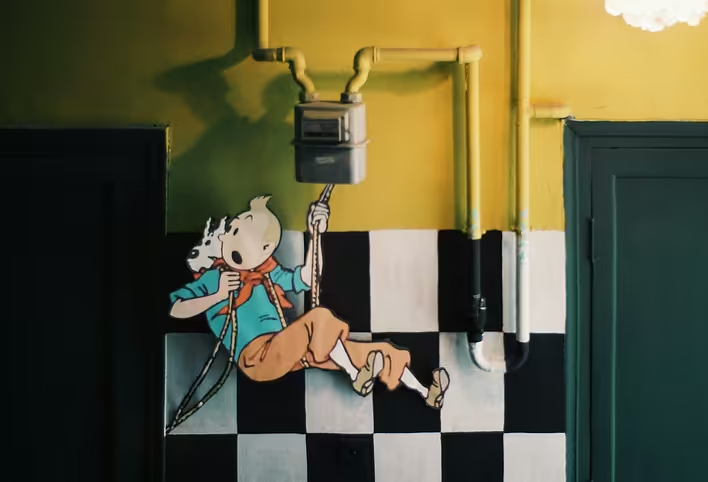
One of the most important figures in this history was the Belgian Hergé. In 1929, the adventures of Tintin began to be published in the children’s supplement Le Petit Vingtième. Over time, the series became one of the symbols not only of Belgian but also of European comics in general.
After World War II, magazines Spirou and Tintin had a significant influence on the development of BD, and in the late 1950s, the French Pilote joined them. It was in its first issue on October 29, 1959, that “Asterix” appeared, created by writer René Goscinny and artist Albert Uderzo.
The history of Francophone bande dessinée is generally hard to separate from the history of the press: The National Library of France traces the development of BD from early illustrated stories through the magazine culture of the 20th century to the modern graphic novel.
How bande dessinée differs from American comics and manga
The simplest answer is history and publishing culture.
The American industry largely developed from newspaper comic strips to periodical comic books. In Japan, serialization of manga in magazines played an important role, followed by the publication of individual volumes.
In the Franco-Belgian tradition, one of the characteristic formats became the album — a relatively large colored book, often in hardcover. In the second half of the 20th century, albums of about 48 pages became particularly widespread. This format became so associated with Franco-Belgian comics that it even received the informal designation 48CC — 48 pages, cartonné, couleurs, meaning “48 pages, hardcover, color.”
This does not mean that every modern bande dessinée has exactly 48 pages or necessarily comes out in hardcover. Today, formats are much more diverse, and the boundary between the traditional album and the graphic novel has become less clear.
A notable feature of many classic BD is also the great attention to page composition. The artist works not only with individual frames but also with how the reader's gaze will move between panels, where pauses will occur, how the rhythm will change, and how much information one spread will contain.
However, it would be a mistake to speak of a single “bande dessinée style.” It simply does not exist.
Ligne claire and other styles
One of the most famous artistic traditions associated with Franco-Belgian comics is ligne claire, or “clear line.”
This term is most associated with the work of Hergé and his followers. Ligne claire is characterized by a clear, uniform contour, clean color areas, minimal shading, and a well-readable composition.
However, ligne claire is just one of the directions. Alongside it, caricature and very dynamic styles, realistic adventure drawing, fantastic graphics, authorial minimalism, and experimental forms have developed.
That is why “Asterix” is visually almost impossible to confuse with the western Blueberry, and the fantastic works of Moebius — with “Tintin.” And all this remains part of one large comic culture.
The most famous bande dessinée
One of the most famous examples is Hergé's “Tintin,” the story of a young reporter whose adventures began to be published back in 1929. Over time, Hergé became one of the most influential authors of European comics.
Another iconic series is “Asterix” by René Goscinny and Albert Uderzo. From its first publication in Pilote in 1959, the adventures of the Gauls turned into an international phenomenon. According to the official Asterix website, the series has been translated into more than a hundred languages and dialects.
Classics also include “Lucky Luke” by Morris, “The Smurfs” by Peyo, and the western Blueberry, created by Jean-Michel Charlier and Jean Giraud.
But bande dessinée has not remained a world of only humorous or children’s adventures. In the second half of the 20th century, authors increasingly experimented with form and worked for an adult audience. Magazines like Métal Hurlant, associated with the work of Moebius, became important, and later, the authorial graphic novel became increasingly prominent.
Therefore, alongside classic adventure series, one can find science fiction, autobiographies, historical works, noir, political satire, and experimental graphics in Francophone comic culture.
Why comics are called the “ninth art”
In France and Belgium, bande dessinée is often referred to as “the ninth art” — le neuvième art. This does not mean that there is an official list in which comics strictly occupy the ninth place.
The name arose as a continuation of the tradition of conventionally numbering different types of art. For example, cinema was already referred to as “the seventh art” in the early 20th century. When, in the middle of the century, comics began to be increasingly perceived not just as children’s entertainment or part of the mass press, but as an independent form of creativity, a similar definition also emerged for it.
The expression neuvième art regarding comics began to spread in the 1960s. In 1964, the name 9e Art was used by Morris, the author of “Lucky Luke,” and Pierre Vankeer in a series of articles about the history of comics in the magazine Spirou. Over time, the concept became so entrenched in the Francophone environment that it became almost synonymous with comic art. The history of the emergence of this name is explained in more detail by Cité internationale de la bande dessinée.
The meaning of the expression is primarily symbolic. It emphasizes that comics are not just text with pictures, but a distinct way of telling stories, where meaning is created by the drawing, page composition, text, sequence of frames, and pauses between them.
This well illustrates the place of bande dessinée in Francophone culture. Here, comics have long been able to be not just an adventure or humorous story, but also an autobiography, political satire, historical drama, fantastic epic, or experimental graphic novel.
“Asterix,” “Tintin,” and “The Smurfs” therefore do not define bande dessinée, but only represent its most famous part. Behind them stands a vast culture of illustrated narrative that has developed alongside American comics and Japanese manga but has formed its own history, publishing tradition, and artistic language.
Like it?React
🧵
This post doesn't have any additions from the author yet.