Let's be honest, if you're currently studying to become an IT specialist or just got your diploma, your eye is definitely twitching from the news from time to time. You scroll through the feed and it's a complete apocalypse: "AI has taken jobs from juniors," "Six hundred applications for one vacancy in an hour," "The industry is in deep crisis." And you sit in front of the monitor and think: "Great, why did I burn my brain with these labs and sessions if Claude or GPT does everything in a second and for free?" Or maybe the metal paw of AI has touched those labs and sessions too? 👀Calm down. Panic is currently the most popular commodity on the internet. The industry hasn't died; it has just gone through a tough upgrade and changed the rules of the game on the fly. AI can indeed code "for electric food." But that's not a reason to close your laptop and go study to become someone else. Let's figure out, without stuffy lectures, what is really happening and how you can find your place in the sun.
What is really happening with job vacancies?
Previously, the entry threshold was much lower. If you could Google, knew basic syntax, and wrote a couple of crooked scripts – welcome to the team, here’s your first offer. That shop has been closed for a few years now. The market is oversaturated with beginners who can only do mechanical, template work, being executors. Obviously, neural network templates work better, faster, and without coffee breaks, without questions like how to center a div or how to stretch a group in Figma.
Because of this, companies are no longer looking for just "hands that can rewrite code from tutorials." They need people who understand why this code is being written at all and what business problem it solves. AI is your super-fast assistant, but it is completely devoid of critical thinking. It can generate a piece of code or sketch an interface, but it doesn’t know if it will be convenient for a real person. Your task is to become the one who manages this process, not just copy-pasting from chat to editor.
The big dilemma – to know a little of everything or to dig deep in one area?
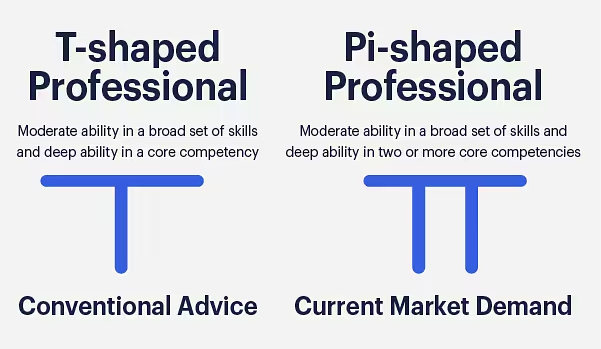
When I think about this choice, I often see people swinging to extremes. Some say you need to become a super-narrow specialist, while others say it’s worth knowing a bit of everything. For many years, the so-called T-Shaped model was in trend, where you have a broad outlook but know something deeply. In my opinion, today that’s a bit insufficient.
I lean towards the idea that the market is starting to demand us to be Pi-Shaped specialists. What does this mean? Starting with the classic letter "T" – that’s absolutely okay for a start. You study your base, for example, interface design, project management, marketing, or testing. But to stand confidently on your feet when everything around is changing so rapidly, you will eventually need a second "leg" – another deep competency.
How does this look in real life if you look beyond the development environment?
A designer who not only draws interfaces but deeply understands UX research and analytics, or can even code their layout at a basic level.
A QA specialist who not only looks for bugs by checklist but understands the product like a manager and comprehends the user’s business logic.
A project manager who, besides planning tasks, dives into product analytics and can work independently with databases.
Two such pillars, in my opinion, provide real stability. If one area starts to decline due to automation or a crisis, you can always lean on the other. Of course, the more "legs," the better, but don’t forget that learning should be step-by-step, that any programming language, Figma, Jira, n8n, Blender..., is just a tool, and you are interested in deep knowledge.
My action plan to avoid being left behind
This is not an instruction, just my observations on what might work now. If you want to move forward, I would recommend paying attention to a few simple things.
First, stop mindless copy-pasting. This applies to all roles. If you are a manager and ask Claude to outline a project structure, or a copywriter who generates ideas through GPT, make sure to understand the logic behind what you received. Your task is to manage the process and check the quality, not just to toss texts or files back and forth.
Second, train the habit of asking "what for?" Before drawing a new feature, writing code, or setting up ads, think about what specific business or user problem this solves. AIs do not have consciousness and do not see the big picture; they just do what they are told, but understanding the relevance of a task is purely a human trait.
Third, create real things. It doesn’t matter what your specialty is. If you are a PM – organize a real small event, a hackathon, or at least streamline processes for some student project. If you are a designer or marketer, find a friend with a microbusiness and help them with a real product. A live, albeit imperfect, case in your portfolio always weighs more than a pile of certificates for completing theoretical courses.
And of course, develop what is hard to automate. English is a fundamental skill that is almost embarrassing to mention; it’s simply a must-have, along with the ability to communicate adequately, perceive constructive feedback without offense, and find common ground during calls. Robots lack empathy; they can only pretend, so human skills are valued now more than ever.
In my opinion, a crisis is not the end of the world, but just a time when the industry is washing out those who came here by accident or purely for an easy picture. If you truly enjoy understanding how digital products are structured, creating something new, and finding solutions to complex problems, you will definitely find your way.
Make decisions wisely, learn to adapt, and may the force be with you!