Table of contentsClick link to navigate to the desired location
This content has been automatically translated from Ukrainian.
The term "random" has become part of our everyday lexicon at such a speed that we didn't even notice when it stopped being something unusual. Now this word can be found almost everywhere: from memes and gamer forums to everyday conversations on the street. But how did the term "random" make its way into our dictionaries, and why has it taken root so organically?
Origins of the term "random"
If we dig deeper, the word "random" comes from the English language. In turn, the English "random" originates from the Old French word "randon," which meant "speed" or "movement in no particular direction." This emphasis on unpredictability and chaos has become key to the modern usage of this term.
In English-speaking countries, "random" has long been used to denote something accidental, unpredictable, or that does not conform to any logic. The word has firmly established itself in various fields: in science, statistics, computer games, and even in culture. With the development of the internet and gaming, this term gradually began to migrate into other languages, including Ukrainian.
How did "random" end up in the Ukrainian space?
In the early 2000s, when the internet was becoming increasingly accessible to the general public, Ukrainians began to encounter English terminology more frequently. Many terms from computer games, forums, and meme culture entered our language directly without translation, and one of these was "random."
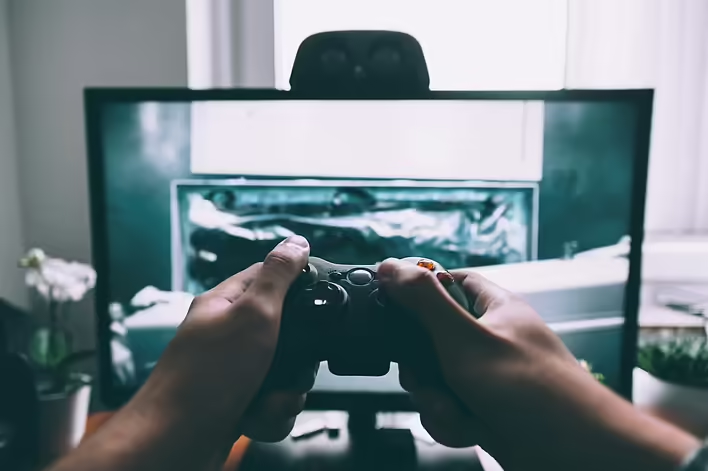
With the emergence of gamer communities, the term "random" became an integral part of their slang. For example, when someone talks about randomly dropped gear in a game, they refer to it as "random." Also, if someone performs an incomprehensible or unpredictable action, it can be said that it was "random" behavior.
The phenomenon of "randomness" in internet culture
The internet has made the word "random" a symbol of certain unpredictability and absurdity. Meme culture loves to play with the concept of randomness, where unexpected things are combined in videos or images that seemingly make no sense at first glance. This humor is based on a sudden change of context that surprises and evokes laughter.
In a sense, "randomness" has become a new form of creative expression - not adhering to any rules or patterns, it allows for the generation of the most incredible combinations.
"Random" in the age of artificial intelligence and algorithms
With the development of technology and, in particular, artificial intelligence, the concept of "random" has taken on new meaning. In digital systems, randomness is often artificial, controlled by mathematical algorithms that attempt to simulate true randomness. For example, when we talk about "random numbers," these are actually numbers generated by a specific algorithm, making them seem random.
However, in real life, we still encounter true randomness: from unplanned events to sudden meetings or unusual coincidences.
This post doesn't have any additions from the author yet.