Procrastination is the intentional postponement of tasks or duties that need to be completed, despite the potential negative consequences of such delay. It is not just laziness or an inability to manage time, but a complex psychological phenomenon with deep roots and significant impacts on a person's life.
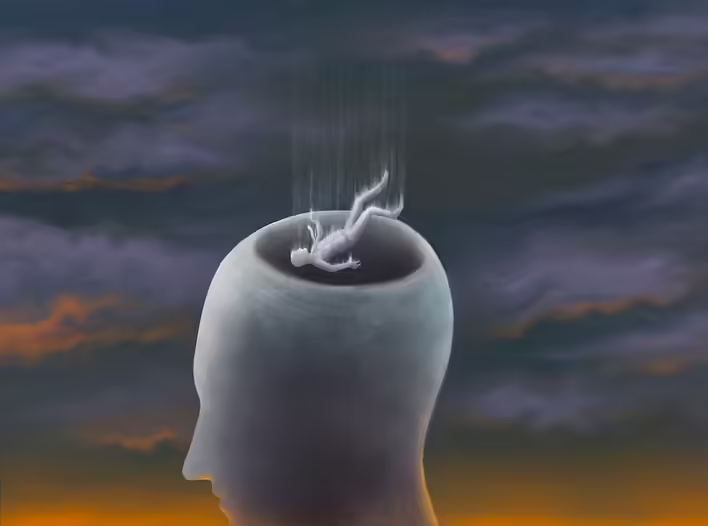
It is an irrational choice to delay actions that need to be taken. At its core are complex neurobiological and psychological mechanisms. Our brain, evolutionarily inclined to seek instant gratification and avoid discomfort, often succumbs to the temptation to switch to something more pleasant instead of overcoming the difficulties associated with challenging or unpleasant tasks.
The prefrontal cortex, responsible for planning and self-control, can be "overridden" by signals from the limbic system, which seeks immediate rewards, or the amygdala, which reacts to fear.
Causes and Types of Procrastination
There are several main types of procrastination:
1. Fear-based procrastination is the most commonThis is the fear of failure, where a person fears that their work will not be good enough, or the fear of success, which may bring new expectations and responsibilities. It also includes the fear of uncertainty, where the lack of a clear plan leads to analysis paralysis, and perfectionism, where the pursuit of perfection paralyzes any attempts to start.
2. Rebellion or resistance-based procrastinationManifests as a passive protest against imposed obligations or an internal rejection of what the person believes "should" be done.
3. Low self-regulation and impulsivity-based procrastinationIs related to the inability to manage emotions, the search for instant gratification, and low tolerance for or endurance of unpleasant feelings.
4. Skill deficit-based procrastinationArises from the inability to plan, manage time, or simply from a lack of necessary knowledge to complete the task.
Procrastination usually develops cyclically:
The task causes discomfort, the person postpones it, feeling temporary relief. As the deadline approaches, stress increases, leading to panic-driven activity at the last moment. After completion (or non-completion), there is temporary relief, but it is often accompanied by feelings of guilt and lowered self-esteem, reinforcing the tendency to procrastinate in the future.
The consequences of procrastination extend far beyond missed deadlines. It leads to chronic stress, anxiety disorders, depression, lowered self-esteem, loss of professional and personal opportunities, and may negatively affect physical health.
Tips for Overcoming Procrastination
When dealing with procrastination, it is important to understand its true causes, not just the external manifestations.
Psychologists recommend breaking large tasks into smaller steps,applying the principle of "do something" (starting with the smallest action),setting priorities, and, if possible, eliminating distractions.
It is also necessary to develop self-control skills, learn to forgive oneself for past delays, and seek professional help if needed.