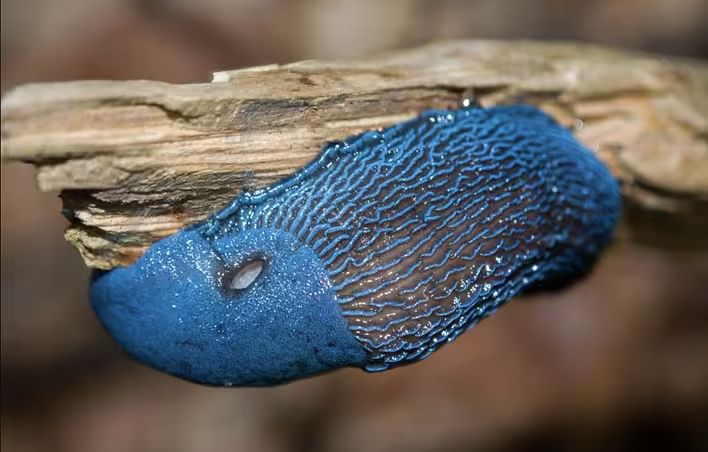
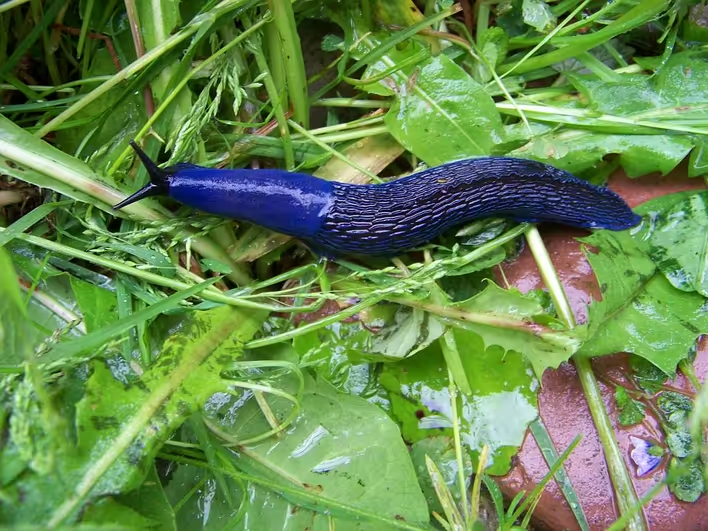
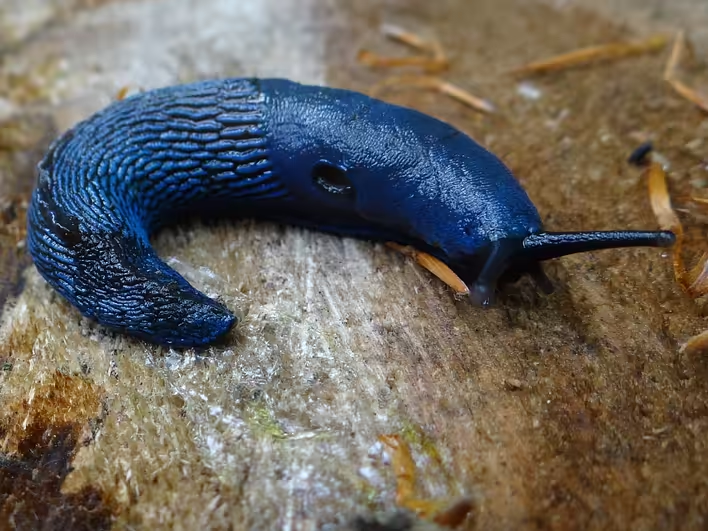
The Carpathian slug is one of those creatures that easily seem fictional until you see them with your own eyes. This is a large terrestrial snail, known scientifically as Bielzia coerulans. Its main feature is its unusual coloration: adult individuals can be blue, blue-green, purple, or almost black. Against the backdrop of moist forest foliage and moss, such a snail looks very noticeable, although it leads a rather hidden lifestyle.
The species was described in the 19th century by malacologist Michael Bilz. The Carpathian slug is also interesting because it is the only species in the genus Bielzia. So it is not just a "blue snail from the Carpathians," but a distinct and very recognizable representative of terrestrial mollusks.
Where the Carpathian slug lives
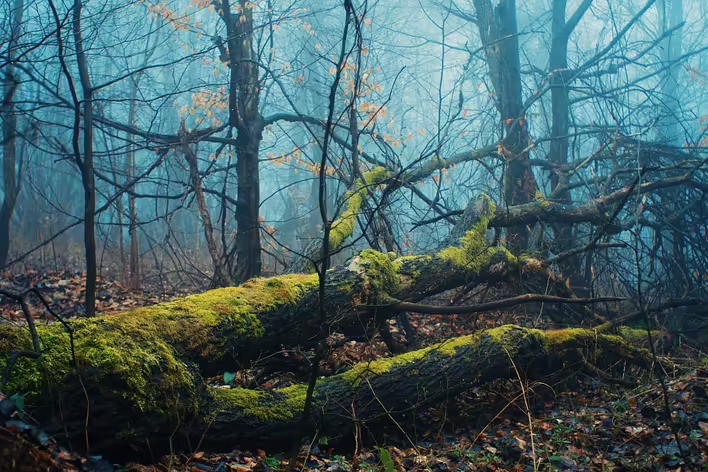
This species is considered an endemic of the Carpathians, meaning it is naturally associated with the Carpathian Mountains and nearby regions. It can be found in Ukraine, Romania, Slovakia, Poland, the Czech Republic, and some other countries in Central and Eastern Europe. In Ukraine, the slug can be encountered in moist mountain forests, especially where there is shade, dead wood, moss, fallen leaves, and sufficient moisture.
It most often stays close to the ground: hiding under bark, logs, in stumps, or among forest litter. In the Carpathians, it can be found at elevations of up to approximately 2000 m above sea level. During the day, the slug is usually inconspicuous, becoming more active at night or after rain, when the air is moist and the risk of drying out is lower.
What it looks like
The Carpathian slug can reach approximately 10-14 cm in an extended state, making it quite a large snail. Adult individuals have a smooth elongated body with a characteristic cool hue: from deep blue to malachite green or purple-black. The head and tentacles are often darker, while the underside of the body may be lighter.
Young slugs look different: they are light brown, often with dark stripes on the sides. Because of this, they can be easily unrecognized if one expects a brightly blue animal. A noticeable blue or purple color is a sign of an adult snail.
There is no external shell, which we are used to imagining in snails, in the slug. Like other snails, it moves thanks to its muscular foot and leaves a slimy trail behind. The slime helps with movement, protects the body from drying out, and partially from mechanical damage.
Why it is interesting
The Carpathian slug is not just a beautiful forest inhabitant. It is part of the natural life of the forest litter: it resides among dead wood, moss, fallen leaves, and other moist microhabitats. Such places are important for many small organisms, and their presence often indicates a more natural state of the forest.
Another interesting feature is reproduction. Slugs, like many terrestrial gastropods, are hermaphrodites. Mating usually occurs in June-July, after which a single clutch can contain from 30 to 80 eggs. Adult individuals die after laying eggs, while young slugs hibernate and continue their development the following season. Fully adult individuals usually appear in spring, around May.
Why it should be protected
The Carpathian slug is not one of the animals to be feared or destroyed. It is not a garden pest in the usual household sense, as its habitat is primarily the moist Carpathian forests. Its greatest threat comes from the loss of natural habitats: the logging of old forests, drying of areas, destruction of dead wood, and excessive interference in the forest litter.
In different countries, attitudes towards the conservation of the species may vary. For example, in Moravia, it is considered vulnerable, while overall information about population status depends on the region. For travelers, this means a simple rule: if you come across a slug, it is better not to pick it up unnecessarily, not to move it, and not to take it from the place where it lives.
If you see a slug in the Carpathians, it is best to simply observe it and not take it from nature. Its bright color is not an invitation for a souvenir, but a reminder that even very slow and inconspicuous creatures can be among the most interesting inhabitants of the mountain forest.