This content has been automatically translated from Ukrainian.
Rhythm is the foundation of any music. One can perfectly dissect a complex piece, but ruin it with an uneven tempo. The listener will feel this immediately, even without musical education. The metronome lays this foundation from the very first lessons. A simple device with a steady pulse trains the sense of time better than any video lessons or manuals. It does not evaluate or suggest anything. It simply lets you know whether you are in tempo or if it just seems that way.
What a metronome gives to a beginner
Internal pulsation (the ability to feel a steady tempo without external reference) is formed not by natural talent, but by training. A young violinist or pianist thinks they are playing evenly. A recording on a phone quickly disproves this – by the third measure, the tempo speeds up, and by the seventh, it already slips. The metronome provides objective control. Its steady pulse creates a grid onto which the melody lays. Thus, the first lessons are not easy. The student gets frustrated, stumbles, complains.
Buying a metronome is not difficult; it is much harder to return to it after the first failures and keep replaying the same part. For this reason, music school teachers and consultants at the Komora music store often advise not to chase speed, but to first learn to maintain a steady tempo.
By the third week, the tempo becomes internal, the body memorizes the pulse, and the playing evens out. How to work with a metronome correctly? Start slowly. 60 BPM (beats per minute) is considered the basic tempo for most exercises. Play the melody twice as slowly as indicated by the composer. Gradually increase the speed, adding 4–6 BPM daily. A sudden increase in tempo ruins accuracy. Work in sections: break the composition into segments of 4–8 measures and practice each until it fully matches the pulse. Only after this, combine them into a complete piece. From time to time, turn off the metronome and play on your own, then check yourself again. If the match is accurate, that’s progress. If not, return to a slow tempo and work on the difficult spots.
Which metronome to choose
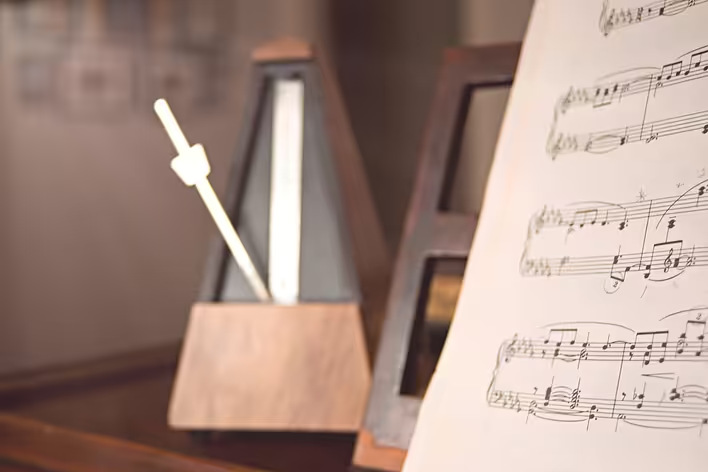
A mechanical metronome is better suited for beginners than an electronic one, as it is heard more clearly. The pendulum in front of your eyes sets a visual pulse. The brain catches the rhythm through two channels, both ear and eye. An example of quality metronomes is the German Wittner series. All models in the line work without batteries, have a long wind-up, and precise gear transmission. The Wittner M855-131 model in a walnut case is suitable for those looking for a warm classic for a home room. The Wittner M855-161 looks more modern due to its dark finish. And the Wittner M855-111 is a concise black version for a strict interior or teaching office. The technical filling of the three models is identical, and the price is also the same, up to 3,000 UAH. The choice is dictated by aesthetics. What affects the price of mechanics? First of all, the material of the case. Wood is more expensive than plastic, solid wood is more expensive than veneer, and exotic species are more expensive than standard ones. A brass wind-up lasts for decades, while a stamped steel one lasts about 5–7 years of active use. The best assembly is either German or Japanese. Such metronomes will be 25–30% more expensive than Asian ones. In this case, you pay for quality and warranty service. An electronic option will be needed later. When the student grows to clicking in headphones, to recording on digital workstations, and working with backing tracks. But at the start, most teachers still recommend mechanical ones — they better discipline the ear and do not allow you to “hide” behind electronic prompts. At Komora, mechanical Wittner metronomes are often chosen specifically for music schools, home lessons, and basic rhythm training. Over time, the pendulum begins to work as an internal reference, and that’s when the musician stops counting beats and truly feels the tempo of the playing.
Like it?React
🧵
This post doesn't have any additions from the author yet.