This content has been automatically translated from Ukrainian.
Chicory is rarely perceived as something independent — it is most often mentioned in comparison to coffee or as its substitute. However, the history of chicory as a beverage is much longer and more complex than it may seem. It is an example of how a product born out of necessity gradually transformed into a cultural habit and, ultimately, into a conscious choice.
Origin and Properties
For beverages, the root of wild or cultivated chicory (Cichorium intybus) is used. It is washed, dried, roasted, and ground. During roasting, the root acquires a dark color and a characteristic aroma that truly resembles coffee — bitter, slightly caramel-like, with earthy notes.
Unlike coffee, chicory contains no caffeine. Its main feature is a high content of inulin, a plant fiber that affects digestion and provides a natural mild sweetness. It is precisely because of inulin that the chicory beverage often seems softer and "rounder" in taste.
Chicory in Europe: A Beverage of Times of Scarcity
The widespread use of chicory in Europe is associated with economic and political crises. As early as the 18th century, it was used as a cheaper alternative to coffee, and in the 19th century — especially during Napoleon's continental blockade — chicory became almost a standard additive to coffee in France and Germany.
In the 20th century, this tradition returned during both world wars. Coffee was scarce or too expensive, while chicory was easily grown locally. It was during this period that many countries developed the perception of chicory as "poor man's coffee" or a forced compromise.
Interestingly, with the restoration of stable coffee supplies, chicory did not disappear. In France, Belgium, Poland, Germany, and Eastern European countries, it remained in everyday life as a separate beverage. For older generations, it was a familiar taste, while for younger ones, it was part of family memory.
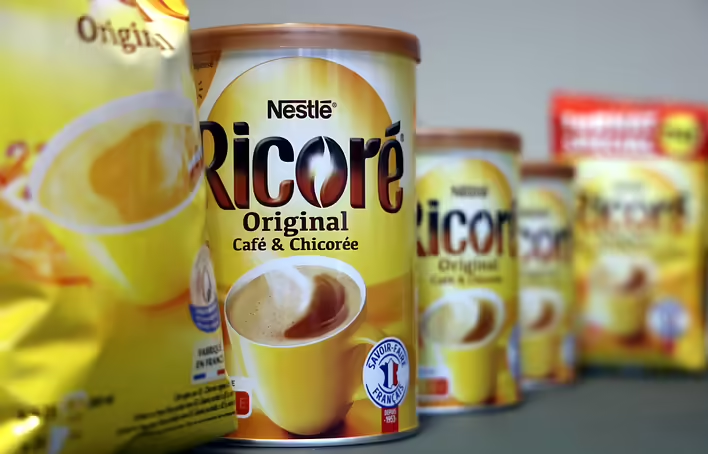
Gradually, chicory ceased to be merely a symbol of scarcity. It established itself as softer beverage that can be consumed in the evening, given to children, or enjoyed without the fear of caffeine overload. It is on this logic that products like Ricoré emerged — a compromise between coffee and chicory, rather than an attempt to completely replace one with the other.
Chicory and Taste: Why It Is Not "Just Like Coffee"
Although chicory is often described as a coffee-like beverage, its flavor profile is actually different. It has less sharp bitterness, but more earthy, woody, and caramel notes. It lacks the acidity of coffee and does not provide a sharp boost of energy.
That is why many people either love chicory from the first sip or do not accept it at all. It is not a substitute in the literal sense, but a different beverage with a similar consumption form.
Today, chicory is experiencing a quiet resurgence, but in a different context. It is valued as a caffeine-free beverage, as a source of plant fibers, and as an alternative for people who consciously limit stimulants. In cafes and health food stores, it appears alongside matcha, grain beverages, and other "soft" coffee alternatives.
Like it?React
🧵
This post doesn't have any additions from the author yet.