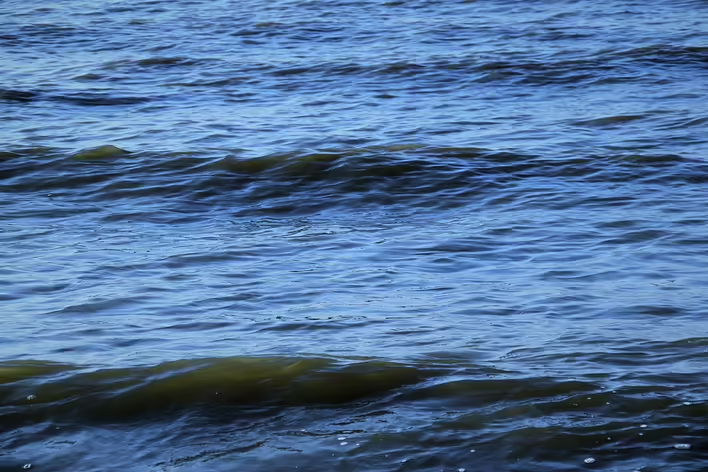
Seiches are special waves that occur in enclosed or semi-enclosed bodies of water when the water begins to oscillate back and forth like a pendulum. Unlike regular waves that move across the surface, seiches remain in place: the water level rises at one end of the lake while it drops at the other. Then the process repeats in the opposite direction. Such oscillations can be observed in lakes, bays, fjords, and even large reservoirs.
How seiches occur
The cause of seiches is usually a prolonged strong wind or a sudden change in atmospheric pressure that pushes the water to one shore. When the wind calms down or the pressure equalizes, the water "recedes" back and begins to oscillate until equilibrium is established. Seiches can also form after earthquakes — in such cases, they are called seismic. In these instances, the water in lakes can oscillate for minutes or even hours after the tremors.
In addition to surface seiches, there are also internal seiches. They form not at the surface but inside the body of water, between layers of water of different temperatures or densities. These internal oscillations can be significantly larger than what is visible from the outside and can greatly affect ecological processes — mixing of water, distribution of oxygen, and nutrients.
How seiches differ from tidal bores
Alongside the concept of seiches, tidal bores are often mentioned — this is a completely different phenomenon. A tidal bore is observed in narrow river mouths when, during high tide, seawater rushes upstream against the current, creating a high and moving wave that rolls up the river. So, while a bore is a moving tidal wave, a seiche is stationary. It does not move forward but only oscillates within the body of water.
Seiches in Loch Ness
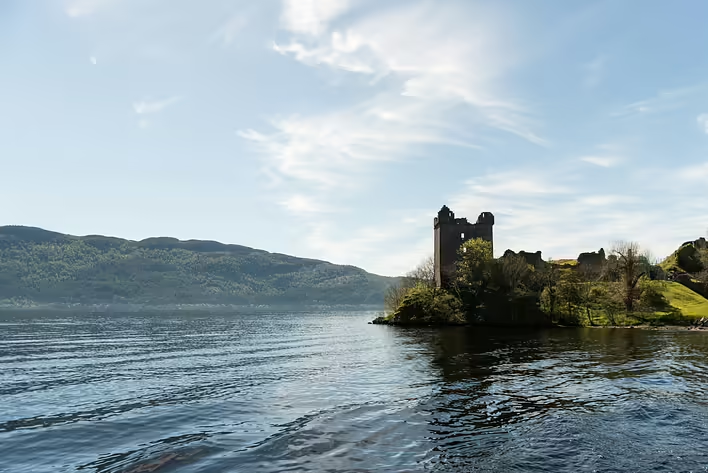
One of the most famous places where seiches have been observed is the Scottish Loch Ness. Scientists have confirmed that internal seiches regularly occur there — large underwater waves that move along the lake at the boundary between cold and warm layers of water. These underwater oscillations can reach tens of meters in amplitude, although the surface of the lake remains almost calm. It is these natural phenomena that, according to scientists, could explain the "strange waves" or unexpected movements of water that were sometimes mistaken for manifestations of a mythical monster.
Significance and observation
Seiches are not only an interesting natural phenomenon but also an important factor for hydrology. They affect the mixing of water, temperature and oxygen distribution, and in harbors, they can create strong level fluctuations that are dangerous for vessels and docks. Modern scientists track seiches using water level sensors, buoys, and temperature probes to better understand how they affect ecosystems and the behavior of water bodies.