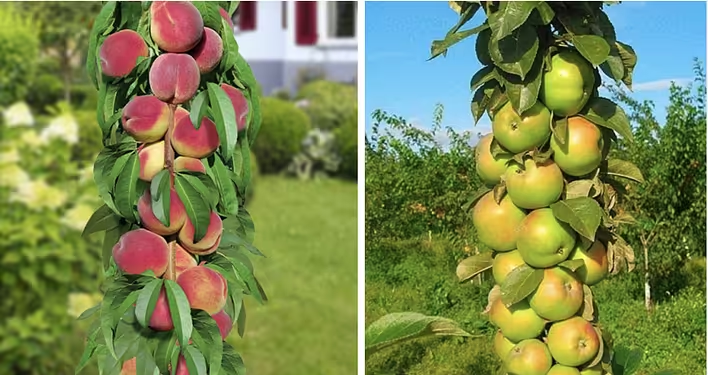
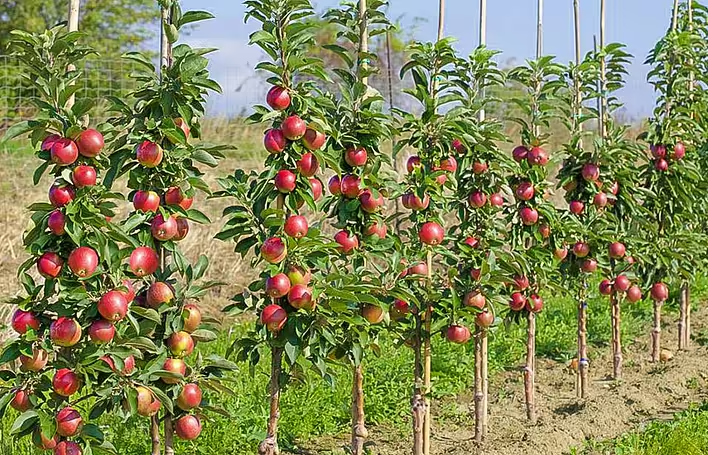
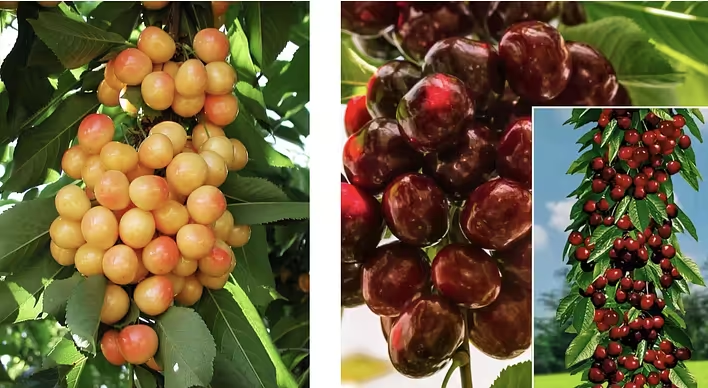
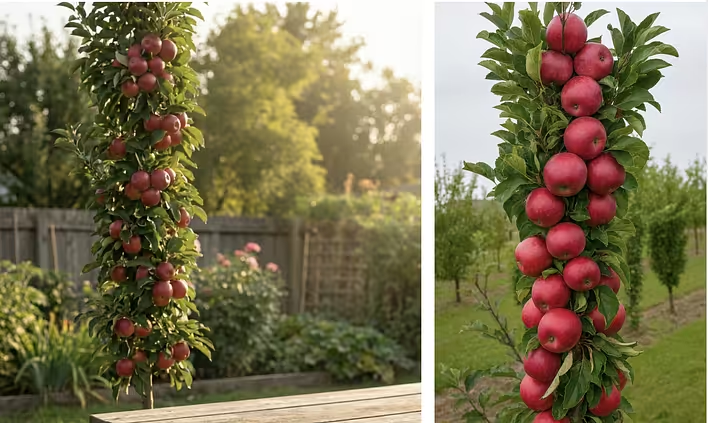
Columnar fruit trees are a special form of garden crops that combine high yields with minimal sizes. They are easily recognizable by their narrow, almost vertical crown without sprawling branches: the tree grows upwards, forming a kind of "column." This format has become a true discovery for owners of small plots, balcony gardens, or intensive industrial plantings.
What are columnar trees
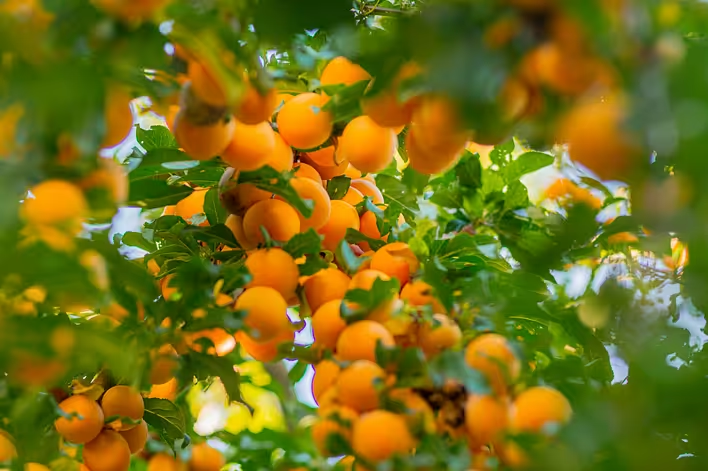
Columnar trees are varieties of fruit crops in which the development of lateral branches is naturally suppressed or achieved through selection. Fruits primarily form along the main trunk on short fruit formations. Most often, apples, pears, plums, cherries, and even peaches are grown in this format.
The height of such trees usually ranges from 2 to 3 meters, while the width is only 30 to 60 cm. This allows them to be planted much more densely than classic garden trees.
The history of columnar trees began in the 1960s in Canada. On one of the ordinary apple trees, a branch with unusually vertical growth and minimal branching was accidentally discovered. This natural mutation was fixed by breeders, leading to the development of the first columnar apple varieties. Over time, similar forms were created for other fruit crops.
Advantages of columnar seedlings
The main advantage is compactness. Dozens of trees of different varieties can be placed in a small area, which is especially convenient for private gardens.
They also enter fruit-bearing much faster. Many columnar trees produce their first fruits as early as 2 to 3 years after planting, which is significantly quicker than traditional varieties.
Harvesting becomes easier: short trees do not require a ladder, and the fruits are easily accessible.
Another plus is their decorative appeal. Thanks to their neat shape, these trees look tidy and can even serve as a living fence or an element of landscape design.
Moreover, columnar trees require minimal pruning, as they naturally maintain a narrow crown shape.
Disadvantages and limitations
Despite their advantages, columnar trees also have their downsides. One of the main ones is a shorter active fruit-bearing period. Usually, after 10 to 15 years, their productivity declines, and the trees need to be replaced.
They are also more demanding in terms of care. Due to their relatively compact root system, these trees require regular watering and fertilization.
Another nuance is the higher cost of seedlings compared to traditional trees.
The yield of one tree is usually lower than that of a large traditional tree, but due to dense planting, the overall yield from the area can even be greater.
Features of cultivation
Columnar trees grow best in well-lit areas with fertile soil. It is important to ensure regular watering, especially in the first years after planting.
The distance between trees can range from 50 cm to 1 meter, allowing for the creation of compact rows.
Pruning is kept to a minimum: usually, only damaged or excessively long lateral shoots are removed to maintain the column shape.
It is also important to monitor the central leader — if it is damaged, the tree may lose its characteristic shape.
Columnar seedlings are an excellent solution for those with limited space or who want to create a modern, tidy garden. They are suitable for both beginners and experienced gardeners but require a bit more attention to care.
In conclusion, this is not a replacement for a traditional garden but an interesting alternative or addition — compact, decorative, and quite productive.