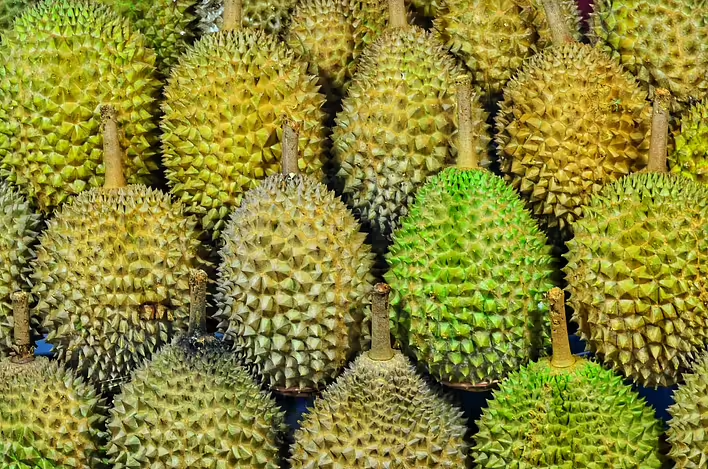
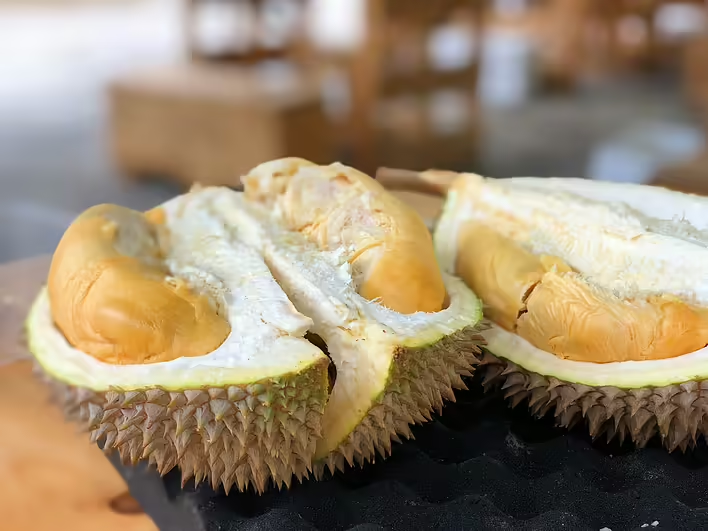
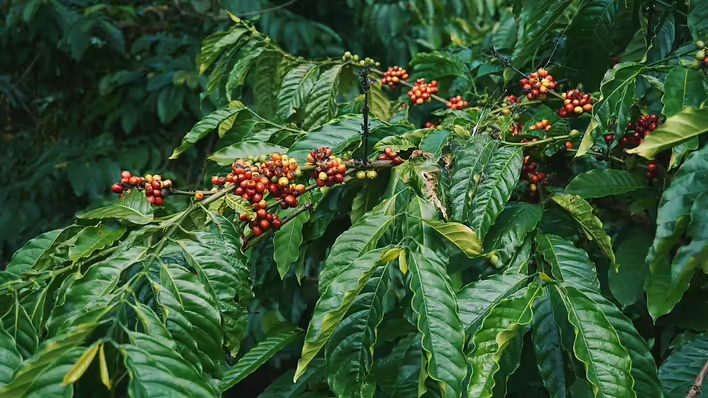
At first glance, these markets do not intersect, but in Southeast Asia, they are connected by the simple economics of farmer choice. Where limited land can be used to grow either coffee or a more profitable fruit, farmers are increasingly choosing durian — primarily due to the rapid growth in demand in China and attractive prices for fresh fruit and frozen pulp.
Durian exports from Vietnam to China exceeded $2 billion in 2023, five times more than the previous year
Coffee, especially Robusta, which the region supplies in large volumes for instant coffee and espresso blends, is losing the competition for land, water, labor, and investment. As some coffee plantations are repurposed for durian orchards, a supply gap forms in the global market: there are fewer beans, while demand in cafes and the food industry remains unchanged — resulting in higher prices.
Vietnamese farmers are abandoning coffee in favor of durian due to significantly higher profits — in some estimates, up to five times greater
Additionally, coffee crops (and especially Robusta in Vietnam) are increasingly suffering from droughts and climate stresses, further pushing farmers towards durian, which allows them to reduce risks and achieve better incomes.
Against the backdrop of increasing areas under durian, coffee plantations in Vietnam have significantly decreased — Robusta coffee exports in June 2024 fell by 50% compared to the previous year
It is important to understand that the connection is indirect and heterogeneous in space: not all coffee-exporting countries are simultaneously transitioning en masse to durian, and not every region is equally suitable for both crops. The Central Highlands of Vietnam, parts of Thailand, or the Malay Peninsula differ in soil, moisture, and access policies to the Chinese market, so the scales of substitution vary. Moreover, durian is not a "risk-free" alternative: it is sensitive to excess moisture during flowering, depends on effective pollination, requires capital-intensive investments, and faces regulatory barriers for export. If these risks materialize, the farming economy may sway back towards coffee — but the inertia of horticulture is significant, and trees cannot be transplanted in one season.
дуріан
There are also mitigating strategies. Some producers are moving towards agroforestry: coffee remains under the shade of trees, while durian is planted as the upper layer; this way, the farm diversifies income and spreads risks over time. Others keep coffee on the best plots and durian on the periphery, or combine it with mango and avocado.
Such practices contribute to adaptation to climate change and enhance the long-term resilience of farms
State policy — loans for drip irrigation, crop insurance, support for processing — can slow down the abrupt outflow from coffee and smooth out price "hills." Ultimately, the connection between the durian boom and more expensive coffee is a chain of three links: competition for resources, time lag of orchards, and climate volatility. It is not mechanical and not universal, but strong enough to be felt on the exchange and in the receipt for a latte. The longer high demand for durian and favorable prices for it are maintained, the greater the incentive for the agricultural sector to support this reorientation — and thus keep coffee in the high-value zone.
кавове дерево
Interesting Facts
Durian has become a key export commodity for Vietnam — its exports in 2024 rose to $3.3 billion, capturing almost half of the fruit market.
China imports over 1.5 million tons of durian at ~ $7 billion — trade is at a record level.
Coffee prices have soared — due to climate, reduced harvests, and trade barriers: Arabica +58–70%, Robusta +70%, retail: +84%.
Exchanges reacted immediately: Robusta — $5,700/ton, Arabica — +70% year on year.