Table of contentsClick link to navigate to the desired location
This content has been automatically translated from Ukrainian.
These names are often used as synonyms, but in reality, they mean quite different things. To understand where geography ends and politics begins, it's worth sorting everything out.
England is not all of Britain
England is just one of the four countries that make up the United Kingdom. It is located in the southern part of the island of Great Britain, has its capital in London, and is the largest in terms of area and population. Over 80% of the entire state's population lives here.
Historically, England was a separate kingdom that emerged in the 10th century and later became the dominant force in the British Isles. It was England that gradually united other parts of the island under its crown.
Great Britain is an island, not a country
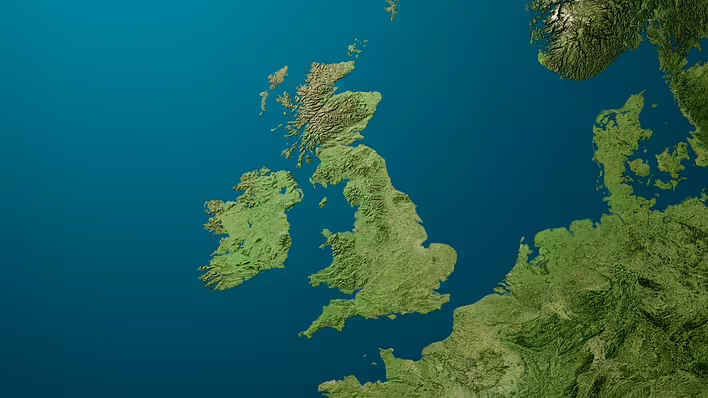
Great Britain is the geographical name of the island, the largest in Europe, on which are located:
- England
- Scotland
- Wales
The name "Great Britain" is used to distinguish this island from the smaller island of Ireland. It is not the full name of the country, although in everyday use it is often used as a synonym for the United Kingdom.
The United Kingdom is a country made up of several parts
The United Kingdom of Great Britain and Northern Ireland is the official name of the state, which we often shorten to Britain or the UK (United Kingdom). It includes:
- England
- Scotland
- Wales
- Northern Ireland (which is located on the island of Ireland, next to the Republic of Ireland)
Each of these parts has its own identity, and Scotland, Wales, and Northern Ireland even have their own parliaments or assemblies that partially govern local affairs.
A bit of history: how did all this come together?
- 1707 — England and Scotland sign the Act of Union, which unites them into the state of Great Britain.
- 1801 — Ireland joins Great Britain, forming the United Kingdom of Great Britain and Ireland.
- 1921 — after a long struggle, most of Ireland becomes the independent Republic of Ireland. Only Northern Ireland remains part of the United Kingdom.
Since then, the state has had its modern name: the United Kingdom of Great Britain and Northern Ireland.
And a little about Ireland
Ireland is an island
Ireland is a large island to the west of the British Isles. It is the second largest after Great Britain. The island of Ireland is divided into two parts:
- The Republic of Ireland (an independent state)
- Northern Ireland (which is part of the United Kingdom)
This is a key difference that is often overlooked.
The Republic of Ireland is an independent country
The Republic of Ireland (often simply "Ireland") is an independent state that occupies most of the island. Its capital is Dublin, and the official languages are Irish (Gaelic) and English. It is not part of the United Kingdom.
- Gained independence from Britain in 1921 (after a long struggle and liberation war).
- Initially was the Irish Free State, and since 1949 has been a fully independent Republic.
- Today it is a member of the European Union and is not part of the Commonwealth of Nations.
Northern Ireland is part of Great Britain
Northern Ireland is one of the four countries that make up the United Kingdom (along with England, Scotland, and Wales). Its capital is Belfast.
This part of the island remained under British control after the other part of Ireland gained independence.
A bit of history: why did Ireland split?
- For centuries, Ireland was under the rule of England and Great Britain.
- In the 19th century, famine and social upheaval intensified the desire for independence.
- In 1916, the Easter Rising occurred — a symbol of the struggle for a free Ireland.
- In 1921, the Anglo-Irish Treaty was signed, which made most of the island independent.
- Northern Ireland, where the majority of the population were Protestants and supported union with Britain, decided to remain part of the United Kingdom.
Conflicts in Northern Ireland
In the second half of the 20th century, Northern Ireland became the scene of a bloody conflict between:
- nationalists (Catholics) who sought unification with the Republic of Ireland,
- unionists (Protestants) who supported ties with Great Britain.
This period is known as The Troubles and lasted from the late 1960s until 1998, when the Belfast (Good Friday) Agreement was signed, bringing peace.
This post doesn't have any additions from the author yet.