This content has been automatically translated from Ukrainian.
“Heave!” and “lower!” — these are traditional commands used to coordinate joint physical work. The first means “lift”, the second — “lower”.
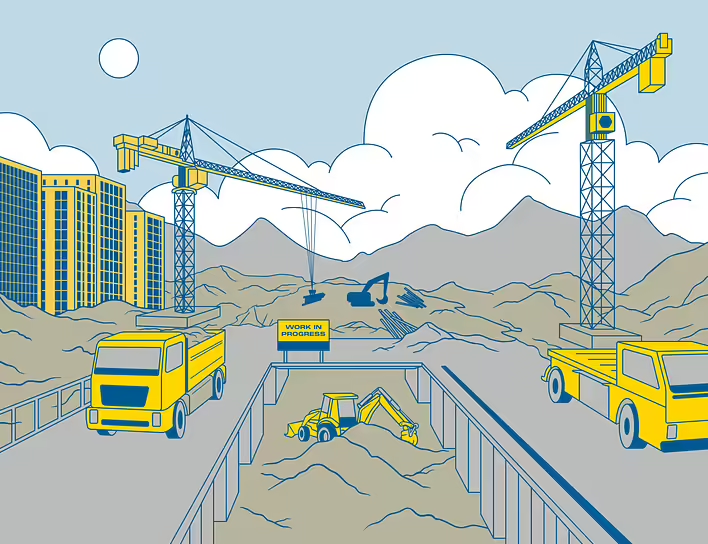
They can be heard during construction, assembly, or loading work when several people simultaneously lift or lower a heavy object. Such short shouts help perform the action synchronously and avoid confusion.
For example:
— Heave! (everyone lifts the load simultaneously)— Lower! Slowly! (the load is carefully lowered)
Despite the fact that these words have been used for many decades, their meaning is not well known to everyone today. For the younger generation, they often sound like mysterious or even meaningless shouts, although they can still be heard in professional environments.
The Origin of the Commands “heave” and “lower”
The origin of the word “lower” is explained much better than the origin of “heave”.
Most linguists associate “lower” with maritime terminology. Similar commands existed in the languages of European sailors and meant “to lower,” “to let down,” “to ease tension”. Over time, this term transitioned to other professions where it was necessary to work with lifting mechanisms or heavy loads.
That is why today the word “lower” is used not only by sailors but also by builders, assemblers, crane operators, and representatives of other professions.
The situation with the command “heave” is more complicated. Its exact origin is not definitively established, and there is no single explanation among researchers.
Most likely, it is a very ancient professional shout that became established in the language specifically as a command to lift a load. For many generations, the word was passed down orally from master to master, so its original meaning may have been lost many decades ago.
Because of this, today one can encounter various versions of the origin of “heave,” but none of them is considered definitively proven.
Where the Commands “heave” and “lower” are Used
Although these shouts may seem outdated today, they still remain part of professional vocabulary. They are used everywhere where several people need to lift or lower a heavy load simultaneously.
These commands can most often be heard:
- on construction sites — during the assembly of structures, moving construction materials, or working with cranes;
- in rigging work — when it is necessary to coordinate the movement of oversized loads;
- in workshops and manufacturing — during the installation of heavy equipment;
- in agriculture — during the manual movement of large objects or structures;
- in maritime affairs — historically, these commands originated here, although today they are more often heard on land.
Thanks to the fact that the words are very short and easily distinguishable by ear, they remain convenient even in noisy environments where long commands may be poorly heard.
Similar Commands in Other Languages
Short shouts for synchronizing physical labor exist in many languages around the world. Their emergence is quite natural: when several people are simultaneously pulling a rope, lifting a log, moving a stone, or working with sails on a ship, it is very important to perform the movement at the same moment. One short signal allows everyone to exert effort simultaneously, making the work faster, safer, and more efficient.
That is why different countries have developed their own commands for joint work.
In English, the well-known shout Heave-ho! has historically been used by sailors when they pulled ropes together, lifted anchors, or performed other heavy physical work. Over time, this expression began to be used by dockworkers, builders, and other workers who needed to act synchronously. Today, heave-ho can be heard not only in real life but also in movies, cartoons, and literature as a symbol of collective effort.
In German, the command Hau-ruck! serves a similar function. It is shouted at the moment when several people simultaneously lift or move a heavy object. Its meaning is close to the Ukrainian “together!” or “let’s lift!”
The most interesting for the Ukrainian language is the maritime term maina!, which is found in Italian as well as in a number of other European maritime traditions. This command means “to lower,” “to let down,” or “to ease”. Most researchers consider it the source of the Ukrainian shout “lower!”.
Alongside it, the command vira! was also used, which meant the opposite action — to lift, to tighten, or to pull the rope. That is why there is a widespread version that the Ukrainian command “heave!” also comes from maritime terminology. Although its etymology is not definitively proven, the similarity in sound, meaning, and area of use makes this hypothesis the most likely.
Despite their different origins and sounds, all these commands perform the same function — they help several people act as harmoniously as possible. This is a kind of universal “start signal” that for centuries has been used by sailors, builders, dockworkers, and representatives of many other professions where the success of work depended on the precision of joint movements.
Despite their different origins and sounds, all these commands perform the same function — they help people act as harmoniously as possible. This is a kind of universal signal for simultaneous movement that for centuries has been used by sailors, builders, dockworkers, and representatives of many other professions.
Interesting Facts
- In modern Ukrainian, “lower” and “heave” belong to exclamatory commands. They are even recorded in academic dictionaries of the Ukrainian language.
- The word “lower” has a much better researched etymology, while the origin of “heave” is still not definitively established.
- Although both commands originated in a professional environment, today they are often used humorously in everyday life when several people lift furniture, appliances, or other heavy items together.
- Due to frequent joint use, the expression “heave-lower” is sometimes used in a figurative sense, describing constant ups and downs, sharp changes, or continuous movement back and forth.
Frequently Asked Questions
What does the command “heave” mean?
“Heave!” is a command that means “lift” or “up”. It is used during the joint lifting of loads.
What does the command “lower” mean?
“Lower!” means “let down” or “down”. It is the opposite command to “heave.”
Are the words “heave” and “lower” related to the common words “faith” and “property”?
No. Despite the same spelling, these are separate command words that have no relation to the concepts of “faith” as a belief or “property” as ownership.
Why are these words still used?
They are short, easily heard, and allow several people to perform one action simultaneously. That is why, despite their age, these commands remain convenient in work.
Like it?React
🧵
This post doesn't have any additions from the author yet.