This content has been automatically translated from Ukrainian.
Children's Bicycle: Three Things That Will Make Your Purchase Successful
You take your child to the store, they see a row of shiny bicycles and their eyes light up. But how can you ensure that this choice doesn't turn into disappointment a few months later? Buying a children's bicycle is not just a gift, but an investment in your child's development, safety, and joy.
👶 Size Matters
The first and most important criterion is the correct size. A bicycle that is too big can scare a child, while one that is too small will quickly become uncomfortable.
- For toddlers aged 3–5 years, 12–14 inch wheels are suitable.
- For children aged 5–7 years — 16–18 inches.
- For schoolchildren aged 7–12 years — 20–24 inches.
Imagine this situation in more detail: the child sits on a brand new bicycle, hands firmly gripping the handlebars, eyes shining with joy… but suddenly it turns out that their feet can't reach the ground. It seems like a minor detail — what are a few centimeters? But those centimeters can lead to serious problems.
When a child cannot confidently place their feet on the ground, they lose the sense of control. Instead of joy, fear arises: "What if I can't stop?" This feeling of uncertainty quickly turns riding into stress. And here we come to the main point — safety. According to research, over 60% of falls in children occur due to the inappropriate size of the bicycle. This is not a myth, but statistics that show: the wrong choice can cost health.
Consider a real-life situation: a child is riding in the yard, suddenly a dog or a ball runs into the road. An adult has a chance to quickly jump off and maintain balance. But a little one who can't reach the ground simply doesn't have that option. They fall, often sharply and painfully. And this is no longer about scratches — the risk of injury significantly increases.
Choosing the right size is like choosing shoes. You wouldn't buy your child sneakers two sizes too big "to last longer," would you? Because you know: they will rub, be uncomfortable, and sometimes even dangerous. The same goes for a bicycle. Buying "for growth" is a classic mistake parents make, which quickly leads to loss of interest and even health problems.
So what should you do? There is a simple rule: when the child stands with both feet on a flat surface, with the frame between their legs, the distance from the top tube to the crotch should be at least 5–7 centimeters. This is called standover height. It ensures that the child can instantly and safely jump off the bicycle in case of danger. And while sitting in the saddle, the little one should be able to touch the ground with their toes — this gives a sense of control and confidence.
Imagine how much the child's psychology changes: instead of fear — freedom, instead of uncertainty — the desire to ride again and again. And this moment determines whether the bicycle will be a friend for many years or remain a disappointment in the garage.
Therefore, when you choose a children's bicycle, remember: size is not just a number in a catalog, but the key to your child's safety, joy, and health. And if you want to select a model that will last long, it's worth paying attention to specialized offers — for example, in the catalog of children's and teenagers' bicycles.
👉 Don't skimp on centimeters — they can be crucial for your child's safety and happiness.
🛡️ Safety First
The second factor is quality and safety. There are no compromises here.
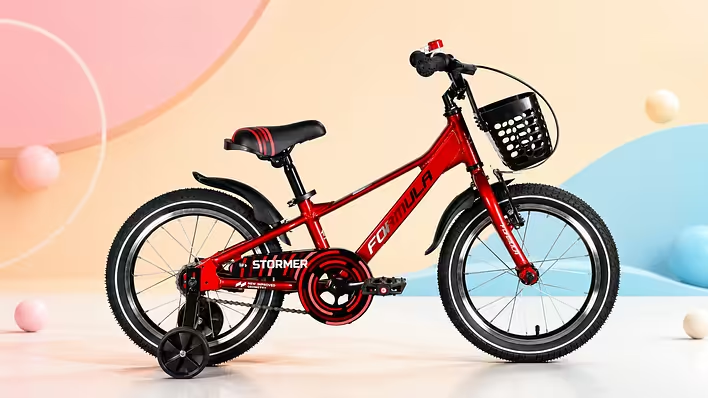
- Brakes: for toddlers, foot brakes are better, for older children — hand brakes.
- Chain: must be covered to avoid injuries.
- Frame: lightweight but sturdy. Aluminum is the ideal option, as it doesn't rust and doesn't weigh down the bicycle.
Recall this everyday scene in more detail. The child is happily riding in the yard: the wheels quietly crunch on the asphalt, the wind blows through their hair, and it seems like the world belongs to them. Suddenly, a dog runs out from around the corner — unexpectedly, quickly, right into their path. At that moment, seconds decide everything.
If the brakes are weak or respond with a delay, the child instinctively squeezes the handles, but the bicycle doesn't react quickly enough. The wheels keep moving, speed doesn't decrease, and the risk of falling becomes enormous. Imagine: the little one tries to turn the handlebars, but due to panic and lack of control, they lose balance. The fall can be sharp — onto knees, elbows, or even the face. And this is no longer about scratches: the injury can be serious.
Now imagine a different scenario. The same situation, the same dog, but the bicycle is of high quality, with reliable brakes. The child presses — and the wheels stop immediately. There’s even a chance to roll back a little, avoiding a collision. The little one feels in control, fear quickly turns to relief, and you feel grateful to yourself for making the right choice.
It's like the difference between a cheap umbrella that breaks at the first gust of wind and a sturdy model that withstands a storm. In a critical moment, quality determines the outcome. A bicycle with reliable brakes can literally save from injury, and sometimes from serious consequences.
Therefore, when you choose a children's bicycle, don't consider brakes as a "secondary detail." They are the heart of safety.
🎨 Comfort and Design
The third criterion is convenience and appearance.
- The saddle should be soft and adjustable.
- The handlebars should adjust to height.
- The grips should not slip and feel pleasant to the touch.
And now a bit of emotion: imagine a boy who received the "right" bicycle, but he doesn't like the color. The result? He rides only a few times because "the bicycle is ugly." Design is not a trivial matter, but a motivation. If the child likes the appearance, they will ride with pleasure.
📌 Tips in List Form
- Check the size — the child should be able to reach the ground with their feet.
- Evaluate safety — brakes, frame, chain protection.
- Consider comfort — comfortable saddle, adjustable handlebars, pleasant design.
🏁 Conclusion
Buying a children's bicycle is a balance between practicality and emotions. If you consider size, safety, and comfort, you will give your child not just transportation, but true freedom of movement and happy memories. Want to select a model that will last long? Check out the catalog of children's and teenagers' bicycles https://irpin.bike/products/dityachi-ta-pidlitkovi in a specialized store. And if you want to explore the entire range, visit the main page of Irpin.Bike https://irpin.bike/
Give children the freedom to move — and they will reward you with happy smiles!
Like it?React
🧵
This post doesn't have any additions from the author yet.