Table of contentsClick link to navigate to the desired location
This content has been automatically translated from Ukrainian.
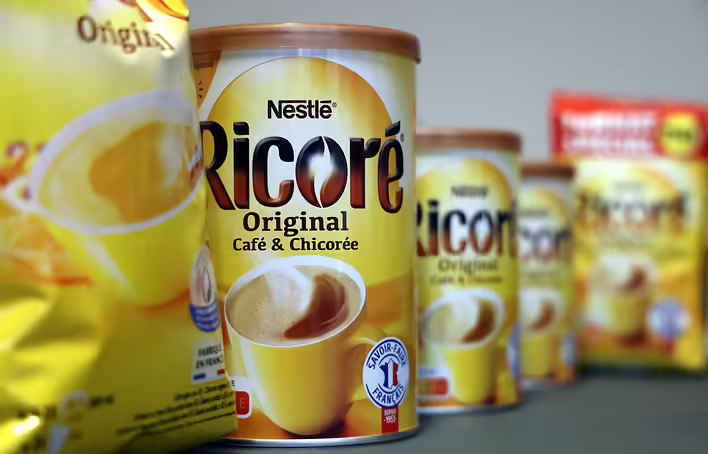
Ricoré is a soluble drink that combines coffee and chicory and has been a part of everyday life in France for over half a century. For some, it is simply a milder alternative to coffee, while for others, it evokes childhood memories, mornings in the kitchen, and leisurely breakfasts. It is hard to call it fashionable or trendy, but that is its strength: Ricoré is stable, recognizable, and very "homely".
Origin and Composition of the Drink
Ricoré was created by Nestlé in 1953. The base of the drink is a mixture of instant coffee and instant chicory. Chicory is the roasted root of the Cichorium intybus plant, which has been used in Europe since the 18th and 19th centuries as a substitute or additive to coffee. It is caffeine-free, has a natural bitter-sweet note, and pairs well with coffee flavor.
In the classic version of Ricoré, the proportion of chicory is quite high, which makes the drink smoother, less bitter, and less stimulating than regular coffee. It is usually consumed with hot milk or a mixture of milk and water — rarely as a purely "black" drink.
The emergence of Ricoré coincided with the post-war period when coffee in Europe was still an expensive and not always accessible product. The addition of chicory allowed for reduced costs while preserving the familiar taste and aroma. However, unlike many wartime "coffee substitutes," Ricoré did not disappear with the return of abundance.
In the second half of the 20th century, the drink gradually transcended the logic of economy and became a full-fledged product with its own identity. Advertising campaigns of the 1970s and 1990s established Ricoré as a drink for the whole family, ideal for breakfast, warm conversations, and a calm start to the day.
Why Ricoré is So Loved in France
The love for Ricoré in France is not just based on taste. Firstly, it is a matter of habit and cultural continuity. For many French people, it is a drink that their parents or grandparents enjoyed. It is associated with home, the kitchen, milk in a cup, and morning silence.
Secondly, Ricoré fits well into the French attitude towards coffee as a ritual, rather than just a source of caffeine. It is not a "to-go" drink, but something to be sipped slowly, often alongside toast or a croissant. Its lower caffeine content makes it comfortable even for those who do not want a strong stimulating effect.
Thirdly, the taste of chicory itself is not foreign to French cuisine. It is not perceived as a compromise, but rather as a distinct, full-fledged flavor category.
Geography of Popularity
Ricoré is undoubtedly most associated with France. It is sold in practically every supermarket there and remains a mass product. Besides France, it can be found in Belgium, Spain, Portugal, Poland, and some other European countries.
At the same time, the very idea of combining coffee with chicory has a much broader geography. Similar drinks exist in the USA (especially in New Orleans), in South Africa, as well as in Central and Eastern European countries. However, it is Ricoré that has essentially become a brand synonymous with this approach to coffee in the French context.
Today, Ricoré is not a trendy specialty product nor part of the third wave of coffee culture. Rather, it is an example of how a drink can remain relevant due to emotions, memories, and simplicity. People drink it not because it is "better," but because it is familiar, predictable, and comfortable.
In this sense, Ricoré is a good example of how gastronomic culture consists not only of high tastes and trends but also of those things that simply stay with people for a long time.
This post doesn't have any additions from the author yet.