This content has been automatically translated from Ukrainian.
Imagine a typical American classroom in 1967, where students, as always, listen to a history lesson. But something changes: the teacher begins to demand strict discipline from them, enforcing a strict order and obedience. Within a few days, the class transforms into a miniature totalitarian movement, and the students become its devoted followers. This is not fiction, but a real experiment conducted by American history teacher Ron Jones at Cubberley High School in Palo Alto, California.
How did it all begin?
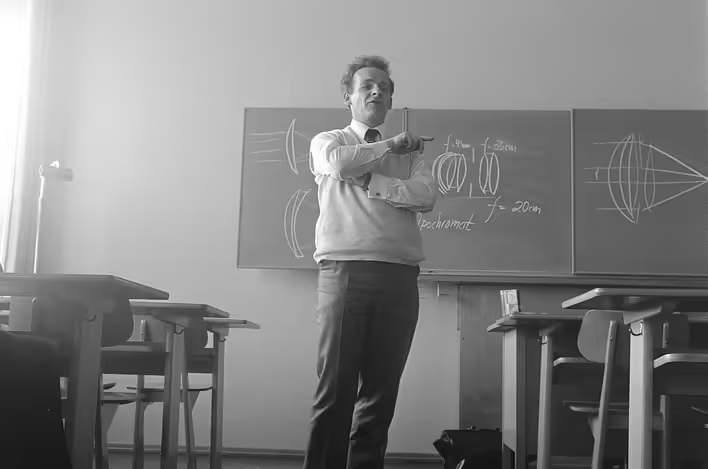
Ron Jones was a young idealistic history teacher who taught about World War II and the Holocaust. During one of the lessons, the students asked him a question:
“How could ordinary Germans not notice the horrors of Nazism? Why did they so easily submit to Hitler?”
Instead of a theoretical answer, Jones decided to conduct an experiment to show how people can become part of a totalitarian movement without even realizing it.
Day One: Discipline

Jones began by enforcing strict discipline: students had to sit up straight, keep their backs straight, respond quickly to questions, and listen to him unquestioningly. He created a simple slogan:
“Strength in Discipline!”
Surprised students began to adhere to the new rules, and even those who were usually passive became more active.
Day Two: Unity

The next day, Jones expanded the experiment. He introduced a new slogan:
“Strength in Community!”
The students received a special sign – a gesture of three fingers bent in a wave – with which they were to greet each other. He named this movement “The Third Wave”, referring to the natural phenomenon: the third wave in the ocean is always the strongest.
Strangely, many students began to feel part of something larger than just a class. They became united, even those who previously had no friends.
Day Three: Loyalty

Jones took the next step – he introduced an identification system: members of the movement received ID cards and were encouraged to expose those who did not follow the rules.
This led to unexpected consequences. Some students reported on their classmates, even on friends. The atmosphere in the classroom became increasingly tense, but also exciting for many – they felt part of an elite movement.
Day Four: Mission

On the fourth day, Jones announced that the “Third Wave” movement was part of a larger national program, and that on Friday a leader of the movement would be announced at the national level. The students were excited and ready for something big.
Day Five: Debunking the Myth

On Friday, Jones gathered the students in the auditorium in front of a screen, where they awaited a message from the leader. But instead, he turned on a blank channel.
Then he told them the truth: there is no movement, and they themselves have become victims of their own need to submit. Jones showed footage from the Nuremberg Trials, where Nazi leaders justified themselves with the words: “I was just following orders.”
The students were shocked. Some cried, some were angry, some were silent. They realized how easily they had fallen under the influence of an idea they had initially criticized.
Consequences and Significance of the Experiment
The experiment ended, but its consequences continued to affect the students for a long time. Some of them said it was the most important lesson of their lives.
Later, Jones wrote a book about it “The Third Wave”, and a film “Die Welle” (2008) and several theatrical productions were made based on the experiment.
Why is this important today?
Jones's experiment remains relevant. It showed that even educated and democratic societies are not immune to authoritarianism if people stop thinking critically.
This story is a warning that totalitarianism does not start with dictators, but with simple choices: to submit or to think, to follow or to question.
Like it?React
🧵
This post doesn't have any additions from the author yet.