This content has been automatically translated from Ukrainian.
Language is a living organism that constantly changes, adapting to the realities of social life. War is one of the most powerful catalysts of linguistic transformations, as it not only changes borders and society but also leaves a mark on the lexicon. The Ukrainian language, which is experiencing another stage of active development in the context of a full-scale invasion, has been enriched with hundreds of new words that reflect the reality of modern warfare. Some of them come from military terminology, others are born as slang expressions, and others become symbols and memes.
Let’s consider three vivid examples of such words: stormtrooper, volunteer battalion, and Bayraktar phenomenon.
Stormtrooper: from aviation to infantry
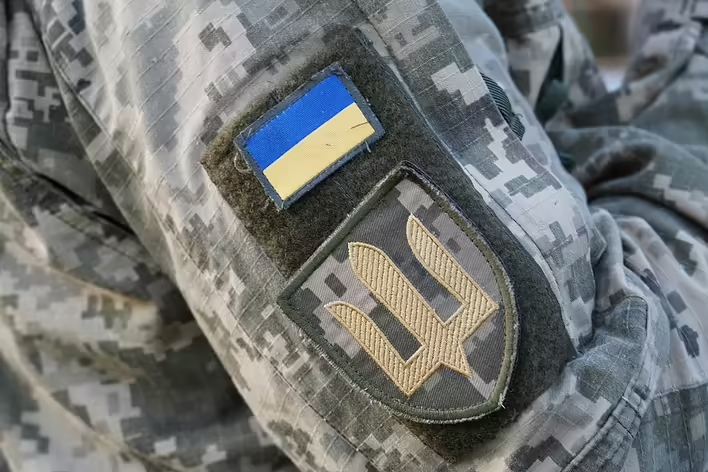
The term "stormtrooper" in the Ukrainian language has long been primarily associated with military aviation. Stormtroopers referred to combat aircraft designed for attacking ground targets, such as the Soviet Su-25 or the American A-10 Thunderbolt. However, since 2022, the word "stormtrooper" has taken on a new meaning that now dominates public consciousness – it refers to soldiers of assault units.
Assault groups carry out particularly dangerous tasks – breaking through enemy positions, fighting in cities, clearing fortifications. That is why the word "stormtrooper" has gained special significance as a designation not just for a military person, but for a fighter who engages in combat on the front lines, often in conditions of maximum danger. This meaning is a peculiar reflection of modern warfare, where infantry plays a decisive role, not just technology.
Volunteer Battalion: the birth of volunteer formations
The word "volunteer battalion" comes from the abbreviation "volunteer battalion." Such formations first appeared in 2014, when regular Ukrainian troops did not have sufficient strength to deter Russian aggression. At that time, patriots who were ready to defend the country even without proper support joined the ranks of volunteer battalions.
Since 2022, the concept of "volunteer battalion" has received new life – now it includes not only volunteer battalions but also a broad concept that encompasses any volunteer and partisan initiatives. Volunteer battalions have become a symbol of civic cohesion, where Ukrainians themselves form combat units, assist the army, and organize logistics and reconnaissance. The word has transcended its purely military context and become part of national identity.
Bayraktar Phenomenon: a symbol of a new war
If "volunteer battalion" and "stormtrooper" are words related to classical military terminology, then "Bayraktar phenomenon" is a phenomenon of a different order. It comes from the name of the Turkish strike drone Bayraktar TB2, which became a legend in the first months of the full-scale invasion.
Initially, the word "Bayraktar phenomenon" was used with a positive connotation – as a symbol of the ingenuity of Ukrainians who destroy enemy equipment with drones and wage war using asymmetric methods. However, over time, this term has taken on an ironic tone. Now "Bayraktar phenomenon" means an excessive belief in technology or an exaggerated confidence that the war can be won solely with drones and hype on social media.
This phenomenon shows how military realities can give rise not only to terms but also to memes that reflect social moods.
War as a driver of linguistic changes
The Ukrainian language is changing right before our eyes. Some words that were previously little known or specialized are becoming part of everyday vocabulary, while others acquire new shades of meaning. War affects not only everyday life and culture but also the way we express our thoughts.
Today we can observe how the words "stormtrooper", "volunteer battalion", and "Bayraktar phenomenon" are changing the Ukrainian language, and likely, some of them will remain in it even after victory. This is a living process, and in the future, we will see time and again how war gives rise to new terms that reflect the spirit of our time.
Like it?React
🧵
This post doesn't have any additions from the author yet.