This content has been automatically translated from Ukrainian.
Lore is a collection of stories, facts, rules, and details about an imagined world, character, or specific phenomenon. Simply put, it explains everything that happened before, how the world is structured, and why everything works the way it does.
The term is most often encountered in games, fantasy, anime, comics, and large media franchises. However, in recent years, the word "lore" has gone far beyond fandoms: now you can hear about "the lore of a blogger," "the lore of this meme," or even "the lore of our group of friends" on the internet.
What does the word "lore" mean
The Ukrainian lore comes from the English lore. In English, this word existed long before the advent of video games and referred to accumulated knowledge, narratives, traditions, or information about a particular topic.
The word itself has ancient origins: the English lore is related to the Old English lār — "knowledge," "learning," "teaching."
In modern pop culture, the meaning has somewhat changed. When people talk about the lore of a particular universe, they usually refer to its backstory, internal mythology, and the rules by which this world exists.
For example, the lore of a fantasy game may include:
- the history of the world's creation;
- ancient wars and disasters;
- the origins of peoples and states;
- religions, myths, and legends;
- character biographies;
- rules of magic;
- the history of items, cities, or organizations.
Some of this information may not be necessary at all for completing the game or understanding the main storyline. However, it creates a sense that the imagined world existed long before the main character appeared and continues to live beyond the specific story.
Lore and plot are not the same
These concepts often intersect, but there is an important difference between them.
Plot refers to the events that happen directly in the story.
Lore is the broader context surrounding them.
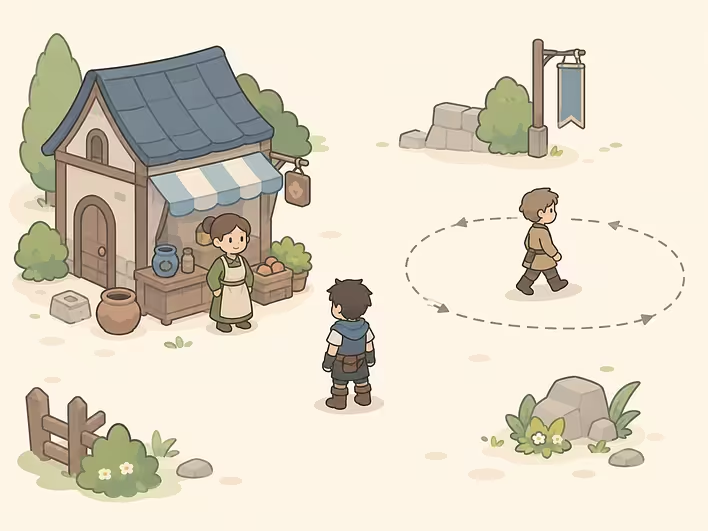
Imagine a game where the hero arrives at a ruined city and tries to defeat a monster. His journey, encounters, and battles with the enemy are the plot.
On the other hand, the explanation of who built the city, why it was destroyed, where the monster came from, who lived there a hundred years ago, and what the strange symbols on the walls mean — that is lore.
That’s why a work can have a relatively simple plot while simultaneously having a very complex and detailed lore.
Where lore hides
Authors do not necessarily tell the story of the world directly. This is especially noticeable in video games.
Lore can be hidden in notes, item descriptions, dialogue from secondary characters, architecture, location names, or even in small details of the environment.
Because of this, entire communities of people often emerge around some games, literally reconstructing the history of the world from individual fragments.
A good example is Dark Souls and Elden Ring. A significant amount of information about their worlds is presented indirectly: through item descriptions, dialogues, location design, and mentions of past events. Therefore, players compare individual details and build theories, trying to piece together a complete picture.
In other works, lore can be presented much more directly — through in-game books, encyclopedias, long dialogues, flashbacks, or separate reference materials.
What is character lore
Lore can refer not only to an entire universe.
The phrase "character lore" usually means their backstory: origins, family, past events, relationships with other heroes, and reasons for their current actions.
For example:
In the series, they almost didn't explain this character's lore.
This means that the viewer was shown the hero but was told almost nothing about their past and motivations.
Or:
After the new expansion, more lore about the main antagonist was revealed.
This means that the authors added new information about their past or role in the world of the work.
Lore, canon, and fanon
Lore should not be completely equated with canon.
Canon defines which events and facts are officially considered part of the work. Lore is the body of information about its world, past, characters, and rules.
Therefore, one fact can simultaneously be part of both lore and canon.
For example, if the author officially established that a certain kingdom emerged a thousand years ago, this is a canonical element of the lore.
However, a popular fan theory about the origin of the king will remain a fan interpretation until it is confirmed by the authors. Depending on the context, it may be referred to as headcanon or part of fanon.
This difference is especially noticeable in large franchises where there are books, series, games, comics, and alternative versions of the same events.
What does deep lore mean
In the English-speaking internet, the phrase deep lore — literally "deep lore" — is often encountered.
This can refer to little-known, specific, or very old details that are mainly understood by long-time fans of a particular game, series, or online community.
For example, a joke may refer to a secondary character who appeared only in a few scenes many years ago. For a new viewer, such a mention will mean nothing, while long-time fans might say:
This is already deep lore.
Over time, this phrase has also become meme-like and started to be used outside of fandoms.
How "lore" became internet slang
The most interesting thing happened when the word began to be applied to things that do not have any official mythology or fictional universe at all.
In social media, you can find phrases like:
I missed the lore of this meme. I need to know the lore of their argument. This cat already has its own lore. This is part of family lore.
In this context, lore means the backstory or the sum of previous events, without knowledge of which it is difficult to understand what is happening now.
For example, if two bloggers have been in conflict for years, a new subscriber might see another argument and ask, "What's the lore here?"
Essentially, they are asking: "What happened before and what do I need to know to understand this situation?"
This humorous usage has made the word much more universal.
Lore can even be about an ordinary person
Due to its meme usage, the term has also started to be applied to real life.
For example:
My lore is too complicated to explain in one meeting.
Or:
He suddenly told me all his university lore.
It is clear that there is no real "canon" here. The word ironically replaces "history," "backstory," or "context".
It works particularly well when a situation has many internal jokes, long-standing conflicts, and stories known only to the members of a particular group or online community.
Therefore, today "lore" can mean both a complex mythology of a fantasy universe and the history of a strange joke between friends that has been going on for several years.
What does "lore" mean in simple words
In short, lore is the backstory and body of knowledge about a world, character, or phenomenon that helps to understand its context.
In fantasy, this can be legends about ancient gods and fallen empires. In games — the history of locations and characters. In fandoms — a large body of facts about a particular universe.
And in modern internet slang, almost any backstory can become lore.
So the phrase "I don't know the lore" often means a very simple thing: "I see that something is happening here, but I don't know what happened before."
Like it?React
🧵
This post doesn't have any additions from the author yet.