This content has been automatically translated from Ukrainian.
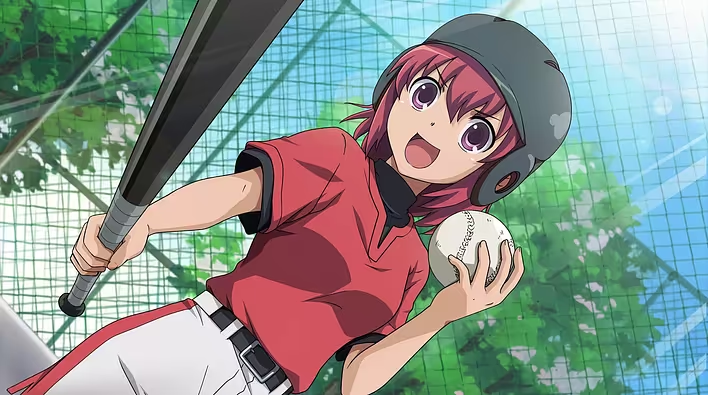
In the company of anime characters, a genki girl can usually be recognized even before someone says her name. She bursts into the room, greets loudly, immediately offers a new adventure, and is genuinely surprised that others do not share her enthusiasm. While others are just contemplating the problem, the genki girl is already running to solve it — sometimes in the wrong direction, but with full commitment.
A genki girl is a recognizable type of an extremely energetic, lively, and active heroine, common in anime, manga, video games, and other works of popular culture. The English term genki girl is most often used, meaning "energetic girl." However, male characters can also have a similar temperament.
What does the word "genki" mean
The Japanese word 元気 (genki) can be translated depending on the context as "healthy," "cheerful," "lively," "full of energy," or "energetic." For example, the question o-genki desu ka? means approximately "How are you?" or "Are you feeling well?".
This meaning is the basis for the name of the character type. A genki girl seems to have a greater reserve of life energy than everyone around her. She moves a lot, speaks quickly, reacts actively to events, and often involves others in her activities.
However, genki is not an official term in Japanese literary studies and is not a strict classification of characters. It is primarily a fan trope used to describe heroines with similar temperaments. Therefore, its boundaries remain quite conditional.
How to recognize a genki character
The main trait of a genki girl is extraordinary activity. Such a heroine rarely sits idle, easily gets excited about new ideas, and willingly takes on tasks that others find too difficult, strange, or exhausting.
A genki character usually:
- is energetic and mobile;
- openly expresses emotions;
- talks a lot and quickly;
- easily makes friends;
- is eager to take on new tasks;
- actively influences events;
- can inspire others with her enthusiasm.
A genki girl can often be impulsive, noisy, impatient, or inattentive. She may act first and think about the consequences later. Because of this, such characters often become sources of comedic situations: they come up with dubious plans, misunderstand tasks, or fail to notice that their friends are already tired of their activity.
However, clumsiness, carelessness, and unrestrained optimism are not mandatory traits. A genki girl can be smart, responsible, and disciplined. What defines her is her temperament, not her abilities or moral qualities.
A genki girl is not necessarily always cheerful
The name of the character type is often simplistically explained as "cheerful girl," but a genki girl does not have to smile all the time. She can get angry, feel disappointed, be jealous, or experience a serious internal crisis. What distinguishes her is not a continuously good mood, but the strength and openness of her emotional reactions.
Even a genki girl's anger is usually as explosive as her joy. She does not silently accumulate feelings but expresses them through words, movements, and actions. If the heroine is excited about something, everyone will notice. If she is outraged — most likely, they will notice that too.
Sometimes authors deliberately show that behind the character's usual activity lie anxiety, loneliness, or fear of being unnecessary. This is not a mandatory part of the character type, but one way to complicate it. The contrast between the heroine's usual liveliness and moments of silence helps to reveal her character more deeply.
What role does a genki girl play in the plot
A genki girl often becomes a driving force in events. It is she who suggests creating a club, participating in a competition, going on a journey, or helping a stranger. Without such a character, more cautious heroes might never leave their comfort zone.
This character type works particularly well alongside a calm, silent, or reserved character. One constantly proposes something new, while the other tries to regain control of the situation. Jokes, arguments, and relationship developments are built on the difference in temperaments.
In team stories, a genki girl can serve as the emotional engine of the group. She keeps the conversation going, brings people together, and prevents others from getting bogged down in doubts for too long. However, this does not mean that every such heroine is automatically a leader. She may not be the one making final decisions but rather the one who motivates everyone to finally take action.
Genki and deredere — what’s the difference
Genki is sometimes confused with deredere, as both character types can be friendly, smiling, and open. However, these names describe different aspects of character.
Genki primarily defines temperament: activity, mobility, emotionality, and enthusiasm. Deredere describes the way of expressing romantic affection. Such a heroine is gentle, caring, and openly demonstrates feelings for the person she loves.
A character can simultaneously have traits of both genki and deredere, but these concepts are not synonyms. An energetic heroine may not have a romantic line at all, while a deredere can be quiet, calm, and unhurried.
Similarly, a genki girl should not be automatically equated with dodgikko — a cute clumsy heroine. These character types often combine in one character, but a genki girl is not necessarily clumsy, and a dodgikko is not necessarily energetic.
Examples of genki in anime
One of the most vivid examples is Mako Mankanshoku from Kill la Kill. She is loud, extremely mobile, emotional, and capable of delivering a whole speech where others can barely get a word in. Mako not only creates comedic scenes but also supports Ryuko and influences her decisions.
Minori Kushieda from Toradora! also has characteristic genki traits. She is active, sociable, works hard, and often behaves eccentrically. At the same time, her cheerfulness does not mean the absence of complex feelings: part of Minori's experiences is hidden behind her energetic behavior.
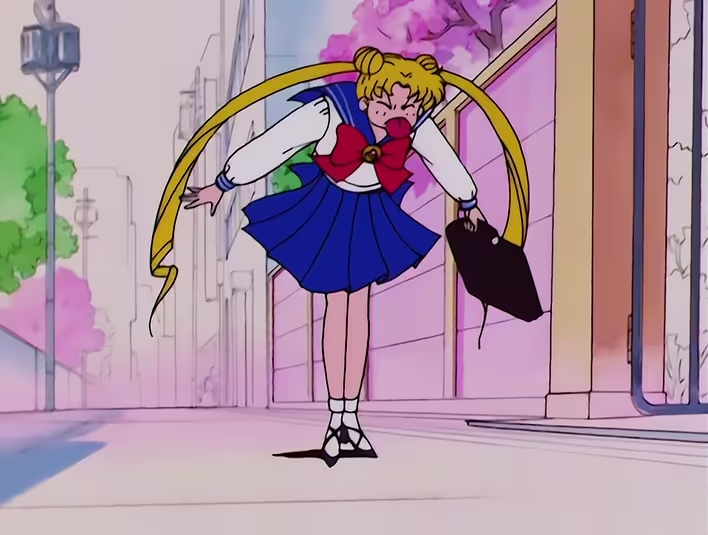
This character type can also include Minako Aino from Sailor Moon. She is cheerful, sporty, dreamy, prone to loud antics and romantic crushes. At the same time, as Sailor Venus, Minako can be serious and responsible, which well demonstrates that a genki girl is not necessarily a frivolous character. Fan guides directly relate her to this trope.
Yui Hirasawa from K-On! also fits many traits of the type: she is emotional, straightforward, easily excited, and livens up the company. However, her image is not limited to just genki. It also includes important traits like distraction, unhurriedness, and a tendency to get sidetracked, so Yui can be considered a mixed rather than a prototypical example.
Some male characters also have a similar temperament, including Naruto Uzumaki and Monkey D. Luffy. They are loud, active, open, and capable of infecting others with their confidence. However, the term genki girl traditionally refers to the female type, so Naruto and Luffy are more accurately described as characters with similar traits rather than genki in the strict sense.
A genki character can easily be turned into a caricature: just keep the loud voice, chaotic movements, and endless exclamations. But a well-written heroine has not just a lot of energy — she directs it toward specific goals, influences people, and changes under the pressure of events. Then a genki girl becomes not only a source of humor but also a full-fledged force that drives the story forward.
Like it?React
🧵
This post doesn't have any additions from the author yet.