This content has been automatically translated from Ukrainian.
She trips over flat ground, spills tea, loses necessary things, and accidentally walks into the wrong room. It seems that her constant mistakes should annoy those around her, yet the heroine is forgiven every time. Her clumsiness appears not malicious or dangerous, but funny and charming in its own way.
This type of character in anime, manga, and Japanese video games is called dojikko. Unlike the energetic character, defined by an excess of energy, the main trait of a dojikko is the tendency to regularly find themselves in awkward situations due to inattention, anxiety, or poor coordination.
What the word "dojikko" means
The Japanese ドジっ子 (dojikko) is derived from the word ドジ (doji) — "blunder," "mistake," "clumsiness" — and 子 (ko) — "child" or "girl." The doubled sound "k" occurs when combining parts of the word.
It is also sometimes written as ドジっ娘, where the character 娘 means "girl" or "daughter." In both cases, the term describes a cute, clumsy heroine who constantly makes small mistakes.
However, a dojikko is not just someone who often messes things up. It is important how her blunders are portrayed in the story. They should evoke sympathy, laughter, or a desire to help, rather than just annoyance. This appealing imperfection distinguishes a dojikko from a character whose actions truly pose a threat to others.
How to recognize a dojikko
A dojikko constantly falls victim to minor domestic mishaps. She may trip, drop dishes, spill drinks, mix things up, or perform a simple task incorrectly. Often, the heroine tries very hard to do everything right, but her anxiety only worsens the situation.
A typical dojikko:
- often falls or bumps into objects;
- loses and confuses things;
- spills drinks or breaks dishes;
- makes mistakes due to haste or inattention;
- feels awkward about her own failures;
- sincerely apologizes if she causes someone trouble;
- tries to fix everything but often creates even more chaos.
It is not only the mistake itself that matters, but also the heroine's reaction. A dojikko usually does not shift the blame onto others and does not remain indifferent to the consequences. She feels embarrassed, upset, or frantically tries to fix the situation. It is this sincerity and effort that make her clumsiness endearing.
This character type is closely related to moe — a feeling of tenderness and emotional attachment to a character. A dojikko appears vulnerable, straightforward, and someone you want to take care of. However, clumsiness is not always the only or even the main trait of her character.
A dojikko is not necessarily unintelligent
Clumsiness can easily be confused with unintelligence, but they are different qualities. A dojikko can be a good student, have an excellent memory, understand complex things, or be skilled in her profession. Her problems arise from inattention, anxiety, insecurity, or poor coordination, not from a lack of mental ability.
This contrast often builds humor. The heroine may ace an exam and then, a minute later, fall off her chair. She can confidently explain a complex topic, only to forget where she put her glasses afterward.
Clumsiness can also manifest only under certain circumstances. For example, a calm and composed character may start mixing up words and dropping things around someone they like. In other cases, a dojikko constantly finds herself in trouble regardless of the situation.
What role a dojikko plays in the plot
The most obvious function of such a character is to create comedic scenes. One failed move can trigger a whole chain of events: the heroine falls, grabs someone nearby, knocks over a table, and accidentally reveals something that was meant to remain a secret.
However, a dojikko is needed not just for humor. Her mistakes can serve as a reason for acquaintance, conflict, or showing care. In romantic stories, a spilled drink or scattered items often helps to start the first conversation between the future couple.
Due to her clumsiness, the character seems more vulnerable, but a well-written dojikko should not be completely helpless. She can learn to control her anxiety, become more attentive, or find an activity in which she feels confident. Her development does not necessarily mean the complete disappearance of clumsiness — it is enough for the heroine to learn to accept herself and take responsibility for her own mistakes.
The type works worse when mistakes have no consequences or are only needed to humiliate the character. If the heroine constantly falls, breaks things, and never changes, her clumsiness quickly turns from an endearing trait into a monotonous joke.
How a dojikko differs from a genki
A dojikko and a genki may seem similar since both character types often find themselves in comedic situations. However, a genki is primarily defined by temperament, while a dojikko is defined by a characteristic behavioral trait.
A genki is energetic, active, emotional, and easily excited about new things. A dojikko can be either active or quiet. Her main characteristic is regular blunders and clumsy movements.
One heroine can combine both types. An energetic dojikko will rush everywhere and turn everything upside down in her path. A quiet one will feel awkward, lose things, and silently clean up the aftermath of her latest mishap.
Dojikko and bakadere are not the same
Another closely related type is bakadere. Its name comes from the Japanese baka — "fool" or "silly" — and deredere, which conveys tenderness and infatuation.
Bakadere is characterized by naivety, thoughtlessness, or comically illogical behavior, especially in romantic situations. In contrast, a dojikko is defined by physical or domestic clumsiness. She may fully understand what is happening but still trip, drop a cup, or forget her bag.
These traits are often combined in one image, so the line between types is sometimes blurred. However, it would be incorrect to label every clumsy heroine as unintelligent.
Famous examples of dojikko
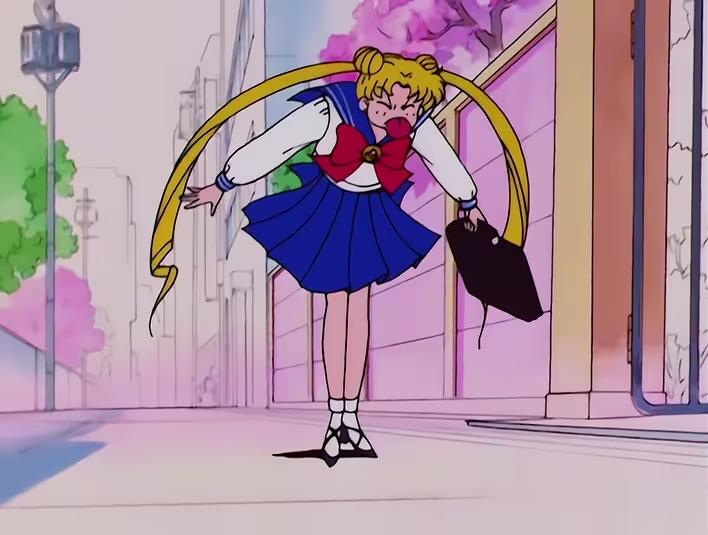
One of the most famous examples is Usagi Tsukino from Sailor Moon. At the beginning of the story, she is often late, falls, cries over her failures, and does not immediately manage her duties as Sailor Moon. At the same time, Usagi gradually matures and shows determination in truly important moments. Her clumsiness does not disappear completely, but it stops defining her entire character.
Miyuki Takara from Lucky Star shows a different variant of the type. She is smart, well-mannered, well-read, and does well in school, but she remains clumsy and prone to minor domestic mishaps. Her character particularly demonstrates that a dojikko is not synonymous with an unintelligent heroine.
The traits of this type are also present in Mikuru Asahina from The Melancholy of Haruhi Suzumiya. She is shy, easily flustered, and often finds herself in awkward situations. However, her helplessness is not only related to clumsiness but also to the pressure from Haruhi, so Mikuru's character should not be reduced solely to dojikko.
The term is primarily used for female characters, although a clumsy and charming character due to their blunders can be of any gender. The writing ドジっ子 does not itself limit the word to girls, but in the context of anime and manga, dojikko is most often imagined as a female image.
Dojikko is easily recognizable by falls, broken cups, and constant apologies. But these external signs only work when they are backed by character. A successful heroine does not just create chaos time and again — she tries, cares about her own mistakes, and continues to act even when everything goes wrong again. It is this persistence that makes her clumsiness not annoying, but endearing.
Like it?React
🧵
This post doesn't have any additions from the author yet.