This content has been automatically translated from Ukrainian.
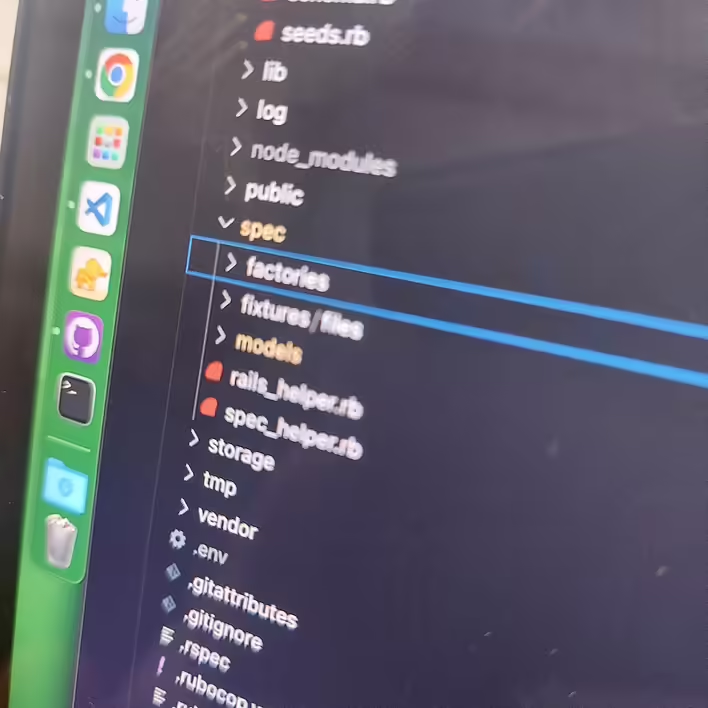
If you are developing an application using Ruby on Rails, you are probably already familiar with testing using RSpec. But every time you open the spec_helper.rb and rails_helper.rb files, you might wonder: why are there two of them and how do they differ?
spec_helper.rb: the foundation for testing
This file is the basic configuration for RSpec. Its purpose is to provide minimal settings for tests. Ideally, spec_helper.rb should not depend on Rails. Simply put, it is a file that contains basic settings for RSpec, namely:
- Test visualization: you can specify how the test results will look in the console (for example, a progress bar).
- Loading additional utilities: you can import special libraries into the file, such as Faker, FactoryBot, or custom helpers for tests.
- Debugging: enabling detailed logging mode or integrating with pry for debugging during testing.
This file is useful if you need to test individual Ruby classes or methods that do not depend on Rails. Using only spec_helper.rb allows tests to run faster, as Rails is not loaded.
rails_helper.rb: integration with Rails
rails_helper.rb is based on spec_helper.rb but adds Rails-specific settings. Among them:
- automatic loading of Rails;
- integration with ActiveRecord for database operations in tests;
- loading helper modules for testing controllers, models, and views.
This file is often used for tests that depend on Rails functionality. For example, testing models with validations or controllers with database queries requires loading rails_helper.rb.
What and when to include?
- Use spec_helper.rb when testing logic that is not related to Rails. This can be regular Ruby classes, modules, or helper modules.
- Use rails_helper.rb when your tests depend on the Rails environment.
In large projects, it is important to minimize the load on the testing process (speeding up tests on CI and reducing resource usage costs). If you always use rails_helper.rb, even for simple tests, the test execution time increases. On the other hand, too frequent separation can complicate setup. Therefore, it is worth combining flexibility and performance by carefully choosing between these files depending on the tasks.
Like it?React
🧵
This post doesn't have any additions from the author yet.



![[Fix] Factory not registered: "user" (KeyError) (FactoryBot / Rails 7)](https://cdn.tseivo.com/gyxl720efgaf5xep8a661gf5w5th)






![[Fix] Heroku / SearchBox addon - indexing error "The client is unable to verify that the server is Elasticsearch"](https://cdn.tseivo.com/m448ldh0z3jg07nqvkzqasw9g4nv)