RDBMS (relational database management system / relational database management system) — is software that allows you to create, manage, and interact with relational databases. In relational databases, information is organized into tables, which consist of rows and columns. Each row in a table represents a separate record (or data row), while the columns contain properties or fields that characterize this record. The foundation for RDBMS is the relational data model proposed by mathematician Edgar F. Codd in 1970.
The relational model is based on the concept that all data should be represented in the form of tables (also called relations, but personally I have not encountered the use of these terms in everyday language). This allows for the storage of large volumes of information in a structured form, using relationships between tables. Relationships are created using keys — for example, using a primary key (a unique identifier for each record) and a foreign key (a reference to the primary key of another table).
One of the key features of RDBMS is support for SQL (Structured Query Language). SQL is used for querying the database, manipulating data (adding, updating, deleting), as well as managing the structure of the database. For example, using SQL, you can obtain a list of all students who passed the exam or update the addresses of all clients who changed their place of residence.
When it comes to examples of RDBMS, the most well-known systems are MySQL, PostgreSQL, Oracle Database, and Microsoft SQL Server. All of them have their own features but operate based on the same relational data model.
The use of RDBMS is extremely beneficial when working with large volumes of data, maintaining relationships between different types of information, and ensuring its integrity and consistency. Thanks to relational databases, you can quickly search for the necessary information, easily change the data structure, and maintain a high level of organization.
One of the key concepts in RDBMS is transactions. A transaction (atomic transaction) is a group of operations on the database that are executed as a single unit. This is important for ensuring the reliability of the system, as it guarantees that even in the event of an error, all changes will either be successfully completed or rolled back.
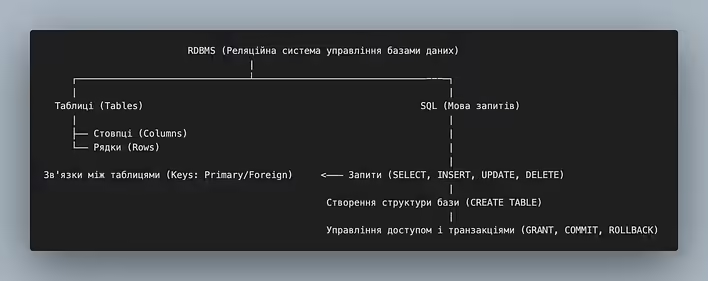
Simplified RDBMS Operation Diagram
In the image, I tried to depict the interaction scheme between RDBMS, SQL, and tables
Спрощенна схема роботи RDBMS
RDBMS is the foundation that enables working with relational databases.
Tables in RDBMS contain columns (data attributes) and rows (individual records).
SQL is the language used to interact with RDBMS. It is used to perform queries for selection, insertion, updating, and deletion of data, as well as to manage the structure of the database and access to it.
We will discuss Primary and Foreign keys in a separate post.











![[Fix] Factory not registered: "user" (KeyError) (FactoryBot / Rails 7)](https://cdn.tseivo.com/gyxl720efgaf5xep8a661gf5w5th)