This content has been automatically translated from Ukrainian.
What are toponyms?
Toponyms are unique witnesses of history, geography, and human culture. They surround us everywhere: the names of cities and villages, rivers and lakes, mountains, fields, forests, and even streets. This word comes from the Greek "τόπος" – place and "ὄνομα" – name, meaning "names of places".
Toponyms in Ukraine: History, significance, and uniqueness
Ukraine is a country with a rich history, reflected not only in architecture or traditions but also in toponyms. The names of cities, villages, rivers, mountains, lakes, and even localities are the key to understanding historical changes, cultural diversity, and the ethnic composition of our state.
The history of Ukrainian toponyms
The toponyms of Ukraine have formed over millennia under the influence of many peoples who inhabited its territory: the Trypillians, Scythians, Slavs, Greeks, Tatars, Lithuanians, Poles, Austrians, Russians, and others. Each of these peoples left their mark, which is today reflected in the names of places.
- Scythian and Sarmatian period. Many rivers and natural objects have retained names from the times of the Scythians and Sarmatians. For example, the Dnipro was once called Borysthenes, and the Dniester – Tiras.
- Kievan Rus. During this period, many oikonyms (names of populated places) with Slavic roots were formed, such as Kyiv, Chernihiv, Pereiaslav.
- Tatar-Mongol influence. In southern Ukraine, names of Turkic origin appeared, such as Crimea, Bakhchysarai, Akkerman (now Bilhorod-Dnistrovskyi).
- Polish-Lithuanian era. Western Ukraine is rich in toponyms of Polish and Lithuanian origin, for example, Lutsk (from the Lithuanian "lukšis" – meadow).
- Austrian and Hungarian influence. In Transcarpathia and Bukovina, names from Austro-Hungarian times have remained, for example, Uzhhorod (from Hungarian "Ungvár" – fortress over the Uzh River).
Geographical classification of toponyms in Ukraine
-
Oikonyms (names of populated places).
- Kyiv. The name of the city comes from the name of one of the founding brothers, Kyi.
- Lviv. The city is named after Lev, the son of King Daniel of Galicia.
- Zaporizhzhia. The name indicates the geographical location beyond the rapids of the Dnipro.
-
Hydronyms (names of rivers, lakes, seas).
- Dnipro. Likely originates from the Scythian "Danapris" – deep river.
- Southern Bug. The name "Bug" has Slavic roots, and the adjective "Southern" is added to distinguish it from the Western Bug.
- Synevyr. The lake is named after the legend of the lovers Syn and Vyr.
-
Oronyms (names of mountains and highlands).
- Carpathians. The name has ancient Greek origins, where the word "karp" means "rock".
- Hoverla. Comes from the Hungarian "Hóvár" – snowy peak.
-
Chronyms (historical-geographical regions).
- Podillia. The name means "land in the lowland" (from the word "podil").
- Polissia. The territory covered by dense forests (from "forest").
- Galicia. Associated with the city of Halych, whose name comes from the word "halytsia" (salt mine).
The significance of toponyms for the history and culture of Ukraine
Ukrainian toponyms reflect not only geography but also national identity, linguistic heritage, and cultural memory.
-
Reflection of ethnic diversity.
- Villages with Tatar names in the south and Crimea (Bakhchysarai, Karasubazar).
- Polish names in the west (Zhovkva, Peremyshl).
- Greek names in the Black Sea region (Odesa, Kherson, Olbia).
-
Preservation of historical memory.
- The name Kamianets-Podilskyi reminds of its history as a fortress on rocky land.
- Slavutych received its name in honor of the ancient name of the Dnipro.
-
Political changes.In the 20th-21st centuries, many names in Ukraine changed due to political processes. During decommunization, historical names were restored to many cities:
- Dnipropetrovsk → Dnipro.
- Kirovohrad → Kropyvnytskyi.
- Artemivsk → Bakhmut.
Interesting facts about Ukrainian toponyms
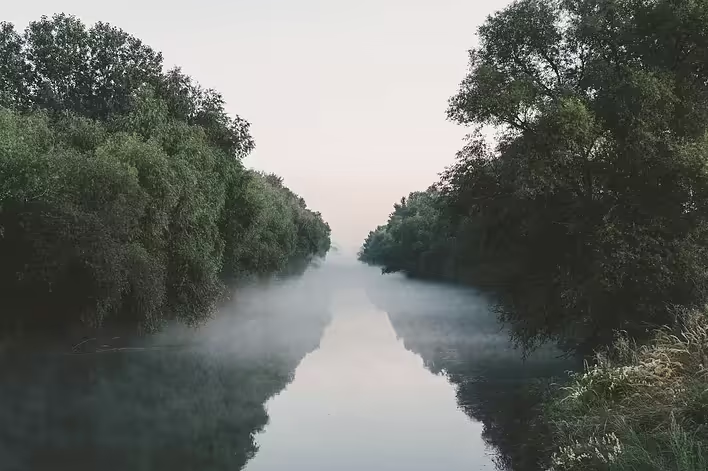
- A river with a female name. Desna is a rare example of a hydronym associated with tenderness and beauty.
- The most common village name. In Ukraine, there are several dozen villages named Mykhailivka, Ivanivka, or Novoselytsia.
- Legends in names. Lake Svitiaz in the Volyn region got its name due to a legend about a submerged city.
Challenges of modernity: new toponyms
In modern Ukraine, the process of creating toponyms continues. New residential areas, city streets, parks, and districts are named to reflect cultural identity. For example, a street named after Roman Shukhevych has appeared in Kyiv, and many cities now have streets named after the Heroes of the Heavenly Hundred.
Like it?React
🧵
This post doesn't have any additions from the author yet.