This content has been automatically translated from Ukrainian.
Sometimes the candle burns only around the wick, while a thick layer of solid wax remains along the walls of the container. With each lighting, the indentation becomes more noticeable, the wick sinks lower, and the candle begins to resemble a small crater. This uneven burning is called tunneling.
The problem is not just in appearance. During tunneling, a significant amount of wax remains unused, the flame gradually weakens, and the aromatic candle spreads its scent less effectively. In a deep pit, the flame may also lack air, causing it to flicker, smoke, or even go out completely.
Why does the candle burn only in the middle
Most often, a tunnel forms when the candle is extinguished too quickly. The flame only manages to melt a small circle around the wick, while the edges remain solid. During the next lighting, the heat again concentrates inside this indentation, causing the pit to gradually deepen.
The first burn is especially important. It is desirable for the top layer of wax to melt almost to the walls of the container before the candle is extinguished. If this does not happen, a ring of solid wax often remains on the surface, which is commonly referred to as a "memory ring."
However, the candle owner is not always to blame. The cause may be an improperly selected wick — for example, one that is too thin for the diameter of the container or the specific wax composition. A small flame simply does not emit enough heat to melt the entire surface. The type of wax, the amount of fragrance composition and dye, the shape of the container, and the wick's placement also affect the burning. If a new candle forms a deep pit even after a sufficiently long burn, the problem is likely in its design.
Does wax really have memory
The phrase "wax remembers" should not be taken literally. Wax does not retain information about previous burns. It is merely a figurative term for a process that gradually reinforces itself.
After a short burn, an indentation remains in the center of the candle. The next time, the wick is positioned lower than the edges, and the wax walls partially enclose the flame. Heat concentrates inside the formed tunnel, causing the center to continue melting while the edges remain cooler. The deeper the pit, the harder it is to level the surface.
Thus, "wax memory" is not a separate property of the material, but a consequence of the shape the candle has taken after previous lightings.
How long should the first burn last
A common guideline is approximately one hour of burning for every 2.5 centimeters of the candle's diameter. For example, a candle about 7.5 centimeters wide may take up to three hours for the wax to melt almost across the entire surface.
However, this is just a guideline, not a universal formula. First and foremost, the manufacturer's instructions should be followed. Typically, candles are not recommended to be left burning for more than four hours at a time. Before reusing, it should cool completely.
It is not advisable to extend the first burn indefinitely in an attempt to melt the wax all the way to the walls. If only a narrow area around the wick remains melted after the recommended time, it is likely not suitable for the size of the candle.
Before each lighting, the wick is usually trimmed to about 5–6 millimeters. A wick that is too long can create a large unstable flame, smoke, and excessively heat the container. At the same time, it should not be cut too short: a weak flame will have a harder time melting the wax, and the wick itself may drown.
How to fix tunneling with foil
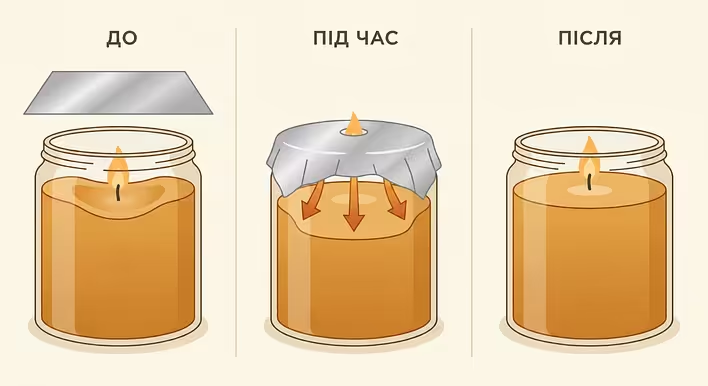
A shallow pit can often be leveled using aluminum foil. It retains some heat above the surface of the candle and helps melt the wax near the walls.
A strip of foil is wrapped around the top of the container, and its edges are bent slightly inward, forming a sort of dome. A wide opening must be left in the center for the flame and free access to air. The foil should not touch the wick, hang directly over the flame, or cover the opening of the container.
The candle is placed on a flat heat-resistant surface, lit, and monitored continuously. When the top layer of wax melts and the surface levels out, the candle is extinguished, the foil is allowed to cool slightly, and then it is carefully removed.
It is not advisable to tightly cover the candle with foil to speed up the process. This can restrict air access and lead to excessive heating of the wax and container. If the glass becomes very hot, the flame smokes, noticeably increases, or approaches the foil, the candle should be extinguished immediately.
The foil method is not universal. If the manufacturer prohibits covering the candle or the container has an unusual shape, it is better not to experiment.
When tunneling is already difficult to fix
It is best to correct tunneling while the pit remains shallow. If the wick is at the bottom of a narrow tunnel, barely protruding above the wax, or constantly goes out, simple warming may not be enough. Sometimes, part of the wax around the wick is carefully removed after the candle has completely cooled, but this only gives the flame more space and does not eliminate the problem of an improperly selected wick.
Even if the surface has been leveled, the candle may start tunneling again. If this occurs after each lighting, it is most likely that the cause is not in the usage method, but in the design of the candle itself.
Do not attempt to restore a candle with a cracked, chipped, or deformed container. Similarly, usage should be stopped when about 1–1.5 centimeters of wax remains at the bottom. If the flame gets too close to the bottom, the container may overheat.
Why you should not overheat the container
The advice to "let the candle burn until all the wax melts" has an important limitation. Prolonged burning heats not only the wax but also the container itself. Even heat-resistant glass is not immune to damage from excessive or uneven heating. It is especially dangerous when the wick has shifted to the side and the flame is close to the wall.
The candle should not be moved while the wax is liquid, left unattended, or placed near drafts and flammable objects. The container should be on a flat heat-resistant surface. If the manufacturer specifies a maximum duration for a single burn, it should not be exceeded even for the sake of correcting tunneling.
Even burning depends on several factors: the duration of the lighting, the size and placement of the wick, the wax composition, and the temperature of the container. If the candle stubbornly burns with a pit under normal usage, it is not necessarily your fault — sometimes it is simply poorly made.
Like it?React
🧵
This post doesn't have any additions from the author yet.