This content has been automatically translated from Ukrainian.
Everyone sooner or later faces a situation where welding is needed: the fence has rotted, the metal gate has become loose, or the chair has broken in such a way that it can't be fixed with a regular bolt. In our case, it was a broken fence bracket and a few rotted sections that were no longer suitable for current repairs with makeshift materials. We also wanted to repair the supports for the grapes, the barbecue…
In short, we were a bit shocked by the price quoted by the master for the repair, as with just a little more money, we could buy a new welding machine. So we decided that it was better to invest once in equipment that would be useful in the future, opting to purchase a welding inverter for home and cottage minor needs.
Before rushing to buy, we decided to figure out what this device is and how to choose the right one.
What is a welding inverter?
A welding inverter is an electrical device used to join metal parts using a high-temperature electric arc. The principle of what we call “welding” is nothing more than converting alternating current to direct current and forming a welding arc. It has a sufficiently high temperature that melts metals and allows them to be joined. Unlike old transformers, inverters are lightweight, compact, and economical. They consume less electricity, provide a stable current even during voltage fluctuations, and are easy to transport. For us, this was a significant plus, as the voltage often “jumps” at the cottage.
A welding inverter is primarily about compactness. It is lightweight, economical, easy to master, and use further. It also provides a stable current even during voltage fluctuations. For us, this was a significant plus, as the voltage often “jumps” at the cottage.
To jump ahead, it's worth mentioning that two to three days and a few ruined parts and electrodes are enough to weld the rotted gates reasonably well and without slag :)
Where did we start?
We googled the specialized site Svarcentr, which has a large selection of inverters. There we learned about the main types of devices and their characteristics. If you need it, here’s the link to them: https://svarcentr.com.ua/59-svarochnye-invertory.
Here’s what we managed to figure out:
There are several types of welding inverters:
- MMA (manual arc welding): works with electrodes;
- TIG: uses a non-melting electrode and protective gas; ideal for delicate metals such as aluminum, but more complicated to use;
- MIG/MAG: fast and convenient for large volumes of work, works with wire in a gas environment. Suitable for large projects and quick welding.
For home use, the best option is MMA inverters, as they are easy to master and affordable.
What parameters to consider when choosing?
Current strength. For thin metals, 120-160 A is sufficient. For thick structures, it is advisable to choose devices with a power of 200 A and above.
Cooling type. Forced cooling of the inverter increases the duration of operation, so it makes sense to consider models with a built-in cooler. It is also practically impossible to find inverters without a built-in cooler nowadays.
Power supply voltage. Some models work even at 160-180 V, which is important for suburban or cottage houses with unstable electricity.
Weight and dimensions. Inverters are lightweight (3-8 kg), which is convenient for transportation. Such a device easily fits in the trunk of an average sedan along with all the wires, a pack of electrodes, and a “chameleon” helmet. + a toolbox and a bunch of metal pieces.
Additional features. We were highly recommended models with “Hot Start” options for easy arc ignition and “Anti-Stick” to prevent electrode sticking.
Which device did we choose?
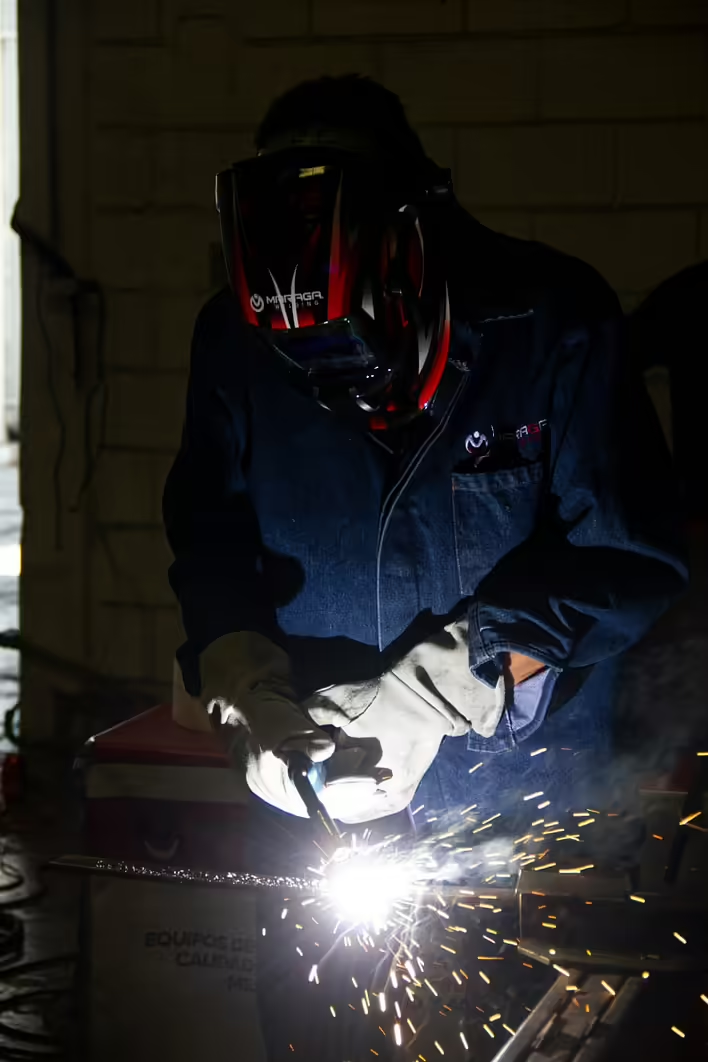
After lengthy comparisons, we settled on a model with medium power (120 A), which is perfect for home use. An important factor was the weight of the device, as it is inconvenient to carry heavy equipment from place to place. We also purchased electrodes and a protective “chameleon” mask, as safety comes first. Now we will learn welding and perhaps share our experience in future blog posts.
Like it?React
🧵
This post doesn't have any additions from the author yet.