This content has been automatically translated from Ukrainian.
Modern water heaters have become a popular choice among residents of small apartments. They are also a practical choice for country houses or cottages, especially when there is no access to gas or centralized hot water supply.
Thanks to their compactness and energy efficiency, a heater can provide comfortable hot water usage even in spaces with limited room. One of the most common options is the 50 l heater. It can meet the household needs of one or two people, taking up minimal space and ensuring a constant supply of hot water.
Heaters with a volume of 30 to 60 liters usually have compact dimensions. They can be easily installed in a bathroom, kitchen, or even in a storage room. They are indispensable where it is important to save every square centimeter of usable space.
Modern models are equipped with insulation systems that minimize heat loss. This helps reduce electricity consumption, which is already not always sufficient in the conditions of a full-scale war.
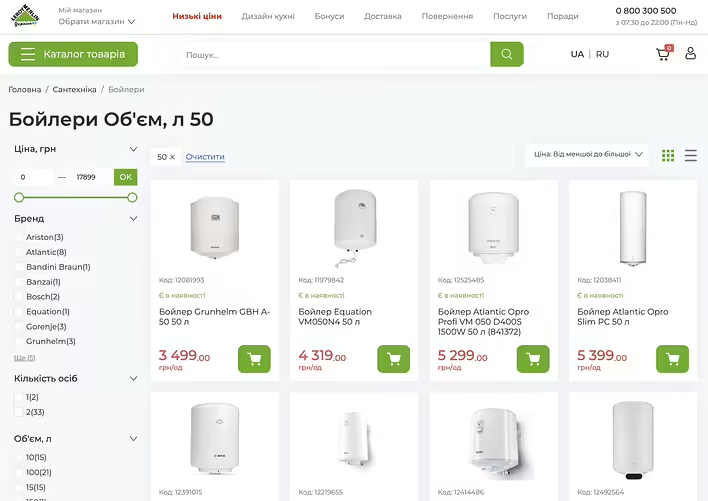
What parameters should you pay attention to when choosing a heater?
- number of heating elements
- type of heating element
- tank material
- shape of the heater
- type of thermostat
- power.
Now let's take a closer look at each parameter and consider the possible pros and cons.
Number of heating elements
- One heating element. Advantages: economical option for a small budget, lower energy consumption. Disadvantages: longer heating time, limited adjustment options.
- Two heating elements. Advantages: quick water heating, ability to operate in economy mode (the option to turn on only one heating element). Disadvantages: higher electricity consumption, higher price.
Type of heating element
- Wet. Guarantees effective and quick water heating, but is prone to scale formation and is very sensitive to hard water. The harder the water, the shorter its lifespan.
- Dry. Among the advantages is that it is insulated from contact with water, which eliminates the factors of corrosion and scale. However, the downside is the price of such heaters. It is higher than that of models with wet heating elements.
Tank material
- Stainless steel. Such a tank is durable and resistant to corrosion. However, over time (actually a very long time), there is a risk of cracks appearing at the weld seams.
- Enamel tank. Also durable, cheaper than others in its segment. However, if such a tank is subjected to sharp temperature fluctuations, there is a risk of cracks in the enamel.
- Glass-ceramic. This tank has the highest thermal insulation compared to stainless steel and enamel. However, it is the most expensive in the segment and sensitive to mechanical damage, especially impacts.
Shape of the heater
- Vertical heater. These are compact models, most often chosen and produced in mass. The downside is that they require more height space.
- Horizontal heater. Advantages: ideal for limited space under the ceiling. Disadvantages: may take up more width space.
Type of thermostat
- Mechanical. Advantages: easy to use, durable. Disadvantages: less accuracy in adjusting the required water temperature.
- Electronic. Advantages: precise temperature setting. Disadvantages: more expensive to repair and maintain.
So, what do we have in summary: heaters are easy to install, and their maintenance consists of regular cleaning of the internal tank and checking the anode protection. However, one of the biggest advantages of this water heating technology is keeping water hot for a long time. Because despite all modern technologies, a heater is essentially a large thermos. Even when the power is off, there remains a reserve of hot water in the tank for use. This makes heaters indispensable in conditions of power outages.
Like it?React
🧵
This post doesn't have any additions from the author yet.




![[Personal Experience] Electric Kettle and EcoFlow River 2 Pro](https://cdn.tseivo.com/1pwkxgsba3505v6h0u1qzjo5izfw)
![[Personal Experience] Refrigerator and EcoFlow River 2 Pro](https://cdn.tseivo.com/1r0v5gpwhp1vxvrr9n27zjkb1hwu)