I have previously published several posts about EcoFlow in this blog. Currently, due to power outages ^_^ these posts have become quite relevant and are the most visited:
In this post, I want to describe my very amateur test of the EcoFlow River 2 Pro and the Whirlpool w7x 82i ox refrigerator. I warn you right away, I have no measuring devices, and the figures provided are purely my experience and may vary significantly depending on the conditions.
Input data:
Whirlpool w7x 82i ox refrigerator
Refrigerator (upper compartment and freezer) filled with products (already cooled)
The upper compartment is set to the coldest mode - 4 degrees (for example, at 8 degrees, the figures may be different)
100% charged EcoFlow River 2 Pro (European version at 220 volts)
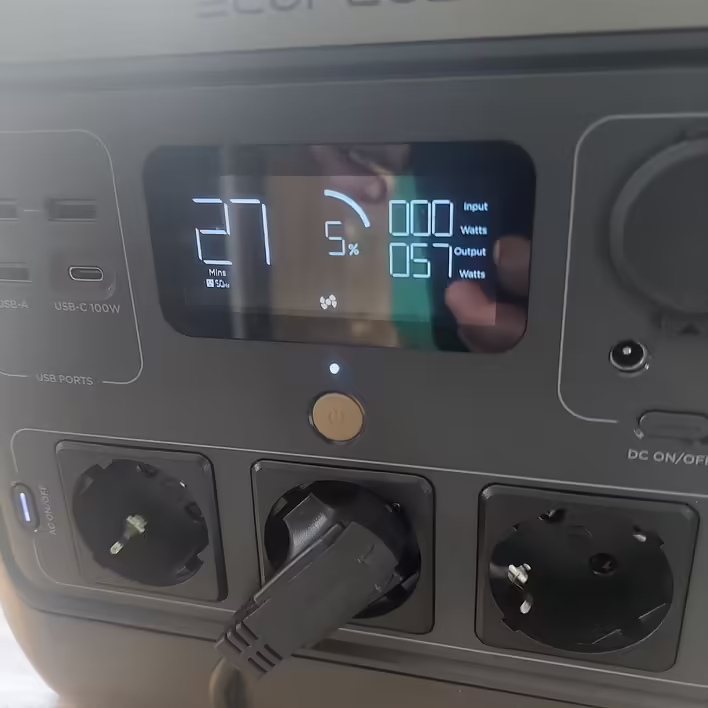
I simply connected the refrigerator to the EcoFlow, measured the time until the battery discharged to 5%. Out of pure curiosity, let's calculate how much this refrigerator A++ should consume in watts per hour.
Було б непогано, якшо б так було постійно ^_^
How much does the refrigerator consume in watts?
Specifications say that the consumption of this refrigerator is 253 kWh/year. Yes, the consumption of refrigerators is stated per year.
How many hours do we have in a year?
365 * 24 = 8760 hours
Average electricity consumption of the refrigerator per hour
According to the specifications - 253 kWh or 253,000 watts. We divide the consumption by the number of hours in a year and get the average consumption:
253,000 / 8760 = 28.88 watts
So if we believe the documentation - the refrigerator consumes ~29 watts on average per hour. Sometimes more, sometimes less. Average, well, you get it. But the specifications do not clarify at what mode these 253 kWh were measured. Because at 4 degrees, I have completely different readings.
Starting current
By the way, when choosing a charging station, do not forget about the starting current needed for the refrigerator to operate.
Starting impulse (or starting current) is a temporary significant increase in the electric current consumed by the electric motor or compressor at the moment of its start. This phenomenon is characteristic of electric motors, especially those used in refrigerators, air conditioners, and other devices with motors.
The duration of the starting current is usually very short — from a few milliseconds to a few seconds. The value of the starting current can be several times (usually from 5 to 10 times) greater than the working current. This is because the motor or compressor requires more power to overcome inertia and start moving.
For a household refrigerator, the working current of the compressor can be 1 A, while the starting current can reach 5-10 A. This means that at the moment of starting the compressor, the power consumed increases significantly, requiring appropriate electrical protection and a stable power source. A little Ruby code to illustrate how starting power is calculated in watts:
U = 220  # Supply voltage in Volts

# For starting current of 5 A
I_start_5 = 5  # Starting current in Amperes
P_start_5 = U * I_start_5  # Starting power in Watts
puts "P_start_5 = #{P_start_5} W"  # P_start_5 = 1100 W

# For starting current of 10 A
I_start_10 = 10  # Starting current in Amperes
P_start_10 = U * I_start_10  # Starting power in Watts
puts "P_start_10 = #{P_start_10} W"  # P_start_10 = 2200 W
Finding such specifications for my model of refrigerator online is not so easy. Let's assume that the starting power in watts is less than 1600 watts (this is the X-Boost model of EcoFlow River 2 Pro), because the refrigerator started... Perhaps some specifications are written on the compressor or somewhere, but I don't really want to pull out the refrigerator right now.
Powering the refrigerator with EcoFlow River 2 Pro
To be honest, I expected to see the starting power on the display of the charging station when connecting the refrigerator. But that didn't happen. Let's ask the expert's opinion, namely ChatGPT:
Does the refrigerator need starting current if it was turned on 5 minutes ago?
Yes, even if the refrigerator was turned on 5 minutes ago, the starting current will still be necessary when restarting the compressor. Here’s why:
Compressor cycle: Refrigerators operate in a cyclical mode. When the temperature inside the refrigerator reaches a set level, the compressor turns off. When the temperature rises, the compressor turns back on. Each time the compressor starts, it requires starting current to begin operation.
Compressor inertia: With each start, the compressor has to overcome its mechanical inertia. This requires additional energy, which manifests as starting current.
System discharge: After the compressor is turned off, the pressure in the cooling system is evenly distributed. During a restart, the compressor must create pressure in the system, which also requires additional energy.
Even after a brief shutdown of the compressor, it will again need starting current upon restart.
Having consulted with the robot, we return to my samurai path:
Disconnected the refrigerator from the network
Waited ~ 3 minutes
Connected to EcoFlow
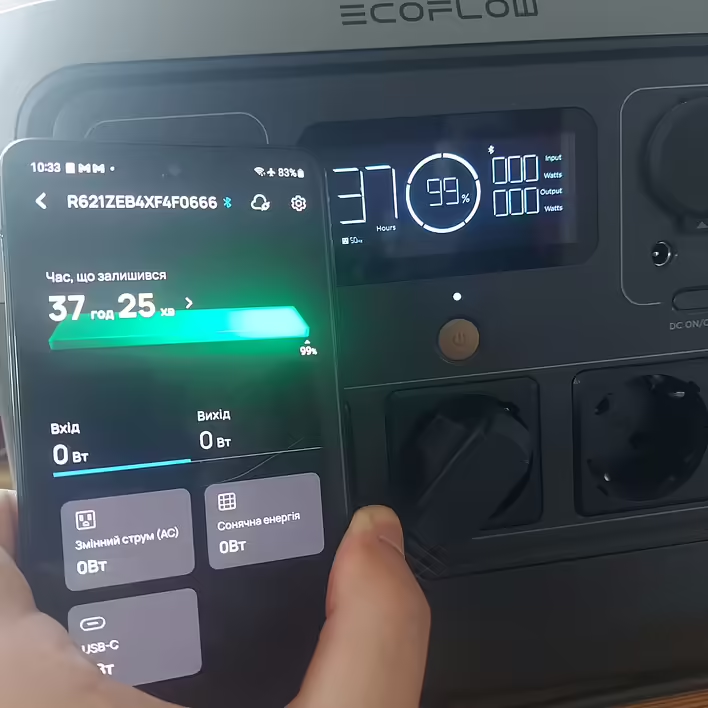
Saw the output indicator jump to 25 watts on the display of the charging station (expected to see X-Boost in action, but no)
Output dropped to 0 for 5-7 minutes
Then Output was 0 - 50 - 70 - 50 - 100 - 70 - 0 and so on
How long did the refrigerator run on the charge?
Зі 100% до 5% за вісім годин
I discharged the EcoFlow to 5% in 8 hours. So let's calculate. Assuming that the new station at 100% charge indeed has a capacity of 768Wh.I discharged 95% or 729 watt-hours.729 watt-hours / 8 hours of refrigerator operation = 91.1 watts per hour my refrigerator actually consumed.
Although after reading the specifications of the refrigerator I expected 28.88 watts per hour, the actual consumption is three times higher. But many factors can influence this:
Refrigerator mode (perhaps the specifications indicated electricity consumption at the first mode)
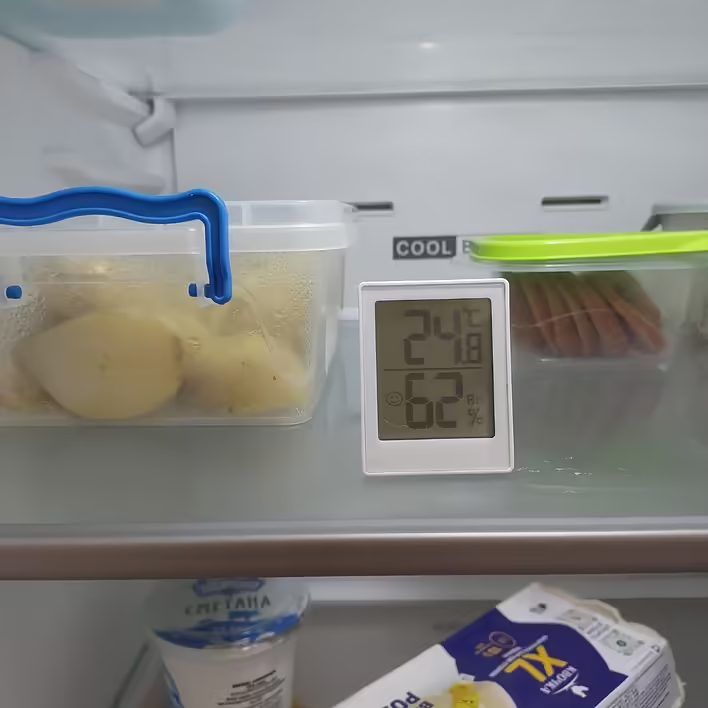
The room is quite hot. The thermometer shows 30 degrees (an abnormal heat wave in Ukraine). So the compressor probably needs more energy
Something else that I don't know
EcoFlow was almost constantly cooled by built-in fans (perhaps important for someone - it hums)
In winter, when it will be less hot in the kitchen, and switching the refrigerator to another mode, I expect less consumption. Perhaps I will add another post to compare.
But I can definitely say that I see no point in using charging stations with battery volumes less than 1kW. The refrigerator keeps cold for the same 8 hours without any problems. The official documentation for my model states:
Time for temperature rise in the freezer compartment from -18 to -9 in case of power outage (hours): 17Storage time at temperature in case of power outage (hours): 17
And to keep the cold even longer - use bottles with frozen water from the freezer or cold packs. There are already recipes circulating online for water and salt solutions that hold cold well (I need to test this, then I will recommend).
Conditionally, a bottle of ice is significantly cheaper and simpler than a charging station for this task. I recommend using charging stations for other devices. For example, drying your hair with a hairdryer in winter can be quite a critical issue.
![Post cover: [Personal Experience] Refrigerator and EcoFlow River 2 Pro](https://cdn.tseivo.com/1r0v5gpwhp1vxvrr9n27zjkb1hwu)
![[Personal Experience] Electric Kettle and EcoFlow River 2 Pro](https://cdn.tseivo.com/1pwkxgsba3505v6h0u1qzjo5izfw)



![[Personal experience] How to hang a swing on a metal pull-up bar?](https://cdn.tseivo.com/e76ifnqj90sapho8adacvm65sp43)