Recently, I encountered a situation like this. My rational beliefs suggested that the relationship with this person had no future, but unconscious emotional reactions made me return every time. I pondered for a long time why this happens, why we consciously hurt ourselves. We understand that certain relationships harm us, yet for some reason, we keep returning to them, as if caught in a vicious circle. I realized that this conflict is not uncommon and has deep psychological roots.
Cognitive Dissonance: The Conflict Between Thoughts and Feelings
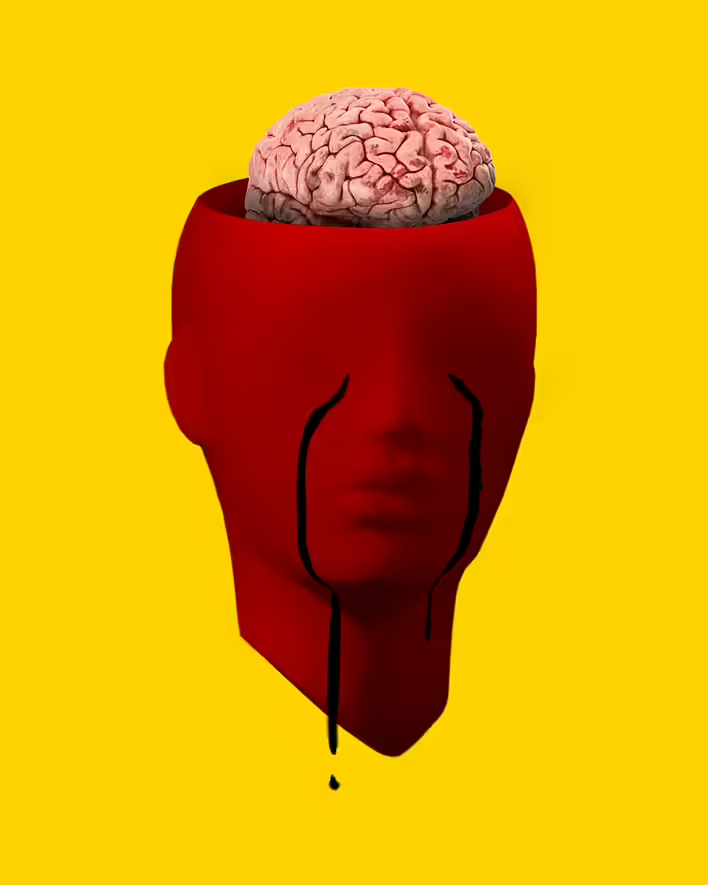
I found a scientific explanation for this — cognitive dissonance. It is a state of psychological discomfort that arises when two of our thoughts or beliefs contradict each other. On one hand, we have rational knowledge that this person does not meet our needs and that the relationship has no future. On the other hand, we feel strong emotions, attachment, and physical attraction. To reduce this dissonance, our brain tries to find justifications: “Maybe I can change her,” “It’s not as bad as it seems,” “My feelings are more important than logic.”
The Biology of Feelings: When Chemistry is Stronger than Reason
From a biological perspective, emotions often overpower rational thinking. When we are in love, our brain produces a whole cocktail of hormones, such as dopamine (the pleasure hormone) and oxytocin (the bonding hormone). These substances create a powerful “high” that we associate with the object of our feelings. Even when we know that the relationship is destructive, we subconsciously strive to recreate those pleasant feelings, pulling us back.
Deep Causes: The Influence of Childhood and Emotional Dependency
The first thing we can pay attention to is the behavior patterns from childhood. Our adult relationships are largely shaped in childhood. If we grew up in an environment where love was unstable or associated with drama, our brain might have learned that this is what “true” intimacy looks like. When we meet someone who replicates these patterns, we unconsciously feel familiar and “at home.” This is a tragic paradox: we are drawn to what is familiar to us, even if it causes us pain.
One reason we return to what harms us is emotional dependency. Just as people can be addicted to alcohol or gambling, we can be addicted to certain emotions. If our past was filled with emotional “roller coasters,” our brain becomes accustomed to such instability. In this case, calm, healthy relationships may seem boring or “wrong.” This habit makes us vulnerable to destructive relationships, as the brain perceives them as something familiar.
Why We Ignore Signals
Often, we idealize our partner, ignoring their flaws, and fall in love not with a real person but with an image we have created for ourselves. This illusion can be so strong that we are willing to ignore warning signals. Another reason is the fear of loneliness. Being alone with ourselves is much scarier for many than being in painful but familiar relationships. This fear pushes us to return to what is familiar, even if that “familiar” is a source of suffering.
How Not to Think About a Person You See Every Day
What to do if avoiding daily contact with a person is impossible? This significantly complicates the healing process, as their constant presence fuels emotions and prevents forgetting. In such a situation, it is necessary to work on creating psychological distance, even if physical distance is unavailable. Try to minimize personal communication, speaking only on the essentials. Consciously direct your attention to other people or work tasks. Use the “stop-thought” technique when you start thinking about this person, and switch your mind to another activity.
How to Break This Cycle
To break out of this vicious circle, one must take a step towards self-worth. The first step is full awareness and acknowledgment of the problem. Keeping a journal where you write down your feelings and rational arguments can help you see the situation from the outside. The second step is to focus on yourself. Direct your energy towards your own life: find activities that bring you joy, connect with supportive people. And perhaps consult a psychologist who can help you understand the reasons for your behavior. Remember, choosing yourself is not selfish. It is a necessary care for your mental health and happiness.
Share this post
Cite post
Select and copy the required citation standard:
This post doesn't have any additions from the author yet.