This content has been automatically translated from Ukrainian.
Rhythmic movements of the front paws are one of the most characteristic habits of domestic cats. They may knead a soft blanket, pillow, throw, or even their owner's knees, often accompanied by purring, half-closed eyes, and a completely relaxed posture. From the outside, this behavior looks almost like a kind of ritual that is repeated over and over.
For a long time, it was believed that this was merely a memory of early childhood when kittens pressed their paws on their mother's belly during feeding. However, modern studies of cat behavior suggest that things are much more interesting. This habit combines several natural mechanisms: early instincts, ways of marking territory, preparing a place for rest, relieving tension, and even aspects of social behavior.
That is why the same movement can mean very different things — from a complete sense of security to a desire to leave their scent in a favorite spot.
The first lesson near the mother
Even before kittens open their eyes, they already know how to knead their mother's belly.
During feeding, the little ones rhythmically press their front paws on the cat's mammary glands. Such movements stimulate milk production and help the kittens get more food.
In many mammals, the behavior of young animals disappears after they mature. In cats, some of these habits persist.
Biologists call this neoteny — the retention of certain juvenile traits in adulthood. Domestic cats demonstrate it quite often. For example, they meow significantly more than wild adult felines and often continue to "knead" with their paws, even though they have long stopped nursing from their mother.
That is why many cats start kneading a blanket or their owner's knees precisely when they feel the most calm and secure.
It's not just childhood memories
For a long time, it was thought that "kneading" was merely a remnant of kitten behavior. Today, researchers believe that the matter is somewhat more complex.
If it were only about childhood memories, all cats would behave the same way. In reality, some knead daily, others only occasionally, and some hardly ever do it at all.
Thus, this behavior has other functions that have developed in adult life.
Marking a place as their own
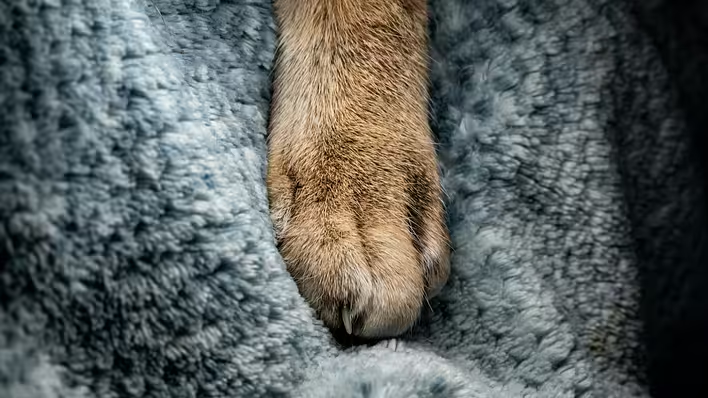
On the pads of a cat's paws are special scent glands.
Humans can hardly perceive their smell, but for other cats, it is an important source of information.
When a cat rhythmically presses its paws on a blanket, sofa, or other surfaces, it leaves its scent there. In this way, the animal seems to say: "It's safe here. This is a familiar place. It belongs to me."
That is why cats often knead those things they use most frequently: their favorite blanket, sleeping spot, armchair, or their owner's clothing.
Preparing a place for rest
In the wild, cats rarely lie down to rest directly on the ground.
Before settling down, they knead grass, leaves, or other vegetation. This helps make the surface smoother, remove small twigs, and ensure that there are no unwanted insects or other small animals nearby.
Domestic cats no longer need to do this, but the instinct remains.
That is why many pets actively knead a blanket or pillow for several seconds before finally settling down to sleep.
Sign of trust
Many owners worry when a cat starts kneading them.
In most cases, this is actually a very good sign.
During "kneading," the cat feels so calm that it allows itself to revert to behavior associated with the very first weeks of life.
If at the same time it is purring, slowly blinking its eyes, or even falling asleep nearby, it indicates a high level of trust in the person.
That is why many experts consider such behavior to be one of the signs of emotional comfort.
Why do some cats extend their claws?
Sometimes pleasant purring suddenly becomes painful — the cat starts to extend its claws.
This does not mean that it is angry or wants to scratch the owner.
During deep relaxation, the movements become more intense, and the claws may extend almost automatically. This is similar to how kittens push against their mother's belly during feeding.
If this causes discomfort, it is enough to place a thick blanket or soft throw on your lap. It is not worth punishing the cat for this — it is not trying to hurt you.
What if the cat sucks on the blanket?
In some cats, "kneading" is accompanied by sucking on the fabric.
This is most often observed in animals that were weaned from their mother too early or that experienced significant stress at a young age.
For most of these cats, this behavior remains a way of self-soothing. They seem to return to a familiar feeling of safety.
If the cat just suckles on the fabric a little and does not swallow it, there is usually no cause for concern.
However, if the animal starts to chew or swallow pieces of fabric, fur, or other materials, it is advisable to consult a veterinarian. Such behavior may be a sign of a disorder known as Pica.
Do all cats knead?
No.
Some do it almost daily, others only occasionally, and some hardly ever show such behavior.
This can be influenced by the animal's character, the conditions in which it was raised, early experiences, anxiety levels, and even breed. For example, in some eastern breeds, "kneading" and sucking on fabric occur somewhat more frequently, although such behavior can arise in any domestic cat.
The absence of this habit does not mean that the cat is less attached to its owner.
Can this be a sign of stress?
In most cases — no.
On the contrary, "kneading" is usually associated with a feeling of calm.
However, any behavior can become excessive. If a cat obsessively kneads the same thing for hours, combines this with constant sucking on fabric, suddenly changes its habits, or starts showing other signs of anxiety, it may indicate stress or health problems.
In such cases, it is advisable to consult a veterinarian or an animal behavior specialist.
Why this habit has hardly disappeared
Domestic cats have lived alongside humans for about ten thousand years, but many of their instincts have hardly changed.
They still mark territory with scents, hunt even on a full stomach, carefully investigate new objects, and retain certain juvenile forms of behavior.
"Kneading" is one of these habits. Once, it helped kittens get more milk, and it allowed the adult ancestors of domestic cats to prepare a place for rest. Today, this behavior has also become a way to express calm, trust, and a sense of security.
That is why, when a cat comfortably settles down nearby, starts purring, and rhythmically kneads with its paws, it is not just repeating an ancient instinct. Most often, it means that it feels so comfortable with you that it has returned to the safest place of its life.
Like it?React
🧵
This post doesn't have any additions from the author yet.