A car is not just a means of transportation, but also a complex technical product that combines engineering precision, comfort, and design. One of its most important components is the body, as it determines the car's appearance, functionality, capacity, and even driving character.
The types of passenger car bodies are classified by shape, number of doors, number of passenger seats, and purpose. The body determines how convenient it will be to use the car in the city, whether it is suitable for travel, and whether it can carry large volumes of cargo or passengers.
With the development of the automotive industry, a wide variety of bodies have emerged: from classic sedans and hatchbacks to practical station wagons, stylish coupes, and spacious minivans. Each of them has its own features, advantages, and disadvantages, and the choice of body type often depends on the lifestyle, needs, and preferences of the owner.
Now a bit of history and interesting facts.
The first car that is officially considered the first in the world was created in 1885 by the German engineer Karl Benz (Karl Benz).Bertha Benz, the wife of Karl Benz, made the first car journey in history in 1888 in this car — about 100 km. She repaired the car herself, bought fuel at pharmacies, and proved that the car could be useful in everyday life. During that trip from Mannheim to Pforzheim, she stopped in the town of Wiesloch (Wiesloch), where she went into a pharmacy and bought ligroin to refuel the car. That was the first automotive fuel. So what is ligroin?
Ligroin is a light fraction of petroleum, similar in composition to gasoline. It has a low boiling point (similar to gasoline) and evaporates easily. At that time, it was used as a solvent, so it was sold in pharmacies, particularly for cleaning stains from clothes.
Returning to the main topic — body types. They are classified by shape, number of doors, number of passenger seats, and functionality.
Types of bodies:
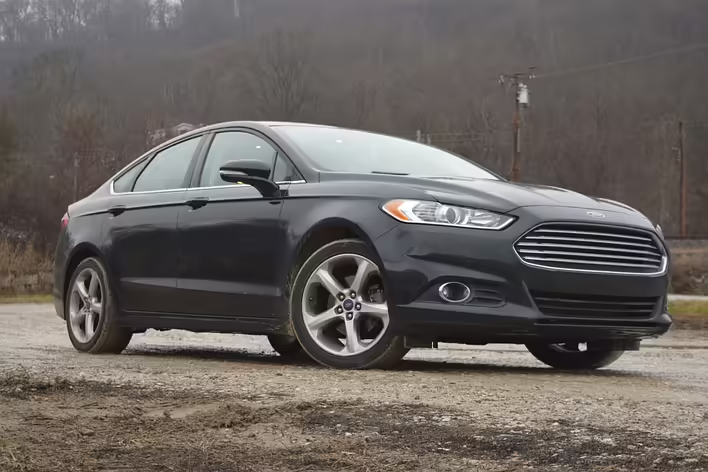
1. Sedan
4-door body with a separate trunk.
Usually has three compartments: engine compartment, passenger cabin, and trunk.
Popular for family use.
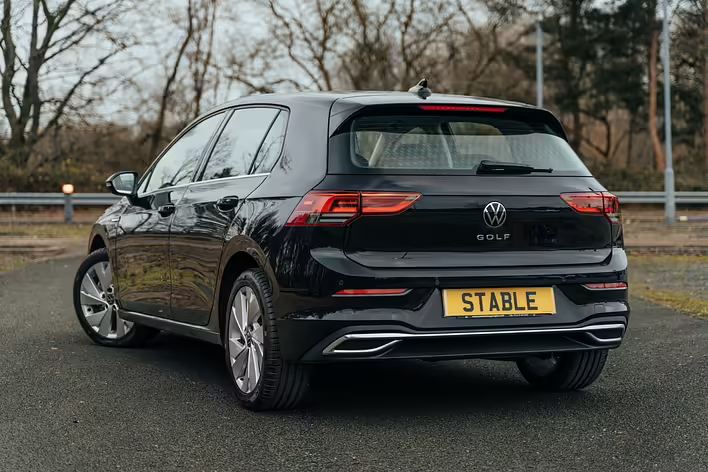
2. Hatchback
3 or 5 doors (including the rear hatch).
The trunk is combined with the cabin.
Compact and convenient in the city.
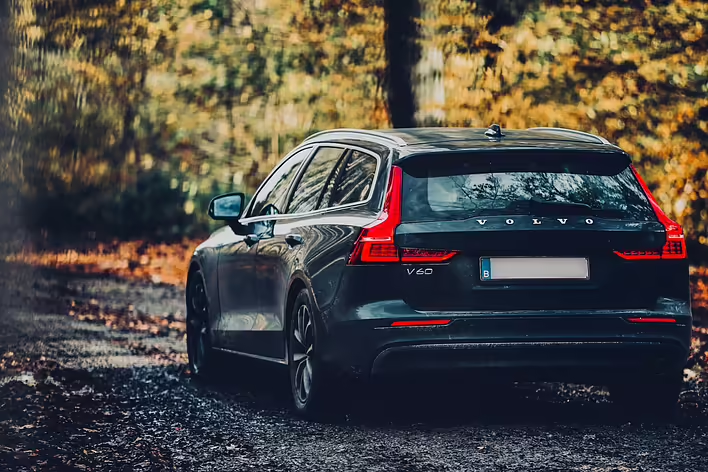
3. Station Wagon / Estate
Similar to a hatchback, but with an extended body and larger trunk.
Ideal for transporting a large amount of stuff.
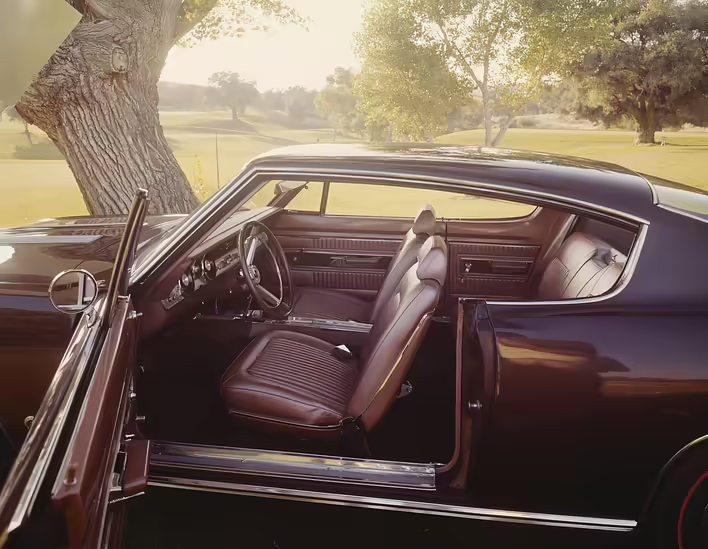
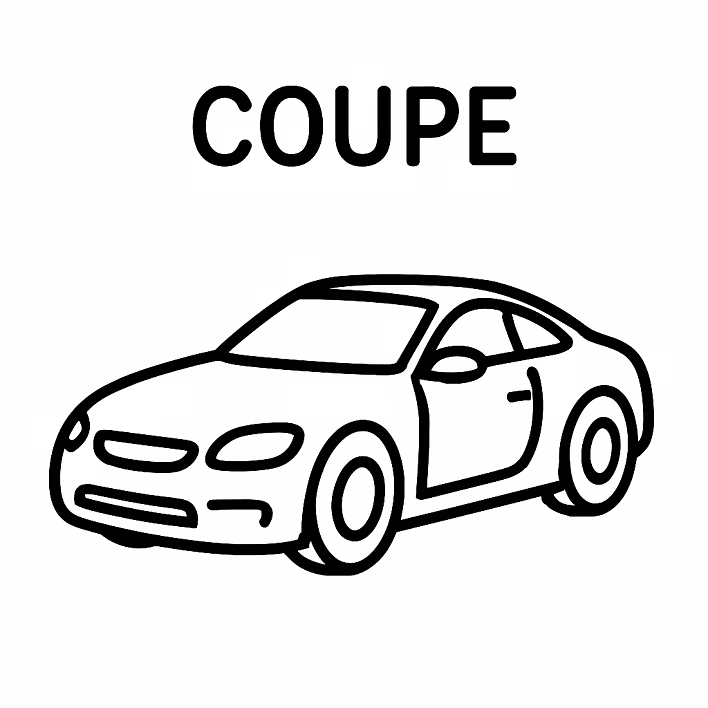
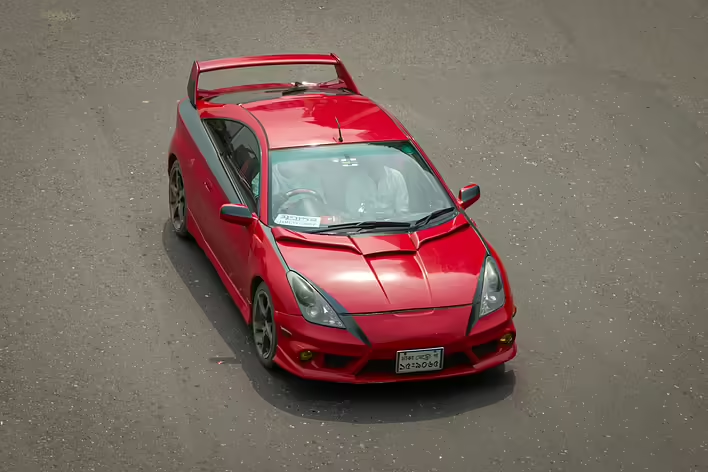
4. Coupe
2-door car with a sporty design.
Usually has 2 or 4 seats.
Less space in the back row.
5. Convertible (Cabriolet, Roadster)
A car with an open top (soft or hard roof).
Designed for the pleasure of driving, not for practical use.
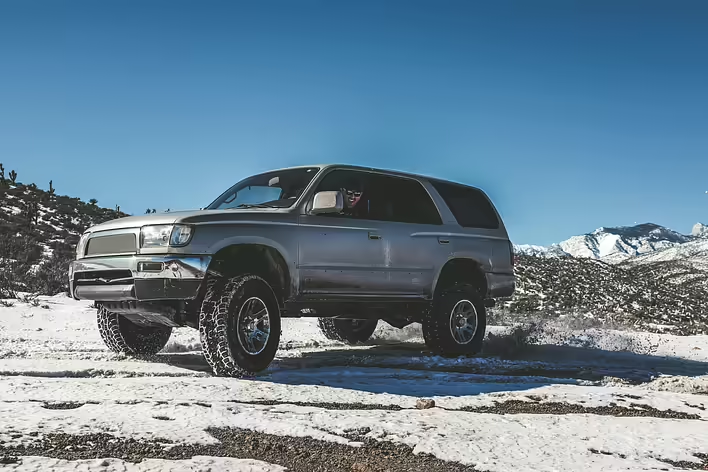
6. SUV (Crossover)
High ground clearance, increased dimensions.
Often has all-wheel drive.
Popular as a family car with increased off-road capability.
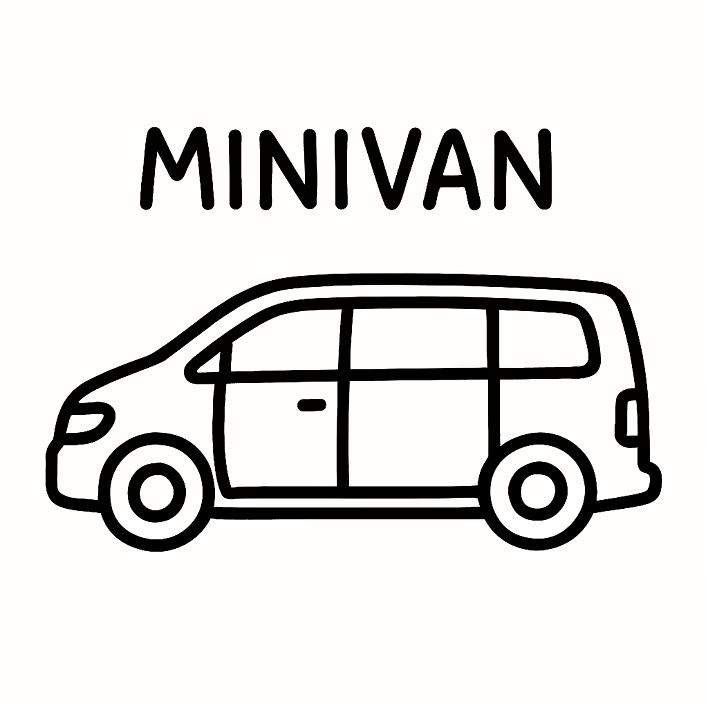
7. Minivan / MPV
Spacious cabin, often 7 seats or more.
Convenient for large families.
Sliding side doors are a common feature.
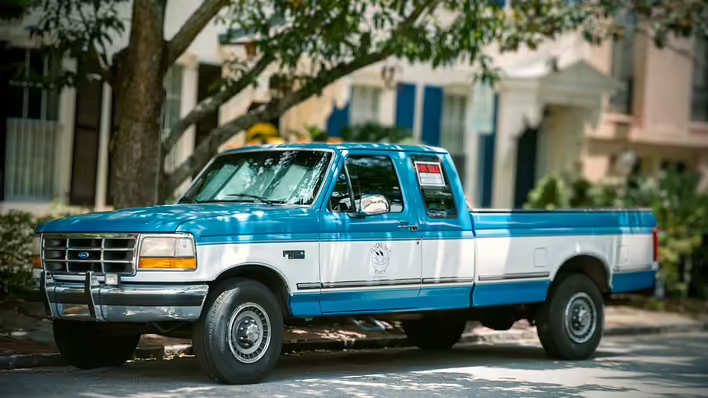
8. Pickup Truck
Body with an open cargo platform.
Often used for commercial purposes or active recreation.
9. Liftback
Similar to a sedan, but the rear opens together with the glass (like a hatchback).
Stylish appearance + convenient access to the trunk.
10. Fastback
Sporty body shape with a smooth transition from the roof to the trunk.
Similar to a coupe, but may have more doors.
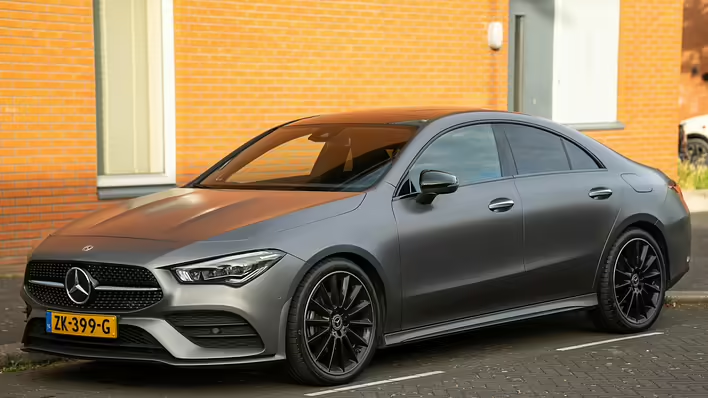
What is a sedan?
A sedan is a type of passenger car body with three separate compartments:
Front compartment — engine compartment.
Middle compartment — passenger cabin.
Rear compartment — trunk (with a lid, not a vertical door like in a hatchback).
Usually has:
4 doors
5 seats (sometimes 4)
History of creation:
1910–1920s The name "sedan" comes from the Italian word "sedia" — "chair," which hints at the comfortable seating inside. The term first appeared in the USA in the 1910s to describe a passenger car with a rigid roof and a fully enclosed cabin.
1920–30s: Sedans became popular among affluent buyers due to comfort and protection from the elements. They were also valued for privacy compared to open cars.
Post-war era (1940–60s) Sedans dominated the market. Manufacturers like Ford, Chevrolet, Mercedes-Benz, Peugeot, and others offered dozens of models specifically in the sedan body.
1990–2000s Peak popularity: practical, spacious, elegant. For example: Toyota Camry, BMW 5 Series, Mercedes E-Class, Volvo S70.
Present (2020–2025) Despite the growing popularity of crossovers and SUVs, sedans remain in demand due to their aerodynamics, fuel efficiency, and premium appearance.
Examples of popular sedans
🔹 Economy class:
Toyota Corolla
Honda Civic
Hyundai Elantra
Skoda Octavia
🔹 Business class:
Toyota Camry
Mazda 6
Volkswagen Passat
🔹 Premium class:
Mercedes-Benz E-Class
BMW 5 Series
Audi A6
Lexus ES
Interesting facts about sedans
Aerodynamics: Sedans have a better drag coefficient than SUVs. This reduces fuel consumption.
Safety: Thanks to clearly divided zones (especially the engine compartment), sedans demonstrate high results in crash tests.
Police cars: In the USA, classic police cars remained sedans for a long time — Ford Crown Victoria, Chevrolet Impala.
Status symbol: In many countries, a sedan is a sign of respectability. For example, in China, sedans prevail over hatchbacks due to perceptions of status.
Electric sedans: Modern electric vehicles, such as Tesla Model S, are also produced in sedan body style, maintaining the popularity of the form factor in the new era.
What is a hatchback?
A hatchback is a type of passenger car body in which the trunk is combined with the passenger cabin and has a rear door that opens upwards along with the glass. Usually, this is:
A 3- or 5-door car (including the rear door),
with compact dimensions,
foldable rear seatbacks to increase trunk volume.
History of creation:
The first attempts to make a car with rear doors that open upwards appeared back in the 1930s.
However, the classic hatchback is considered to be the Renault 16 (1965) — the first mass-produced car with a body that modern manufacturers define as a hatchback.
In the 1970s and 1980s, hatchbacks became wildly popular in Europe due to their compactness and convenience. Models like Volkswagen Golf, Ford Fiesta, Peugeot 205 became legendary.
Advantages of hatchbacks
Compactness — convenient for urban conditions and parking.
Practicality — the rear door provides easy access to the trunk.
Transformability — folded rear seats create a large space.
Economy — usually lighter and more economical than larger bodies.
Affordable price — mid-range, accessible to a wide audience.
Disadvantages
Less trunk space than in a station wagon or SUV.
Less prestigious appearance than a sedan (according to some drivers' perceptions).
When the trunk is opened, cold or noise can enter the cabin.
Famous examples of hatchbacks
🔹 Economy class:
Volkswagen Golf
Ford Fiesta
Renault Clio
Hyundai i20 / i30
Toyota Yaris
Kia Rio
🔹 Golf class (C class):
Mazda 3 Hatchback
Honda Civic Hatchback
Peugeot 308
Skoda Scala
🔹 Premium hatchbacks:
Audi A3 Sportback
BMW 1 Series
Mercedes-Benz A-Class
Lexus CT 200h
Interesting facts
The name "hatchback" comes from the English word "hatch" — "hatch," and "back" — "back."
In some countries, 5-door hatchbacks are confused with station wagons, although the latter have an extended rear.
Volkswagen Golf is the most popular hatchback in the world. It has been produced since 1974 and is considered an icon of the class.
Hatchbacks are often used as first cars due to their ease of maintenance and affordability.
In 2020–2025, hatchbacks slightly lost popularity due to the crossover boom, but remain the top choice in Europe.
Electric hatchbacks have emerged — for example: Volkswagen ID.3, Renault Zoe, Peugeot e-208.
What is a station wagon?
A station wagon (in English — Station Wagon or Estate) is a type of passenger car body that combines the comfort of a sedan with additional space for transporting items. A station wagon has:
4 doors + a large vertical rear hatch door,
an extended rear overhang,
a cabin that smoothly transitions into the trunk, without a clear partition,
foldable rear seats that allow for significant cargo volume increase.
History of emergence
The first station wagons appeared in the 1910s and 1920s in the USA. Initially, they were made to order as "family" or commercial variants.
The name station wagon comes from the English "wagon for the railway station," meaning a car for transporting passengers and luggage from train stations.
In the 1950s and 1970s, station wagons became very popular among families in the USA and Europe, as ideal cars for travel, nature trips, shopping, etc.
In the 1990s, they solidified as an alternative to minivans, thanks to a more dynamic design and better handling.
Advantages of station wagons
Large trunk volume — often larger than that of crossovers.
Convenience for trips and transportation — great for families, travel, hobbies (bicycles, gear).
Comfortable cabin — retains the convenience and ergonomics of a sedan.
Economy — has a lower center of gravity and better aerodynamics than an SUV.
Classic appearance — often looks restrained and solid.
Disadvantages
Lower ground clearance — not designed for off-road.
Less popular in the 21st century — has given way to SUVs and crossovers.
Not considered "trendy" among young people, especially in markets focused on style.
Examples of station wagons
🔹 Classic:
Volvo V70 / V90
Audi A4 Avant / A6 Avant
Skoda Superb Combi
Volkswagen Passat Variant
Peugeot 508 SW
🔹 Sports station wagons:
BMW 3 Touring / 5 Touring
Mercedes-Benz E-Class Estate AMG
Audi RS4 Avant
🔹 Premium/luxury segment:
Porsche Panamera Sport Turismo
Jaguar XF Sportbrake
Interesting facts
In Scandinavian countries, station wagons are especially popular due to the weather, roads, and culture of active recreation.
Volvo has become a legend in the production of station wagons — its models are considered the standard of safety and practicality.
Many station wagons have additional roof rails for cargo or boxes.
Some station wagons have versions with all-wheel drive and increased ground clearance, for example: Audi A6 Allroad, Subaru Outback — they combine the features of a station wagon and an SUV.
Station wagons are gradually giving way to crossovers, but they remain popular in Europe, especially among drivers who value handling, comfort, and fuel economy.
In 2020–2025, manufacturers are creating more stylish, dynamic station wagons to attract a younger audience.
Electric or hybrid station wagons are also emerging, for example: Peugeot 308 SW Hybrid.
What is a coupe?
A coupe (in English — Coupe) is a type of passenger car body that emphasizes sporty, stylish design and driving dynamics. The most characteristic features:
Usually has 2 doors, less often 3 (if counting a hatch-style trunk).
Low roof and lowered seating — for better aerodynamics.
Often 2+2 seating: full front seats and limited rear row.
Less space in the cabin and trunk than in sedans or hatchbacks.
History of coupes
The origin of the name is from the French coupé, meaning "cut." This reflects the shortened body shape compared to a classic sedan.
In the first cars, a coupe meant a closed body with a rigid roof, often for two or three people.
In the 1950s to 1970s, coupes became synonymous with sporty or executive cars, for example: Chevrolet Camaro, Ford Mustang, Mercedes-Benz SLC.
Coupes have always been a symbol of prestige and drive, the ideal choice for car enthusiasts.
Advantages of coupes
Stylish, sporty appearance — attracts attention and creates emotions.
Better handling — usually have a stiffer suspension and lower center of gravity.
Aerodynamics — a sleek profile improves movement and reduces fuel consumption.
Less weight — due to the absence of extra doors and spaces.
Disadvantages
Less space in the back row of seats — often the rear seats are purely nominal.
Inconvenient access to the rear seats — through two doors.
Limited trunk — for small items or carry-on luggage.
Higher insurance costs — as for a "sports" car.
Not practical for families or long trips.
Famous examples of coupes
🔹 Classic:
Ford Mustang
Chevrolet Camaro
Dodge Challenger
🔹 European premium coupes:
BMW 4 Series Coupe
Audi A5 Coupe
Mercedes-Benz C-Class Coupe
🔹 Sports coupes:
Porsche 911
Toyota GR86 / Subaru BRZ
Nissan Z
🔹 Luxury:
Bentley Continental GT
Lexus LC
Aston Martin DB11
Interesting facts
Porsche 911, although it has a rear row of seats, is still considered a coupe — due to its shape and sporty character.
In the 2000s, four-door coupes appeared, for example: Mercedes CLS — a combination of coupe design with sedan convenience.
"Super coupe" — these are super-powerful versions capable of accelerating to 100 km/h in less than 4 seconds (for example, Audi RS5 or BMW M4).
In Japan and the USA, coupes are often associated with the "dream car" of youth.
In 2020–2025, coupes lost market share due to the popularity of crossovers.
However, they remain a favorite choice for enthusiasts, design aficionados, and sports driving lovers.
Electric coupes are emerging, for example: Tesla Roadster (2025), Audi e-tron GT.
What is a convertible?
A convertible (in English — Convertible or Cabriolet) is a type of car body with an open roof that can be folded or removed, transforming the car from a coupe or roadster into a fully open vehicle.
Main features:
Removable, folding, or hard roof (soft top or hard structure).
2 or 4 doors depending on the model.
Often has 2 seats (roadster) or a 2+2 layout.
Designed more for emotional satisfaction than practicality.
History of the convertible
The first cars did not have roofs at all — so early models from the late 19th century were technically convertibles.
In the 1920s and 1930s, folding fabric roofs appeared, and convertibles became popular among wealthy owners.
In the 1950s and 1960s, convertibles became symbols of style and luxury, such as the Jaguar E-Type, Chevrolet Corvette, Mercedes SL.
In the 1990s, engineers developed hard folding roofs (hardtop), which made convertibles more convenient for everyday use.
Advantages of convertibles
Unmatched feeling of freedom — ideal for good weather, trips along the sea, or out of town.
Stylish and eye-catching appearance — convertibles attract attention.
Versatility — one car can be both a coupe and an open roadster.
Premium positioning — often produced only in expensive configurations.
Disadvantages
Less body stiffness — especially in models with a soft roof (can affect handling).
Less safety in case of rollover, although modern models have special safety bars.
Less trunk space — the folding roof takes up a lot of room.
High maintenance costs — the roof has complex mechanisms that wear out.
Dependence on weather — in winter or rain, a convertible loses its appeal.
Famous examples of convertibles
🔹 Classics:
Mazda MX-5 Miata
BMW Z4
Mercedes-Benz SL-Class
🔹 Sports:
Porsche 911 Cabriolet
Chevrolet Corvette Convertible
Jaguar F-Type Convertible
🔹 Premium and luxury:
Bentley Continental GTC
Rolls-Royce Dawn
Audi A5 Cabriolet
🔹 Historical and iconic:
Volkswagen Beetle Cabriolet
Citroën DS Décapotable
Ford Mustang Convertible
Interesting facts
A roadster is a type of convertible, usually two-seater, focused on sportiness. Example: Mazda MX-5, Honda S2000.
The best-selling convertible in history is Mazda MX-5 — over 1 million units.
In many convertibles, the roof opens automatically at the push of a button within 10–20 seconds.
In some countries, there are "convertible days" when owners of open cars hold parades.
Today, convertibles have become niche models — due to high prices, climate change, and the popularity of crossovers.
However, in Europe, California, and Australia, they are still purchased for pleasure and leisure.
Electric convertibles are also emerging, for example: Fiat 500e Cabrio, Mini Cooper Electric Convertible.
What is an SUV?
An SUV (in English SUV — Sport Utility Vehicle) is a type of car body designed for movement on both public roads and off-road. The main features:
Increased ground clearance (high seating).
Full or all-wheel drive (4x4, AWD).
Massive, high body.
Large cabin accommodating 5–7 passengers.
Often has a frame structure (traditional SUVs) or a unibody structure (in crossovers).
History of SUVs
The first "SUV-like" cars appeared in the 1930s and 1940s: Willys Jeep (1941) — a military vehicle that became the basis for future civilian SUVs.
In the 1950s, Land Rover Series, Toyota Land Cruiser, Chevrolet Suburban appeared.
From the 1980s, SUVs gradually transformed from strictly utilitarian vehicles into comfortable multifunctional machines.
In the 1990s and 2000s, the first crossovers appeared — passenger cars with the appearance of SUVs but with a suspension from a passenger car (for example, Toyota RAV4, Honda CR-V).
Advantages of SUVs
Off-road capability — ideal for rural roads, mountainous regions, bad weather.
Capacity — convenient for large families or groups.
Versatility — can be both a family car and a vehicle for active recreation.
Increased safety — due to the massive body and better visibility from the cabin.
Modern models have luxurious interiors, driver assistance systems, and electronics.
Disadvantages
Higher fuel consumption — large dimensions and all-wheel drive consume more.
Poor maneuverability in the city — not always convenient for parking.
In some countries, additional taxation due to large engines or weight.
Examples of SUVs
🔹 Classic all-wheel drive SUVs:
Toyota Land Cruiser
Land Rover Defender
Jeep Wrangler
Suzuki Jimny
Mitsubishi Pajero
🔹 Large SUVs:
Chevrolet Tahoe / Suburban
Ford Expedition
Nissan Patrol
Toyota Sequoia
🔹 Premium SUVs:
Mercedes-Benz G-Class
BMW X7
Lexus LX
Range Rover
🔹 Electric SUVs:
Tesla Model X
Rivian R1S
Mercedes EQS SUV
Interesting facts
Land Rover Defender was a symbol of British colonies and one of the most recognizable SUVs of the 20th century.
Toyota Land Cruiser has a reputation for being "unstoppable" — used in armies, expeditions, and the UN.
SUVs in the USA are the most popular class of cars: over 50% of new car sales.
There are luxury SUVs, for example: Bentley Bentayga, Rolls-Royce Cullinan, which combine S-class comfort with jeep clearance.
What is a minivan?
A minivan (in English — Minivan or MPV — Multi-Purpose Vehicle) is a type of car body specifically designed to transport a large number of passengers with maximum comfort. The main characteristics:
A body with a high roof and vertical walls.
Usually has 3 rows of seats for 6–8 passengers.
Sliding side doors — convenient for boarding/alighting.
Large trunk or the ability to transform the cabin.
Often has many niches, glove compartments, holders — all for the family.
History of minivans
The first minivans appeared in the 1950s: for example, Volkswagen Type 2 (Microbus).
The real breakthrough occurred in 1984 with the Chrysler Voyager/Dodge Caravan — the first true modern minivan.
In the 1990s, minivans became the top choice for families in the USA and Europe, displacing station wagons.
In the 2000s, more compact MPVs began to appear, as well as premium minivans with a high level of equipment.
Advantages of minivans
Highest capacity among passenger cars — up to 8 passengers + luggage.
Maximum convenience for boarding — high roof, wide doors, sliding mechanisms.
Transformable cabin — seats can be folded, removed, rotated.
Ideal for families and travel — plenty of space, safety systems, entertainment for children.
Comfort on long trips — minivans were created as microbuses for people.
Disadvantages
Large dimensions — not always convenient in the city.
Less attractive design — utility is more important than style.
Not suitable for off-road — low ground clearance, front-wheel drive.
Gradually being displaced by crossovers — which look more modern but are less practical.
Famous examples of minivans
🔹 Classic minivans:
Toyota Sienna
Honda Odyssey
Chrysler Pacifica
Renault Espace
Volkswagen Sharan
🔹 Compact MPVs:
Ford C-Max
Opel Zafira
Citroën Grand C4 Picasso
Mazda 5
🔹 Premium minivans:
Mercedes-Benz V-Class
Lexus LM
Hyundai Staria Lounge
Toyota Alphard
💡 Interesting facts
Toyota Alphard has become a favorite for VIP transportation in Asia — it has almost a "business class" cabin.
In some minivans, the rear seats have their own multimedia, tables, climate control.
Honda Odyssey in some configurations has a built-in vacuum cleaner for the cabin!
Minivans are the favorite class of taxi in Europe and Japan due to capacity and ease of entry/exit.
Although in Europe and the USA the popularity of minivans has somewhat decreased due to crossovers, in Asia, the demand for them continues to grow.
Electric minivans are emerging, for example: Volkswagen ID. Buzz, Maxus MIFA 9.
More and more minivans are focused on the luxury segment, emphasizing business trips and VIP transportation.
What is a pickup?
A pickup (in English — Pickup truck) is a passenger car with an open cargo platform (bed) at the back, separated from the passenger cabin. The main features:
Cabin for 2–5 people (single, double, or crew).
Open cargo platform with sides.
Often has all-wheel drive (4x4) and high ground clearance.
Designed for transporting cargo + daily use.
History of pickups
The first pickups appeared in the USA in the early 20th century as modifications of passenger cars for farmers.
In 1925, the Ford Model T Runabout with Pickup Body became the first factory pickup.
In the second half of the 20th century, pickups became popular not only in rural areas but also among urban users — due to their reliability and versatility.
In the 1990s, pickups even became family vehicles — with comfortable double cabins and all conveniences.
Advantages of pickups
Cargo capacity — can transport building materials, equipment, tools, sports gear.
Off-road capability — all-wheel drive, high ground clearance, powerful engines.
Durability and reliability — built for tough conditions.
Versatility — suitable for both business and family use.
Customization options — from roofs to beds (winches, canopies, bars, camping gear).
Disadvantages
Large dimensions — difficult to park in the city.
Not always comfortable for rear passengers (especially in models with a small cabin).
Open cargo platform — cargo needs to be protected from rain/theft.
Higher fuel consumption than sedans or crossovers.
Taxation and inspections — in some countries, pickups are considered commercial vehicles.
Examples of pickups
🔹 Popular mass models:
Toyota Hilux
Ford Ranger
Nissan Navara
Mitsubishi L200
Isuzu D-Max
🔹 Large American pickups:
Ford F-150
Chevrolet Silverado
Ram 1500
GMC Sierra
🔹 Premium or exclusive:
Tesla Cybertruck (electric)
Rivian R1T (electric)
Mercedes-Benz X-Class (based on Nissan Navara)
Interesting facts
Ford F-150 has been the most popular vehicle in the USA for over 40 years.
In many countries, pickups are exempt from tax as "commercial vehicles," even if used privately.
Modern pickups can have leather interiors, adaptive cruise control, navigation, heated seats, etc.
In rural areas, a pickup is almost indispensable: it can carry hay, a tiller, fuel, anything.
More and more electric pickups are emerging, for example: Cybertruck, Rivian R1T, Ford F-150 Lightning.
Manufacturers offer luxury versions with a high level of comfort.
The popularity of pickups is growing in Europe, where they were previously rare.
What is a liftback?
A liftback (in English Liftback) is a type of body that externally resembles a sedan, but instead of a separate trunk lid, it has a sloping rear door that lifts together with the glass, like in a hatchback.
Main features:
4 or 5 doors, where the fifth is a large rear hatch with glass.
Profile — similar to a sedan, but with a more sloping roof.
The trunk is often larger and more convenient than in a sedan, thanks to the wide opening and foldable seats.
History of the liftback
1965 — the first serial liftback is considered to be the Renault 16.
In the 1970s and 1980s, Ford Capri, Toyota Celica Liftback, Mazda 626 Liftback appeared.
In the 2000s, models like Skoda Octavia, Audi A5 Sportback became popular — where prestige appearance and practicality are combined.
Liftbacks are actively used in the business segment, taxis, and family transport.
Advantages of liftbacks
Larger trunk opening — convenient for loading large items.
Greater trunk volume than in a sedan.
Foldable seats — the possibility of transporting even long items.
More elegant appearance than a regular hatchback.
Aerodynamic profile, sometimes better than that of sedans.
Disadvantages
Less privacy in the trunk — due to the glass rear door.
May lag behind sedans in sound insulation (especially due to large doors).
Not as compact as a hatchback.
Some manufacturers do not clearly distinguish liftbacks from hatchbacks or fastbacks — which creates confusion.
Famous examples of liftbacks
🔹 Mass models:
Skoda Octavia Liftback
Toyota Corolla Liftback
Mazda 6 Liftback
🔹 Business class:
Audi A5 Sportback
BMW 4 Series Gran Coupe
Kia Stinger
🔹 Electric vehicles:
Tesla Model S
Porsche Taycan (some versions)
💡 Interesting facts
Skoda Octavia Liftback is so practical that it is often confused with a station wagon.
In some models, the rear hatch of the liftback has electric drive, like in crossovers.
“Gran Coupe” or “Sportback” — these are commercial names for premium liftbacks (in BMW, Audi).
A liftback is one of the best compromises between a family car and a business class vehicle.
What is a fastback?
A fastback (in English — Fastback) is a type of body in which the roof smoothly and continuously transitions into the rear of the car, forming a sloping silhouette. This design creates an aerodynamic, elongated shape that visually gives the car a sporty appearance.
Features:
Externally resembles a coupe or sedan, but has a continuous roof line to the trunk.
The rear is very sloped — often more than in a liftback.
May have a traditional trunk (like in a sedan) or a hatch that lifts with the glass (like in a liftback).
Often produced in the sports or luxury segment.
History of fastbacks
1930s–40s — the first fastbacks appeared in the USA and Europe: Chevrolet Fleetline, Ford Zephyr.
In the 1960s–70s — the heyday of American muscle cars with fastback design: Ford Mustang Fastback, Dodge Charger.
In the 21st century, fastbacks became popular in the premium class — combining the look of a coupe with practicality (for example, Audi A7, BMW 8 Series Gran Coupe).