This content has been automatically translated from Ukrainian.
Jackal Express is a modern Ukrainian internet slang term used to describe a mass wave of criticism, condemnation, or public pressure on social media directed against a specific person, company, or organization.
In simpler terms, if after some action or statement hundreds or even thousands of users simultaneously flood the comments, mentions, or reviews to express their outrage, it is often said that the person or brand has been “ridden on the jackal express”.
This wave usually arises very quickly. One post or news item begins to spread actively, after which more and more people join the discussion, leave critical comments, create memes, or call on others to pay attention to the situation.
At the same time, “jackal express” does not always mean baseless bullying. In some cases, it becomes a reaction to a truly resonant act or scandal, while in others, it can turn into disproportionately strong pressure, when people who know almost nothing about the details of the situation join the criticism.
That is why today this expression is used not only to describe mass condemnation but also as an ironic warning that a certain story is already gaining significant attention on social media.
For example:
“After this post, the company was immediately taken by the jackal express.” “Be careful with such statements, as you can quickly find yourself on the jackal express.”
In most cases, this expression has a humorous or sarcastic undertone, although the situations it describes can have quite real consequences for a person's or business's reputation.
Origin of the term “jackal express”
The exact authorship of the phrase “jackal express” is unknown. It appeared in the Ukrainian segment of Twitter (now X) and later spread to Telegram, Facebook, and other social networks.
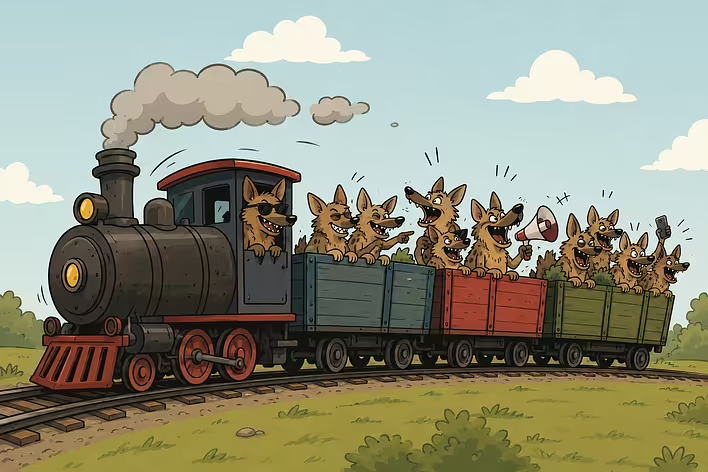
The name is built on a combination of two images.
The word “express” symbolizes speed. As soon as one scandal becomes public, the information spreads through the network like lightning, and more users join the discussion.
The word “jackal” is used in a figurative sense. In popular culture, jackals are often depicted as animals that act in packs. This image forms the basis of the meme: many people simultaneously direct their attention to one person, company, or event.
Over time, the expression has turned into a stable meme. Today, it is used even when it is not about a large-scale scandal, but only about the first signs that the situation is beginning to gain rapid attention.
When do people say “to ride the jackal express”
This expression can be heard in a variety of situations, but almost always it means that a person or organization has found itself at the center of a mass discussion with predominantly negative reactions.
The “jackal express” is most often mentioned when:
- a company has fallen into a reputational scandal;
- a famous person has made a controversial statement;
- a blogger or public figure has published a post that caused outrage;
- news of an ambiguous act or decision has become known;
- users are calling attention to a specific problem.
In such cases, critical comments, mentions, memes, posts, and calls for public reaction may appear en masse on social media.
At the same time, not every wave of criticism is automatically a “jackal express.” This expression is usually used when the reaction becomes truly massive and begins to spread rapidly among different communities.
Does “jackal express” always mean baseless bullying?
No. That is why this term should not be perceived as a synonym for “bullying” or “harassment”.
Sometimes mass reactions arise due to real violations, unethical behavior, or socially important issues. In such cases, public exposure can prompt a person or company to apologize, correct mistakes, or change their policy.
At the same time, there are situations when the wave of criticism becomes disproportionate. People who are not familiar with all the circumstances join it, spread unverified information, or evaluate the event based only on a few fragments.
That is why the expression “jackal express” itself does not evaluate who is right. It merely describes the phenomenon when a large number of users simultaneously direct their attention and criticism at one object.
What consequences can the “jackal express” have?
If the wave of criticism gains significant attention, it can go far beyond social media.
For public figures, this often means reputational losses, the need to provide explanations, or publicly apologize. For companies, the consequences can be even more pronounced: negative reviews, order cancellations, boycotts from part of the customers, or a reassessment of their communication.
At the same time, the scale of the consequences depends on the specific situation. Some stories are quickly forgotten within a few days, while others have a long-lasting impact on a person's or brand's reputation.
That is why many companies closely monitor audience reactions on social media and try to respond promptly to resonant situations.
How does the “jackal express” differ from cancel culture?
Although these concepts are often confused, they are not identical.
Jackal express is primarily a process: a rapid wave of mass criticism that unfolds on social media.
Cancel culture (cancel culture) is a broader phenomenon. It involves not only criticism but also attempts to completely deprive a person or company of public support: stopping cooperation, boycotting products, excluding from public space, or abandoning joint projects.
In other words, the jackal express can be the beginning of cancel culture, but not every wave of criticism evolves into it.
Frequently Asked Questions
What does “jackal express” mean?
“Jackal express” is a slang term for a mass wave of criticism or public condemnation on social media directed against a specific person, company, or organization.
Where does this expression come from?
The term originated in the Ukrainian segment of Twitter (now X) and later spread to other social networks. The exact authorship of the phrase is unknown.
Why is it called “jackal express”?
“Express” symbolizes the rapid spread of information, while “jackal” metaphorically describes a large group of users who simultaneously join in the criticism.
Does “jackal express” always mean bullying?
No. Sometimes mass reactions arise due to real violations or socially important issues. In other cases, criticism can become excessive or based on incomplete information.
Is this expression still used today?
Yes. Despite the term originating a few years ago, it can still be found in Ukrainian social media, especially during loud public scandals.
Like it?React
🧵
This post doesn't have any additions from the author yet.