This content has been automatically translated from Ukrainian.
Conclave is a gathering of cardinals of the Roman Catholic Church convened to elect a new Pope after the death or resignation of the previous one. The word comes from the Latin cum clave, meaning "under lock," as the participants of the conclave are locked away in isolation from the outside world to make decisions without external influence.
Main features of the conclave:
- Only cardinals who are under 80 years old at the time of the Pope's death participate.
- It takes place in the Sistine Chapel in the Vatican.
- Voting continues until one of the candidates receives two-thirds of the votes.
- The results of the voting are announced through smoke:
- Black smoke (burning ballots with additives) — the Pope has not yet been elected.
- White smoke — a new Pope has been elected.
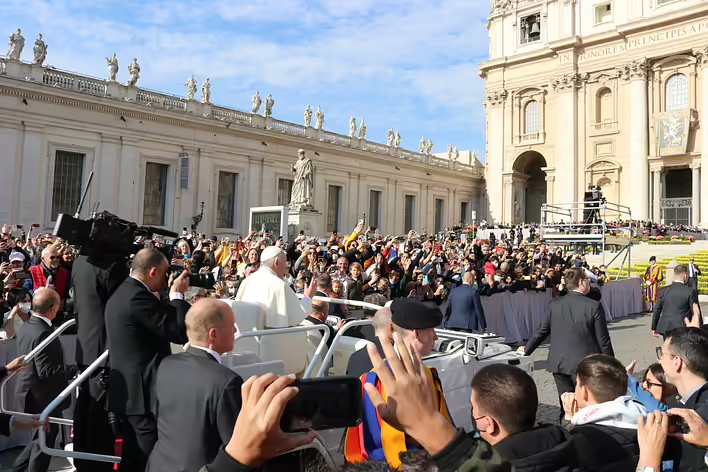
After the election, the newly elected Pope takes a name and appears on the balcony of St. Peter's Basilica to bless the faithful.
Cardinal is a high-ranking clergyman in the Roman Catholic Church who is a member of the College of Cardinals and, among other things, has the right to elect the Pope.
Who can become the Pope?
Formally — any baptized man who professes the Catholic faith. But in practice — only chosen from the circle of cardinals.
Formal requirements:
- Baptized man
- Catholic
- Theoretically, it is not necessary to be a priest (but if a layman is elected, he must be urgently ordained as a priest, bishop, and then proclaimed Pope)
Real practice:
- For over 600 years, all Popes have been cardinal bishops, meaning very experienced church hierarchs.
- The main candidates are influential cardinals in leadership positions in the Vatican or archbishops of major dioceses worldwide.
After the election:
- The elected is asked: "Do you accept your election?"
- If he agrees, he is asked: "What name do you take?"
- Then he appears on the balcony of St. Peter's Basilica with the announcement: "Habemus Papam" — "We have a Pope!"
The Pope does not have to be Italian — the last Popes have come from Poland, Germany, and Argentina. The Pope is the head of the Catholic Church and also the head of state of the Vatican.Thus, although theoretically any baptized Catholic can become Pope, in practice it is almost always a cardinal with significant spiritual and organizational experience.
In fact, an Italian can become Pope, and there have been many in history. Just in recent decades, the Church has consciously chosen Popes from other countries to emphasize the universal nature of the Catholic Church (it is a global community where most believers today live not in Europe but in Latin America, Africa, and Asia) and to demonstrate that the Vatican is not just an "Italian church," but a church for the whole world. One of the goals of such a decision — to rid itself of accusations of nepotism and the influence of Italian politics, as previously, when Popes were almost always Italians, it led to corruption in the Curia (the internal apparatus of the Vatican), excessive influence of the Italian aristocracy and government. Thus, the choice of foreign Popes helps to cleanse the Church's image and show that the elections are genuine, not a political game.
Curia is the administrative apparatus of the Vatican that helps the Pope govern the Church worldwide. The full name is Roman Curia (Curia Romana). Its main functions are: to prepare decisions for the Pope; to oversee the implementation of his directives; to coordinate the activities of bishops, religious orders, and Catholic organizations worldwide; to handle matters related to faith, discipline, liturgy, canon law, etc.
Like it?React
🧵
This post doesn't have any additions from the author yet.