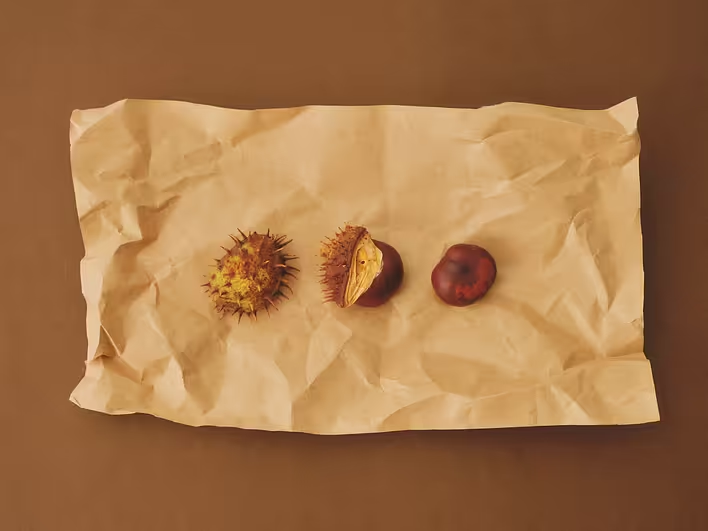
In autumn, dozens of shiny brown "nuts" lie under the chestnut trees. They closely resemble the chestnuts that are roasted on the streets of Paris, Rome, or Istanbul. However, it is not advisable to collect them in the nearest park and take them to the kitchen. In most Ukrainian cities, the non-edible chestnut, or horse chestnut, grows, which is also known as the common horse chestnut. Its seeds are unsuitable for consumption.
The edible chestnuts come from a completely different tree — the sweet chestnut, or edible chestnut. Despite the similar names and the external resemblance of the fruits, these plants even belong to different botanical families.
Horse and edible chestnuts — different plants
The common horse chestnut (Aesculus hippocastanum) belongs to the Sapindaceae family. It is the one most often planted along streets, in yards, and parks. In spring, the tree is easily recognizable by its large vertical inflorescences resembling candles, and in autumn — by the green boxes containing shiny brown seeds.
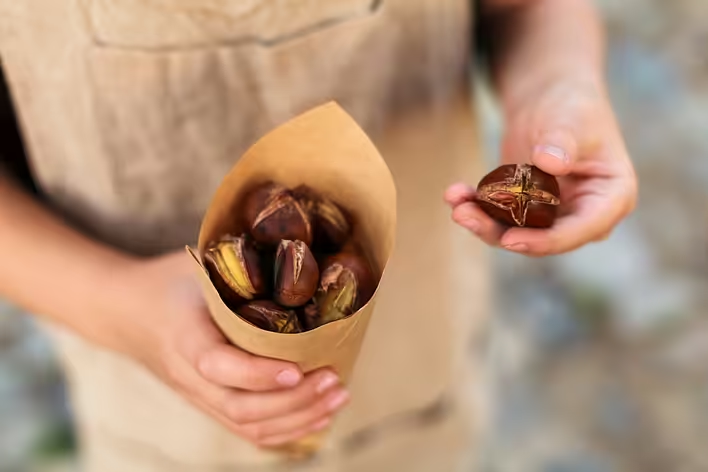
The edible chestnut, or sweet chestnut (Castanea sativa), belongs to the beech family. Its relatives are beech and oak, not horse chestnut. This is the tree whose fruits are roasted, boiled, added to soups and desserts, or ground into flour.
The common name has been established due to the external similarity of the brown seeds of the horse chestnut to true chestnuts. However, the leaves, husk, and shape of the fruits in these trees differ significantly.
How to distinguish edible chestnuts from horse chestnuts
кінський каштан та їстівний
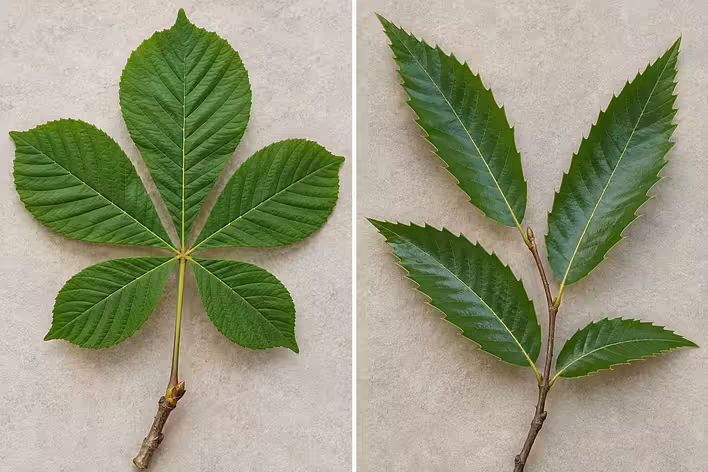
The most noticeable difference is in the leaves. The horse chestnut has compound leaves: from one point, five or seven large leaflets spread out, forming a palm-like shape. In contrast, the edible chestnut has simple, elongated, narrow leaves that are arranged singly on the branches. Their edges have well-defined sharp teeth.
The husks are even more distinct:
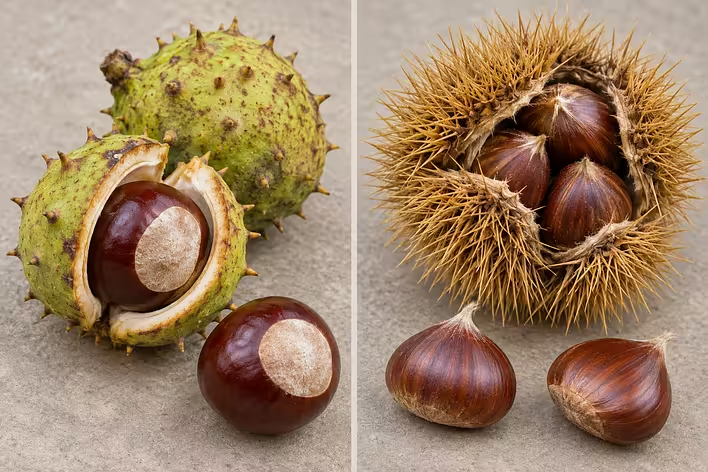
the horse chestnut's fruit is a thick green box with few short spines or bumps;
the nuts of the edible chestnut are contained in a husk densely covered with long thin spines, making it resemble a small green hedgehog.
Inside the horse chestnut's box, there is usually one large, almost round seed. It is smooth, shiny, dark brown, with a large light spot.
The spiny husk of the edible chestnut often hides several nuts. They are slightly flattened on the sides and have a characteristic pointed tip with a small "tail".
кінський каштан та їстівний
Characteristic
Horse Chestnut
Edible Chestnut
Leaves
Compound, with 5–7 leaflets, palm-like
Simple, elongated, with serrated edges
Outer Husk
Thick, with few short spines
Densely covered with long thin spines
Contents of the Husk
Usually one large seed
Often several nuts
Shape
Almost round, with a large light spot
Slightly flattened, with a pointed tip
Edibility
Inedible
Edible
Why you shouldn't roast chestnuts from the city alley
The seeds of the horse chestnut contain toxic compounds. After consumption, symptoms such as nausea, vomiting, abdominal pain, diarrhea, weakness, and other poisoning symptoms may occur. Heating does not turn such seeds into an edible product, so roasting or boiling them "for testing" is not allowed.
The bitter taste is also not a safe way to identify them. Unknown fruits and seeds should not be tasted at all: the plant must be accurately identified first.
The trees that grow abundantly along Ukrainian city streets are mostly horse chestnuts. At the same time, one cannot rely solely on location: edible chestnuts are also sometimes planted in botanical gardens, dendrological parks, and private estates. Botanical characteristics must be decisive, not assumptions that any found "chestnut" is suitable for the kitchen.
The safest option is to buy fruits labeled as edible, sweet, or cultivated chestnuts from a store or a trusted seller. It is not advisable to collect even correctly identified fruits near busy roads or in areas where the trees may have been treated with chemicals.
Where edible chestnuts grow
The natural range of the edible chestnut covers parts of Southern Europe and Western Asia. For centuries, the tree has been cultivated for its fruits and wood, so it is now found in many European countries far beyond its likely original range.
In Ukraine, this species also grows, although it is significantly less common than the horse chestnut. It can primarily be found in warmer regions, particularly in Transcarpathia, as well as in botanical gardens, collection plantings, and private estates.
Edible fruits are not only produced by the European sweet chestnut. The Castanea genus also includes Chinese, Japanese, and American chestnuts. Their varieties and hybrids may be available for sale. In contrast, plants of the Aesculus genus, which includes horse chestnut, should not be considered a source of edible chestnuts.
Why chestnuts are called nuts
In everyday language, various edible kernels are referred to as nuts, although from a botanical perspective, not all of them are true nuts. The fruit of the edible chestnut precisely meets the botanical definition of a nut: it is dry, has a hard shell, contains one seed, and does not open on its own after ripening.
The spiny husk in which edible chestnuts ripen is not the shell of one large fruit. It is a separate protective structure, inside which several nuts usually form. Thus, each brown chestnut with a pointed tip is a separate fruit-nut. True nuts in the botanical sense also include acorns and hazelnuts.
With horse chestnuts, it is quite different. Its green husk is a capsule fruit that opens after ripening. The large shiny brown ball inside is a seed, not a nut. Therefore, calling it a chestnut nut from a botanical perspective is incorrect.