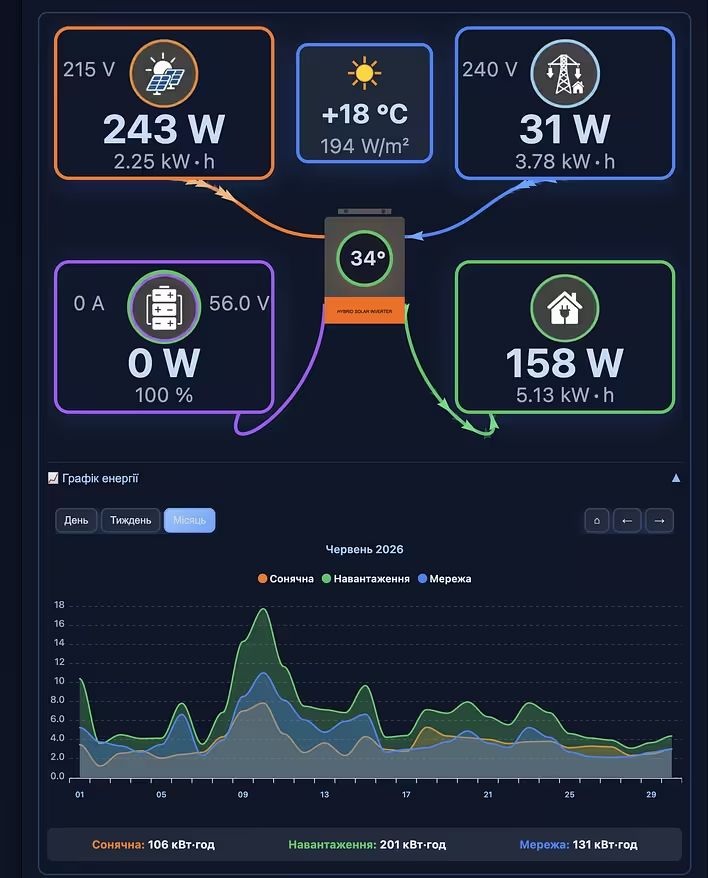
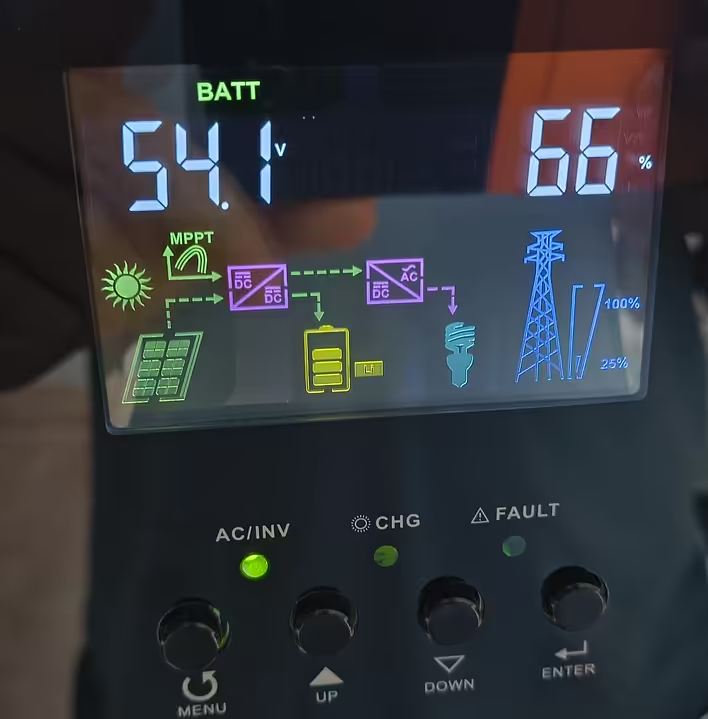
Every day of generation that your station shows is the result of a physical phenomenon discovered in the 19th century and a technology that was brought to practical application only in the mid-20th century. Let's explore how sunlight is converted into electricity that powers a refrigerator during a blackout, and who invented it all.
History: from laboratory curiosity to the roof of your house
The photoelectric effect - the physical basis of solar panel operation - was discovered by the French physicist Alexandre Edmond Becquerel (there is no Ukrainian page, so here is a link to the English Wikipedia - https://en.wikipedia.org/wiki/Edmond_Becquerel) in 1839 when he was only 19 years old. He noticed that electrodes immersed in an electrolyte generate a small voltage when exposed to light. It was an interesting observation, but without any practical application - the efficiency was measured in fractions of a percent.
The next important step occurred in 1954 at the Bell Labs (USA) (Wikipedia). Researchers Calvin Fuller, Gerald Pearson, and Darryl Chapin created the first working silicon solar cell with an efficiency of about 6% - enough to power a small electrical device directly from the sun. This is considered the birth of modern solar energy.
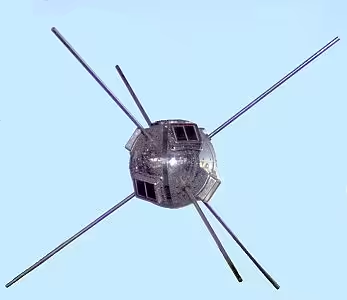
Next, the technology was picked up by the space industry: solar panels became the ideal source of energy for satellites, where there is no possibility to connect to the grid or carry fuel. The first satellite with solar batteries - Vanguard 1 - was launched in 1958, and it transmitted signals for years thanks to a small panel with an area of just a few square centimeters.
Vanguard 1 (wiki)
Wikipedia
The technology returned to Earth en masse only in the 1970s when the oil crisis forced governments and companies to seek alternative energy sources. Since then, the cost of producing panels has fallen by hundreds of times: when the first panels from Bell Labs became commercially available in 1956, they cost about $300 per watt; by 1975, thanks to the development of the space and semiconductor industries, the price had dropped to about $100 per watt; today, a solar module costs less than $0.5 per watt. At the same time, the efficiency of commercial panels has increased from 6% to 20-23%.
The physics of the process: how a photon is converted into an electron
At the core of any solar panel's operation is the photoelectric effect - the ability of certain materials to knock out electrons when exposed to light. In silicon panels, this is realized through the so-called p-n junction.
Two layers of silicon. The panel consists of two thin layers of silicon with different impurities: the n-layer has an excess of free electrons (phosphorus dopant), while the p-layer has a deficiency of electrons, i.e., "holes" (boron dopant).
Electric field at the junction of the layers. At the interface of these two layers, an internal electric field is created - it is this field that will "push" the electrons in the desired direction.
A photon knocks out an electron. When a photon of sunlight hits silicon with sufficient energy, it knocks an electron out of an atom, leaving a "hole." The electric field of the p-n junction immediately separates the electron and the hole, preventing them from recombining.
Movement of electrons = current. Electrons move through the external circuit (conductors on the surface of the cell) to the load - and it is this directed movement of free electrons that constitutes electric current.
Each individual solar cell (module) generates a small voltage - approximately 0.5-0.6 V. Therefore, they are connected in series in the panel: a standard panel with 60-72 cells produces a working voltage of about 30-40 V of direct current.
What a real panel consists of
Let's look at the layers.
Layer
Function
Tempered glass
Protection from hail, mechanical damage, allows 90-95% of light to pass through
EVA film (ethylene-vinyl acetate)
Seals and fixes the silicon cells, protects against moisture
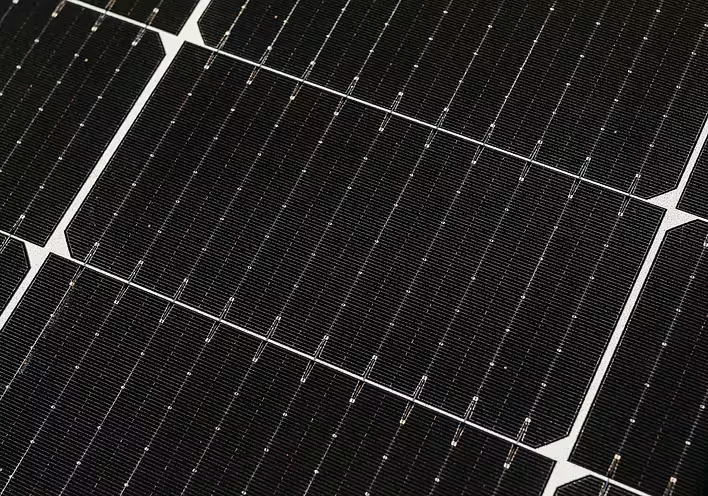
Silicon cells
Actually generate electricity from the photoelectric effect
Backsheet
Insulation and protection from the back side
Aluminum frame
Mechanical rigidity, mounting
Junction box
Brings out contacts, contains bypass diodes
Since the panel produces direct current (DC), while the household grid operates on alternating current (AC), there is necessarily an inverter in the system that converts DC to AC - this component often determines how effectively and "smartly" the entire station operates.
Types of panels: what to choose
Monocrystalline - made from a single solid crystal of silicon. Highest efficiency (21-23%), uniform dark color, most expensive to produce.
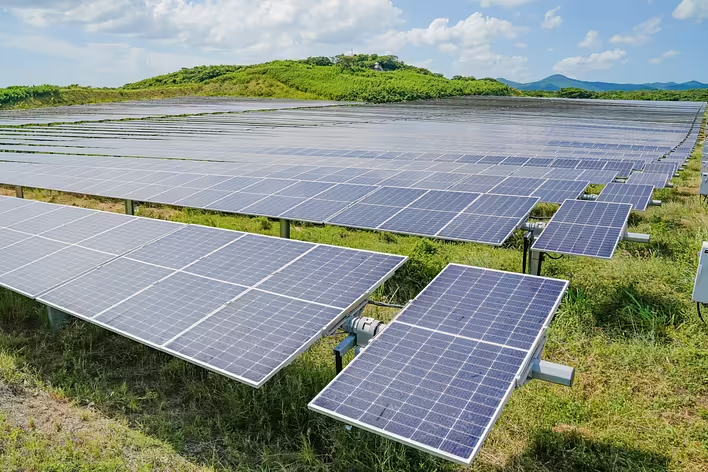
Polycrystalline - silicon crystallizes from several fragments, hence the characteristic "mosaic" bluish tint. Lower efficiency (16-18%), but the price is significantly lower.
Thin-film (amorphous silicon, CdTe, CIGS) - flexible, lightweight, cheaper to produce, but efficiency is usually 10-13%. Used where weight and flexibility are more important than compactness.
For rooftop home systems in Ukrainian conditions, monocrystalline panels are chosen in 95% of cases - due to the limited roof area, it is more important to get the maximum watts per square meter than to save on purchasing.
What really affects generation
Efficiency, indicated on the panel label, is a figure under laboratory conditions (25°C, perpendicular solar radiation of 1000 W/m²). In reality, many more factors affect actual generation:
Temperature. Contrary to intuition, hot weather reduces panel efficiency - silicon cells lose about 0.3-0.5% of power for each degree above 25°C. The best generation occurs on sunny but cool days.
Angle of tilt and orientation. For the latitude of Ukraine (about 48-50°), the optimal tilt angle of the panel is approximately 30-40° from horizontal, with orientation strictly to the south.
Shading. Even a small shadow on one cell (from an antenna, branch, chimney) can "drop" the generation of an entire string due to series connection - this is why bypass diodes and proper planning of panel placement are important.
Surface contamination. Dust, pollen, bird droppings can reduce generation by 5-25% - regular cleaning is truly cost-effective.
Cloudiness. Panels continue to generate even in cloudy weather (diffused light), but power drops by 50-90% depending on the density of the cloud cover.
Why this is especially relevant now
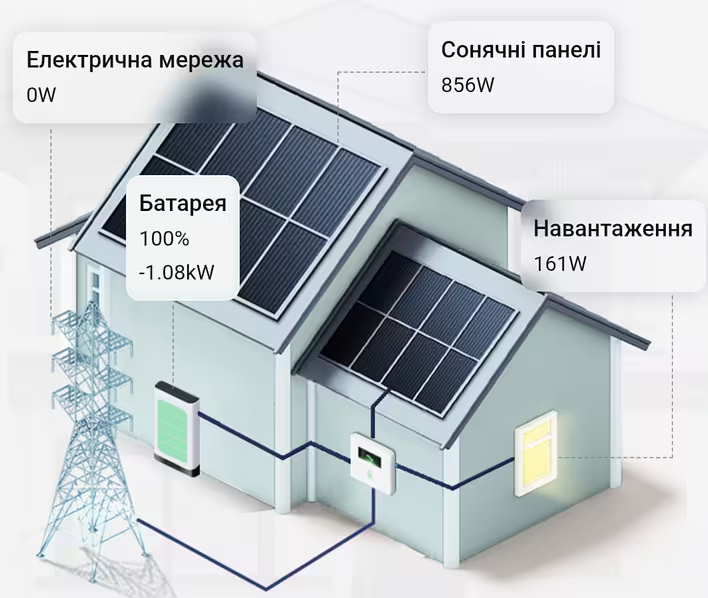
A typical example of a small backup system is that solar panels cover part of the base consumption during the day and charge batteries for reserve. In combination with an inverter and battery, this provides real independence from outage schedules: the refrigerator, router, lighting, and charging gadgets can operate autonomously even during prolonged blackouts. But many factors specific to your site need to be considered. A small station is better than nothing in modern conditions.
The main limitation of a small system is dependence on weather and daylight: in winter, when energy is most needed, the duration of daylight and the angle of sunlight are least favorable, so generation drops significantly compared to summer. This should be taken into account when planning the size of the system and battery capacity.
Since Becquerel's discovery of the photoelectric effect in 1839 to the silicon panel on the roof, more than 180 years have passed, but the principle remains the same: a photon knocks out an electron, the electric field of the p-n junction directs its movement - and current is generated. Understanding this process helps not just to observe the generation numbers in the report, but to consciously design the system: to correctly choose the tilt angle, type of panels, and size of the station according to real needs.
For those who want to delve deeper - here is a link to Wikipedia: p-n-junction.