This content has been automatically translated from Ukrainian.
What is chronophotography?
Chronophotography is a shooting method used to visualize movement. It involves creating a series of photographs that are then combined into one frame, demonstrating the object in different phases of motion. This technique emerged in the 19th century and became the foundation for the further development of cinematography and sports photography.
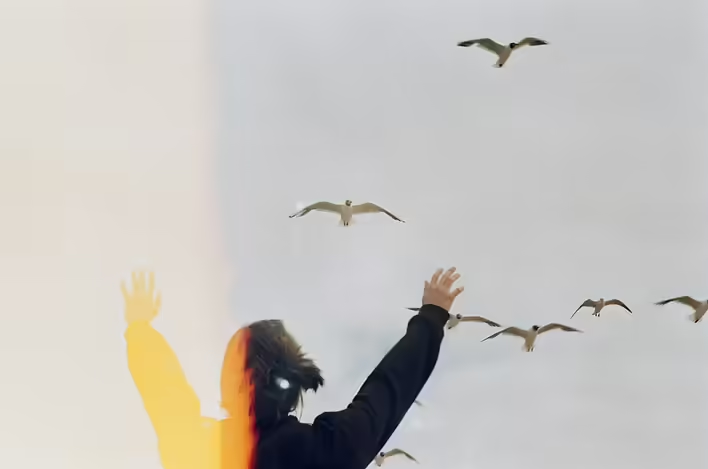
Thanks to chronophotography, one can see how a bird spreads its wings during flight, how a person jumps over an obstacle, or how a ball moves through the air after being struck.
History of chronophotography
The first experiments in capturing motion began in the 1870s when the development of photographic technologies allowed for high-speed shots. Two scientists played a key role in the establishment of this method:
- Eadweard Muybridge – a British-American photographer who in 1878 used a series of cameras to capture a galloping horse. His experiment proved that at a certain moment all four legs of the horse do not touch the ground, which was impossible to see with the naked eye.
- Étienne-Jules Marey – a French physiologist who in 1882 developed the "photo-fusil" – a device that allowed for capturing 12 frames per second on a single plate. His method most closely resembles modern chronophotography, as all stages of motion were captured in one frame.
These studies became the foundation for cinematography, opening new possibilities for studying motion.
How does chronophotography work?
To achieve the effect of chronophotography, several methods are used:
- Sequential series shooting – a series of frames of a moving object is taken at equal time intervals.
- Overlaying images – the obtained frames are combined into one image to show the dynamics of movement.
- Long exposure with flash – combines the effect of motion blur with clear phases when the flash captures key moments.
In the digital age, this effect can be achieved using graphic editors like Photoshop, but classical methods continue to be used in sports photography and experimental art.
Like it?React
🧵
This post doesn't have any additions from the author yet.