Recently, I held in my hands and literally "bought with my eyes" an interesting book — "Vision of Ukraine 2035". And I decided to share my thoughts. Especially today, as we are soon expecting the hardest winter again.
Right now, I am sitting in a café in Kyiv: no electricity, quite cool, but still warmer than at home. It's about 13 degrees there and there's no water. Perhaps this book came into my hands at the worst possible moment. But it seems this locomotive cannot be stopped.
I have always wanted to be a writer and a couch expert, but I didn't think it would happen like this. So, a disclaimer right away: this text does not claim to be the truth. It is rather an opportunity to think together, ask a few uncomfortable questions, and look at our future from a slightly different angle.
You know, over the last time — which is about four years — I haven't read such a selective sci-fi. Respect to the authors, of course. They analyzed everything and wrapped it in a cool package because the book is really of high quality: 1200 hryvnias — that's not just anything :)
But I was much more impressed by the content and substance. And what's even more interesting — it's unclear who exactly the authors were trying to reach: the plebs, the power vertical, or business. It looks a bit like: "Let's show everyone our wishes".
Just a reminder: it's 2026 outside. An extremely difficult winter — both militarily and geopolitically. And here Trump is whistling with his bottle. And amidst all this, we are publishing a vision in 2025, for which we have nine years left to implement.
Next — more structurally. And it won't be funny.
Context
The trouble is that in Europe there is a noticeable shift from supporting liberal-democratic parties towards conservative and right-populist forces that offer simple, "quick and effective" solutions. And this, if you look at the situation more broadly, is a quite understandable reaction to the fatigue from EU politics, the unwillingness to take on new risks, and the increasingly harsh confrontation between the USA, China, and Russia. Everyone is pulling the blanket over themselves, and the world is increasingly resembling a powder keg.
Financially and socially, things are not great either. Not critical, but far from ideal. Trade wars and mutual tariff increases are putting pressure on the economies of countries and unions. At the same time, Europe is accepting millions of people fleeing from war and political instability. Ukraine, Syria, Israel and Palestine, Yemen, Sudan, Myanmar, and dozens of other conflicts create a constant flow of forced migrants. Millions of people have left Ukraine for abroad. Some are already working, paying taxes, and integrating, but the scale of this phenomenon is still enormous.
All of this inevitably affects European voters. In addition to migration and economic uncertainty, there is an increase in defense budgets, fatigue from war, and the question: how much more money and resources need to be invested in security? And against this backdrop, right-wing and populist leaders receive a very simple message: "Get rid of the refugees. Less money for foreign wars. Let's take care of our own first." It sounds simple. And that's why it works.
By points
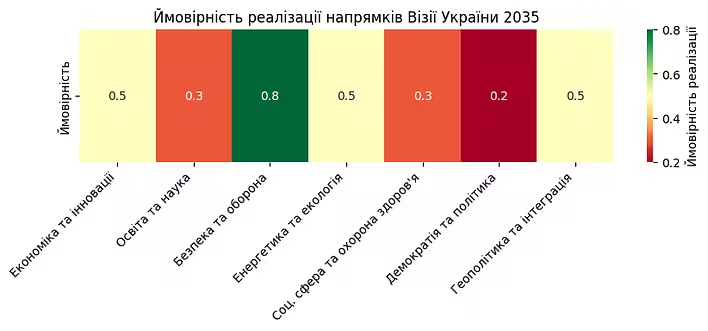
Economy and Innovation
The goals of the vision: a high GDP level, development of IT, startups, innovations, industry, and energy.There is nothing fundamentally new here since the times of Fedorov in the Ministry of Digital Transformation and Shmyhal as Prime Minister. All of this requires financing, the war is slowing down industrial production and investments. Expanding potential in energy is a utopia: rebuilding the CHP plants will take years. A new nuclear power plant will take years. Hydroelectric power plants will also take years. Solar power plants are unreliable due to shelling, and wind generation faces the same reason. And let's not forget that corruption can freeze large infrastructure projects.
Objectively: Odesa, Kyiv, Sumy, Poltava, Chernihiv have not prepared much for new crises four years after the blackouts. The capital is without electricity, water, and heating — wow. IT and outsourcing have potential, but the market is saturated, and dumping mostly reduces prospects to the defense sector.
The state has a public debt of 186 billion dollars (IMF estimates), which is almost 110% of GDP. War is expensive, as always.
Education and Science
Goals: modern education, strong scientific base, integration into the global academic community.The war has caused the migration of students and scholars. In some schools, the admission of foreigners among graduates is close to 90%; in Kyiv it may rise to 95%. The lack of systemic funding and reforms hinders progress. The material and technical base of universities is not improving. Possible success in narrow fields (IT, biotechnology, military technologies) is due to private and international investments, but narrowing everything down to promising technologies is a mistake.
Security and Defense
Goals: a strong army, integration into NATO, cybersecurity.The war stimulates the development of the defense industry and modernization of the army, but not to the level of space marines, as in the vision. Some technologies have already surpassed NATO levels, plus military experience is irreplaceable. Integration into NATO is a strategic goal, but it depends on geopolitics and the mood of allies. Cybersecurity may improve thanks to international grants and partnerships, as domestic resources are insufficient.
Energy and Ecology
Goals: energy independence, green energy, modernization of the energy system, and we all know that even cogeneration is not going as we would like.Partial reconstruction is possible with the support of international donors. Large-scale "green transformation" is unlikely without peace and capital. Corruption and bureaucracy will slow down implementation. Moreover, demining territories after the war will take 10-15 years, and the longer the war lasts, the larger the contaminated area.
Social Sphere and Healthcare
Goals: modern medicine, social support, integration of veterans.This is my favorite after education, as it is the most subsidized area. The war and economic restrictions reduce the possibilities for large-scale reforms. Programs for veterans can be implemented through international grants, but without funding, there will be a rollback. Corruption and political influence slow down systemic changes. Hello NABU and SAP and Bihus.Info for keeping us informed.
Democracy and Politics
Goals: transparent politics, renewal of the political elite, anti-corruption reforms.Utopia: a generation that will live to see elections, will understand the process and their responsibility when there have been no elections for 7 years? Old politicians are still influential. Constitutional reform is problematic due to the Constitutional Court, duplication of laws, and the weakness of the system.
Geopolitics and International Integration
Goals: EU and NATO membership, strategic alliances.Possible, but the pace of integration depends on the war and reforms. International support is decreasing, bureaucracy and internal barriers slow down the process.
Post-War Forecast
We are facing "political" elections and power struggle games — one way or another, they have already begun. We need state consolidation: after the war, the authorities may get a chance for reform, but old political elites may retain control if there is no strong pressure from society — and that's a fact. Pressure is necessary: we must take responsibility for managing the state. Without radical political restructuring, corruption and bureaucracy will remain the main problem. The level of trust in the state and politicians after the war will determine the effectiveness of reforms and the willingness of the population to participate in reconstruction.
Of course, there is a chance for state modernization, but it is limited by the political status quo.
We will face the reconstruction of cities, infrastructure, industrial capacities, energy, and transport networks with international loans and grants. And this will take a long time. Large projects are long and expensive. We will have large external debts, destroyed enterprises, and a decreasing population due to migration. The economy will slowly recover over 5-10 difficult years, with local "islands of success" in innovative sectors. If there is no change of elites, there is a risk of corrupt misappropriation of construction and ineffective use of funds.
We have already lost part of the population due to war and migration. The return of refugees may take years and depends on security, housing, and jobs. We will have a critical need for psychological rehabilitation of the population, education, and healthcare. We all will carry our own trauma of war.
The war has strengthened national unity, but it has left scars and social fractures. If there is no demographic recovery and social programs, economic and political recovery will be incomplete.
Reconstruction may become a push for the development of creative industries, media, arts, and tourism.
Geopolitical tension with the Russian Federation may remain high even after the active phase of the war. I personally hope that in the next 5-10 years there will be no shift towards normalizing relations with Russia, as that would be a loss for us as a society.
If the war ends with a compromise, but political instability remains — Ukraine may remain a "borderline" partner of the EU with limited rights and support.
There may be a second option: a halt to the conflict, we, like older generations, will preserve the remnant and feeling of nostalgia for the dollar at 8, mivina at 4.20, and we will move as we are used to, without changes and reforms. We will again get stuck in the same swamp as before the war, and we will stop, although the pace at the beginning was not bad. Then we will face an economic, social, and political crisis. A return to a new cycle of the wheel of samsara. Crises will happen, the question is how quickly and stressfully we will get out of them.
In this scenario: long and painful, partial recovery, significant population losses, a weak economy, preservation of old political and corrupt structures, risks of new conflicts.
After the war, Ukraine will have a unique chance for modernization and economic recovery, but success depends on political reform, the fight against corruption, effective use of international aid, and, of course, the consolidation of society and readiness to take responsibility for the future of the country.
The war will leave scars, but it will also create an opportunity to "start with a clean slate" for many sectors and for us as a new young civil society.
(The text was written on January 20, 2026)