Dough is the foundation of thousands of dishes around the world. It is used to make bread, pizza, dumplings, croissants, cakes, pies, cookies, and dozens of other treats that are hard to imagine life without. Despite the fact that most types of dough contain similar ingredients—flour, water, fat, and eggs—the method of preparation and the proportions of the components radically change the structure, taste, and purpose of the finished product.
That’s why we decided it was time to explore this universe of dough and identify its most popular types, features, and the dishes for which it is best suited.
Yeast Dough
Probably one of the most popular, widespread, and ancient types of dough in the world. Its history spans thousands of years: archaeologists believe that people learned to use natural fermentation as far back as Ancient Egypt about 4–5 thousand years ago. Thanks to yeast, a simple mixture of flour and water transforms into a fluffy, aromatic dough from which countless types of baked goods can be made.
One of the main advantages of yeast dough is its versatility. It can be tender and sweet, like French brioche, or simple and straightforward, like traditional peasant bread. That’s why varieties of yeast dough can be found in almost every culinary culture around the world.
What dishes use yeast dough?
The list of products made from yeast dough is extremely wide:
bread and baguettes;
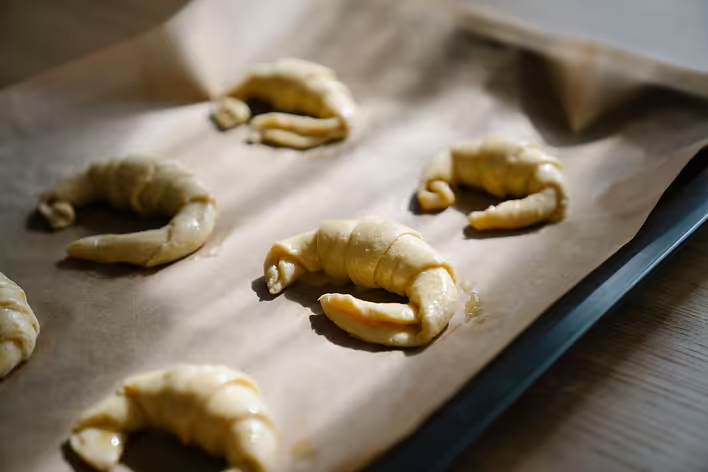
rolls and croissants;
kulich and braided bread;
pies and pastries;
pizza;
focaccia;
brioche.
How does yeast dough differ from other types?
The main difference lies in the fermentation process. Unlike shortcrust or unleavened dough, yeast dough requires time to rise. This characteristic shapes its structure, taste, and aroma. During prolonged fermentation, hundreds of aromatic compounds are formed, which is why freshly baked bread has such a recognizable smell.
Today, yeast dough remains the foundation of global baking. From French baguettes to Italian focaccia, from Ukrainian kulich to American burger buns—all these products exemplify how versatile one of the most important inventions in culinary history can be.
Unleavened Dough
Long before people learned and mastered the processes of fermentation, they were already making simple flatbreads from flour and water. The history of unleavened dough goes back thousands of years, and in this regard, it certainly surpasses yeast dough.
But it’s not just its rich and ancient history that is an advantage of this type of dough. The simplicity and ease of preparation, versatility, and speed are the reasons why it is impossible to imagine most cuisines of the world without unleavened dough.
What dishes use unleavened dough?Unleavened dough is the basis for a large number of popular dishes:
dumplings;
pelmeni;
ravioli;
homemade noodles;
pasta;
chebureki;
lavash;
flatbreads and cakes;
matzah;
some types of Asian dumplings and noodles.
Versatility is the neutral taste of unleavened dough. It does not overpower the filling or other components of the dish but merely highlights them. Thanks to this property, unleavened dough is widely used in the cuisines of various nations around the world—from Ukrainian dumplings and Polish pierogi to Italian pasta and Middle Eastern lavash.
In addition to its culinary value, it also has deep historical and religious significance. For example, unleavened flatbreads were a staple food for many ancient civilizations, and matzah remains an important symbol of Jewish tradition today. Can we imagine our Christmas Eve without dumplings, which are an integral part of the Lenten dinner before Christmas?By the way, you can find our recipes for dough and fillings here.
прісне тісто для вареників
Unleavened dough is also interesting in how differently it is used in various corners of the world. In one cuisine, it is made into thin flatbreads, in another, it is wrapped around fillings, and somewhere it is turned into noodles or pasta. Chinese dumplings, Italian ravioli, Ukrainian dumplings, Mexican tortillas, Georgian khinkali—these dishes are quite different, but many of them are based on simple unleavened dough.
Another advantage is the ability to change the consistency and properties with just a few ingredients or methods of preparation. Adding an egg makes the dough more elastic and nutritious, a bit of oil makes it softer, and boiling water helps achieve a particularly pliable structure. That’s why even the basic recipe for unleavened dough can have dozens of variations.
Moreover, it is probably one of the most "democratic" types of dough. No special ingredients, complex equipment, or a lot of time are needed to prepare it. Flour, water, a little salt—and you can already create a base for completely different dishes. Perhaps this simplicity explains why unleavened dough has survived for thousands of years and continues to be an important part of cuisines around the world.
Puff Pastry
One of the most complex to prepare but very popular types of dough in the world is puff pastry. Each of us knows it well and can easily recognize it in a croissant, pastry, or the famous fornetti. Light, crispy, with countless thin layers—it is quite different from yeast or unleavened dough, although it starts with such familiar ingredients as flour, water, and butter.
The magic of puff pastry lies in its layers. To achieve them, the dough is rolled out many times and folded together with butter. During baking, water turns into steam, which separates the layers—and that’s where the familiar lightness, crispiness, and characteristic "leaves" come from. This is why making true puff pastry requires time, patience, and a certain skill.
What dishes use puff pastry?
And here the list will be very long, as puff pastry works equally well in desserts and savory dishes:
croissants;
fornetti and pastries with various fillings;
mille-feuille;
Napoleon cake;
palmiers;
tarts and tartlets;
fruit pies;
vol-au-vents;
rolls and snacks with cheese, meat, or vegetables;
Portuguese pastéis de nata;
Danish pastries.
And this is far from a complete list. Essentially, if you have a pack of ready-made puff pastry, a bit of imagination, and a few favorite ingredients—there are countless options for what to make from it.
Not by croissants alone
Croissant is probably the first thing that comes to mind when we talk about puff pastry. But in reality, there are many more famous desserts made from it.
Mille-feuille—mille-feuille, which literally means "a thousand leaves" in French—consists of thin, crispy layers of dough and cream. The Napoleon cake is another well-known example. And if we look at the cuisines of other countries, we should mention Portuguese pastéis de nata with delicate custard, French crispy cookies palmiers, and Danish pastries with fruits, cream, or marzipan.
How does puff pastry differ from other types?
Its main feature is its multilayeredness. Yeast dough rises due to the action of yeast, unleavened dough remains denser and more elastic, while puff pastry gets its characteristic structure from the thin layers of dough and butter.
By the way, puff pastry can be either yeast or unleavened. Unleavened puff pastry turns out to be crispier and flakier and is perfect for pies, tarts, vol-au-vents, and various snacks. Yeast puff pastry combines multilayeredness with fluffiness—it is used for classic croissants and many types of Danish pastries.
Also, puff pastry is often confused with strudel dough. For example, traditional strudel is made from strudel dough, although today, ready-made puff pastry is often used for it at home.
Thus, puff pastry is a case where a few simple ingredients and a little patience can turn into something very special. A crispy pastry with coffee, a festive Napoleon, a croissant for breakfast, or snacks for the table—it’s hard to imagine another type of dough that adapts so easily to completely different dishes.
In the second part, we will talk about shortcrust, choux, and other types of dough. Meanwhile, as we feed the material, share in the comments if you have ever made dough yourself? If so, what types? Share your experience ;)