This content has been automatically translated from Ukrainian.
Yandere (Japanese: ヤンデレ, Yandere) is one of the most well-known archetypes of characters in anime, manga, light novels, and Japanese video games. This term refers to characters whose strong feelings—most often love, affection, or the desire to protect a loved one—gradually become so intense that they take on unhealthy forms.
Unlike many other dere archetypes, yandere is defined not by external behavior but by the nature of their emotions. Such a character can genuinely love, care for, and wish well for another person. However, their feelings gradually transform into an obsession, causing them to lose the ability to adequately assess their own actions.
That is why yandere should not be reduced to the image of an aggressive or cruel character. Violence is not an obligatory trait of this archetype. In many works, yandere does not cause physical harm to anyone but demonstrates excessive jealousy, constant control, pathological fear of loss, or a willingness to sacrifice everything for the person they love.
The main feature of yandere is the unhealthy form of attachment, rather than cruelty itself.
The Origin of the Word "Yandere"
The term yandere consists of two Japanese words:
- yanderu (病んでる) — "to be sick," "to be in an unhealthy state," "to have psychological problems";
- deredere (デレデレ) — to show tenderness, affection, or infatuation.
The combination of these words creates the image of a character whose warm feelings have taken on a sickly, obsessive form.
It is important to understand that the word yanderu in Japanese is not a medical diagnosis. It can describe both a physical illness and a psychological state of a person experiencing intense emotional suffering or behaving unusually. That is why in the context of anime, yandere does not mean "psychopath" or "a person with a specific mental disorder." It is an artistic archetype that deliberately exaggerates certain personality traits for the sake of the plot.
How the Yandere Archetype Emerged
Like with tsundere, the archetype itself existed before its modern name was established.
Characters whose love turned into obsession appeared in Japanese literature, manga, and anime as early as the late 20th century. However, the separate term yandere began to be actively used only in the 2000s, when Japanese anime fans started to classify characters based on characteristic behavior patterns.
The archetype gained particular popularity due to the development of visual novels and romantic games, where authors had the opportunity to show the gradual change in a character's personality depending on the development of their relationship with the main character.
Over time, yandere began to appear not only in romantic stories. Today, such characters can be found in psychological thrillers, action films, detective stories, mystical works, and even comedies, where certain traits of the archetype are used as a humorous element.
Why Yandere Became So Popular
The popularity of the archetype is largely explained by its dramatic nature.
Unlike most other dere archetypes, yandere almost always creates a strong internal conflict. The viewer sees a character who genuinely loves another person but simultaneously gradually loses the ability to control their own emotions.
This contradiction makes yandere one of the most emotional archetypes in Japanese pop culture. Authors often use it to show how even the brightest feelings can become destructive when they turn into obsession.
Because of this, many yandere remain some of the most vivid and controversial characters in anime. They can simultaneously evoke sympathy, admiration, and anxiety, which is what makes this archetype so recognizable.
How the Yandere Archetype Manifests
The main feature of yandere lies not in aggressiveness or cruelty, but in the fact that strong attachment gradually ceases to be healthy. Feelings that may initially seem sincere and even touching begin to dictate all of the character's decisions over time.
That is why two yandere can behave very differently. One may become overly caring and try to constantly be near their loved one, while the other may turn into a jealous manipulator. The archetype does not describe specific actions—it describes the way in which love or affection begins to dominate over common sense.
In many stories, this change occurs gradually. At first, the character simply worries more about others, then begins to feel jealous, seeks to control the situation, and eventually their behavior becomes increasingly radical. This evolution is a characteristic feature of a well-written yandere.
Main Traits of Yandere
Although all yandere differ from one another, most share several common features.
Extremely Strong Attachment
For yandere, the person they love gradually becomes the center of their entire world.
Their happiness, safety, or attention begin to seem more important than their own interests, friendships, studies, or even personal life. That is why yandere are often willing to sacrifice themselves if they believe it will help their loved one.
At this stage, the character does not necessarily behave dangerously. Their feelings may simply appear very strong.
Jealousy
One of the most characteristic traits of the archetype is excessive jealousy.
Yandere may painfully react even to completely ordinary interactions their loved one has with friends, classmates, or colleagues. Any potential threat to the relationship is perceived by them as much more serious than it would be in real life.
In artistic works, it is often jealousy that becomes the moment after which the character's behavior begins to change drastically.
Desire to Constantly Protect
Not all yandere seek to control others out of selfishness.
Some genuinely believe that only they can protect their loved one from danger. Because of this, they may become overly protective, trying to always be near or interfering in others' decisions without permission.
This trait clearly shows that yandere are not always negative characters. Their intentions can be good, even if the ways they realize them become increasingly unhealthy.
Loss of Objectivity
The stronger the obsession becomes, the harder it is for yandere to view the situation from the outside.
Such characters increasingly justify their actions by claiming they are acting "for love," "for protection," or "for mutual happiness." Meanwhile, they may not even notice that their behavior has long since crossed the personal boundaries of another person.
This inability to critically assess their own actions is one of the main traits of the archetype.
Not All Yandere Are the Same
The popularity of the archetype has led to the emergence of many variations of it. Although there is no official classification, anime fans often loosely divide yandere into several types.
Jealous Type
The most well-known variant of the archetype.
This character reacts painfully to any attention their loved one gives to others. This type is most commonly found in romantic anime and psychological thrillers.
Protector
The main trait is not jealousy, but the desire to protect their loved one at all costs.
They sincerely believe that the surrounding world is dangerous and therefore constantly try to control the situation to keep their loved one safe.
Manipulator
This character uses open force less frequently.
Instead, they try to influence others through psychological pressure, guilt, lies, or emotional manipulation. This type is often found in more realistic psychological stories.
Self-Sacrificing
Not all manifestations of the archetype are directed against other people.
Sometimes yandere value their loved one so much that they are willing to sacrifice their own happiness, freedom, or even life for their well-being. In such cases, the obsession primarily destroys the character themselves, rather than their surroundings.
This variety best demonstrates that the yandere archetype is not limited to the image of an aggressive pursuer but encompasses a much broader spectrum of behavior.
How Yandere Differs from Other Dere Archetypes?
Despite the common suffix -dere, yandere is significantly different from other archetypes. It is often confused with tsundere, dandere, and kamidere, although the motives and behavior of these characters are entirely different.
Yandere and Tsundere
These two archetypes are often compared because both are associated with strong feelings.
However, tsundere tries to hide their affection. Such a character is embarrassed by their own emotions, does not want to appear vulnerable, and therefore behaves sharply or distantly.
Yandere hides nothing. On the contrary, their feelings become so strong that they gradually begin to define all of the character's behavior. The problem is not in the unwillingness to talk about love, but in the fact that this love turns into obsession.
In short, tsundere hides their feelings, while yandere cannot establish healthy boundaries for them.
Yandere and Dandere
At first glance, these archetypes may seem similar, as both characters often behave quietly and reservedly.
However, dandere is silent due to shyness or lack of self-confidence. They want to communicate but do not always dare to take the first step.
Yandere can be either very quiet or extremely sociable. Their archetype is not related to the level of sociability. What matters is that feelings for another person gradually exceed healthy attachment.
That is why not every shy character is a yandere, even if they are very much in love.
Yandere and Kuudere
Kuudere usually has good control over their emotions.
Even in difficult situations, such a character remains calm, reserved, and rational. They may deeply experience events, but rarely allow emotions to govern their decisions.
Yandere, on the contrary, increasingly subordinates their actions to their feelings. Emotions become the main driving force of their behavior, even if it leads to obviously wrong decisions.
In other words, kuudere is guided by reason, while yandere is guided by feelings that have lost healthy boundaries.
Yandere and Kamidere
At first glance, these archetypes may also seem similar, especially if the character behaves authoritatively or controls others.
However, the motives are completely different.
Kamidere is convinced of their own uniqueness. They believe they know how the world should be arranged and often seek to control others through a sense of superiority.
Yandere does not necessarily consider themselves better than others. Their behavior is driven not by pride but by the fear of losing a loved one or the desire to preserve the relationship at any cost.
Yandere and Himedere
Both himedere and yandere may demand a lot of attention, but they do so for different reasons.
Himedere expects special treatment because they consider it natural or deserved. Their behavior is related to pride, self-love, or a desire to be the center of attention.
Yandere, on the other hand, seeks constant closeness due to a fear of loss. For them, it is not about admiration from others, but about a specific person to whom they feel a strong attachment.
That is why yandere are almost always focused on one character, while himedere seeks general recognition.
Why Yandere Is Not Just a "Crazy Character"?
One of the most common misconceptions about the archetype is that any cruel or mentally unstable hero is called yandere.
In reality, this is not the case.
The character's mental state alone does not define their archetype. What matters is what caused their behavior.
If cruelty or obsessive actions are related to excessive love, jealousy, or fear of losing a loved one, then such a hero can be considered yandere.
If the character behaves aggressively for other reasons—such as a thirst for power, revenge, cruelty, or ideological beliefs—they do not belong to this archetype, even if their behavior seems significantly more dangerous.
That is why yandere describes not the level of a character's cruelty, but the nature of their feelings.
Most Famous Examples of Yandere in Anime
Although the yandere archetype appears in many works, only a few characters have become its true symbols. They best demonstrate that the main feature of yandere is not cruelty but obsession that arises from extremely strong feelings.
Yuno Gasai — Future Diary (Mirai Nikki)


Yuno Gasai is the most famous example of yandere in anime history.
At first glance, she seems caring, attentive, and endlessly devoted to Yukiteru. However, her love gradually transforms into an all-consuming obsession. Yuno is willing to protect her beloved at any cost, eliminate any threat, and sacrifice everything for their shared future.
This contrast between tenderness and danger has made Yuno a symbol of the archetype.
Kotonoha Katsura — School Days


Kotonoha often sparks controversy among anime fans, yet she is traditionally considered one of the most well-known yandere.
At the beginning of the story, she is shy, kind, and very sincerely in love. However, a series of dramatic events gradually destroys her emotional state, and her feelings for Makoto take on an unhealthy form.
Her story shows that yandere are not necessarily born that way from the start. Sometimes a character goes through a complex psychological journey that completely alters their behavior.
Shion Sonozaki — Higurashi: When They Cry


Shion is one of the most complex examples on this list.
Her actions cannot be explained solely by love, as they are influenced by personal tragedies, family conflicts, and the peculiarities of the Higurashi plot. However, in certain storylines, her obsessive attachment to loved ones becomes one of the reasons for her radical behavior.
Because of this, Shion is often cited as an example of a character who combines yandere traits with a much more complex psychological profile.
Anna Nishikinomiya — Shimoneta: A Boring World Where the Concept of Dirty Jokes Doesn't Exist
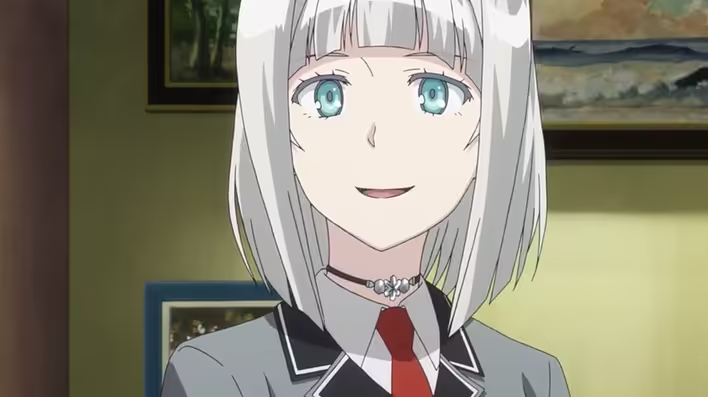

Anna demonstrates a more comedic variant of the archetype.
After awakening romantic feelings, her behavior becomes so obsessive that it turns into the main source of humor in the series. She is ready to stalk, control, and literally not leave her beloved alone.
Although Shimoneta is a comedy, Anna is often referred to as one of the brightest contemporary examples of yandere.
Akane Hiyama — Love Tyrant (Renai Boukun)


Akane is another example of how the archetype can be used in comedy.
She is extremely jealous, emotional, and ready for extreme actions due to her feelings. At the same time, the series deliberately exaggerates her behavior for comedic effect.
Her character well demonstrates that yandere are not always characters in a psychological thriller—sometimes this archetype becomes the basis for parody.
Are All Cruel Characters Yandere?
No.
This is one of the most common mistakes among anime fans.
If a hero behaves aggressively, that does not automatically make them yandere. What matters is the reason for their behavior.
If a character acts cruelly due to a thirst for power, a desire for revenge, ideological beliefs, or simply derives pleasure from violence, they do not belong to this archetype.
Yandere is primarily a hero whose actions are defined by excessive attachment to a specific person. This attachment gradually becomes unhealthy and starts to dictate their decisions.
Because of this, not every antagonist or mentally unstable character is yandere.
Yandere is one of the most vivid and simultaneously ambiguous archetypes in Japanese pop culture. Its main feature is not cruelty, but feelings that exceed healthy attachment and turn into obsession.
That is why yandere can be both a tragic hero and an antagonist or even a comedic character. The only constant remains: love or care so overwhelms the hero that it begins to define almost all of their actions.
This psychological contradiction has made the archetype one of the most recognized in anime and manga. Even today, yandere continues to evolve, but its main idea remains unchanged—to show how the brightest feelings can lose healthy boundaries.
Other Dere Archetypes
If you are interested in character archetypes in anime, we also recommend exploring other representatives of dere:
- Tsundere (Tsundere) — hide their feelings behind cold or harsh behavior.
- Dandere (Dandere) — quiet and shy characters who open up only to those they trust.
- Kuudere (Kuudere) — reserved heroes who rarely show their emotions.
- Deredere (Deredere) — open, friendly, and sincerely show affection.
- Himedere (Himedere) — behave as if they are princesses and expect special treatment.
- Kamidere (Kamidere) — convinced of their own uniqueness and seek to control others.
- Oujidere (Oujidere) — characters who strive to match the image of the perfect prince.
- Mayadere (Mayadere) — former opponents or antagonists who switch sides to the main character.
- Bakadere (Bakadere) — kind, sincere, but very naive or comically clumsy characters.
Like it?React
🧵
This post doesn't have any additions from the author yet.