The word “stalker” today has several meanings. For some, it is the hero of the cult series of Ukrainian video games S.T.A.L.K.E.R., for others — a person who explores abandoned places, while some primarily associate it with obsessive stalking in real life or social networks.
Interestingly, all these meanings share a common root, but emerged at different times and in completely different spheres. Although the English word stalker existed long before the advent of computer games and even science fiction, its modern cultural meaning was formed much later. Initially, it was reinterpreted by literature, then by cinema, and in the 21st century, it was given new life by the Ukrainian gaming industry.
Today, the word “stalker” has long ceased to be just a translation of the English stalker. It has transformed into a separate cultural phenomenon that can mean completely different people depending on the context.
In short: a stalker is a word that has several different meanings. Most often, it refers to the hero of the S.T.A.L.K.E.R. game series, an explorer of abandoned places, or a person who illegally enters the Chernobyl zone. At the same time, in psychology and law, a stalker is a person who obsessively pursues another person. All these meanings derive from the English word stalker, but they formed at different times and in different spheres.
Where the word “stalker” comes from
The word stalker comes from the English verb to stalk, which means “to creep up quietly,” “to pursue unnoticed,” or “to track prey.”
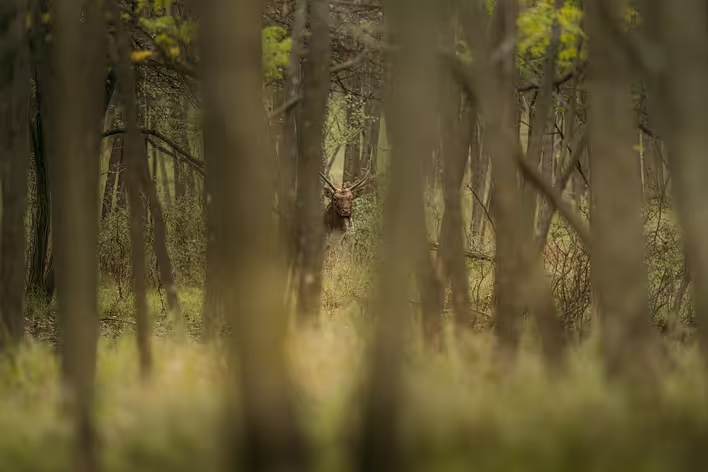
Initially, this term was used mainly by hunters. A stalker was a person who did not chase prey randomly but patiently tracked it, using cover, terrain features, and their own stealth. A good hunter had to approach the animal so closely that it wouldn’t even suspect their presence.
Over time, the concept began to be used more broadly. It came to denote any hidden pursuit — not only during hunting but also in a figurative sense. This meaning became the basis for all subsequent interpretations.
However, the true story of the modern image of the stalker began not in the English-speaking world, but in Soviet science fiction.
The novel that changed the meaning of the word
In 1972, writers Arkady and Boris Strugatsky published the novel “Roadside Picnic”. It was this work that made the word “stalker” famous far beyond the English language.
The Strugatskys were the first to use the English word stalker as the name for the illegal profession of people who penetrate the mysterious Zone. Since then, it began to acquire a completely new cultural meaning.
In the novel, events take place after a mysterious visit from an extraterrestrial civilization. After its disappearance, several anomalous territories remain on Earth, known as the Zone. Inside them, incomprehensible physical phenomena occur, deadly traps are encountered, and strange objects of extraterrestrial origin — artifacts — remain.
Access to the Zone is officially prohibited. However, there are always people willing to risk their lives for money, scientific discoveries, or simply out of a thirst for the unknown. These are the ones called stalkers.
In the novel, a stalker is neither a hero nor a criminal. They are an illegal guide and artifact seeker who knows the Zone perfectly, can navigate its deadly traps, and find a way where an ordinary person would almost certainly perish.
It was after the release of the novel that the word “stalker” ceased to be associated only with pursuit. It acquired a new cultural meaning — a person who consciously enters a dangerous and forbidden world.
Tarkovsky’s “Stalker”: a new philosophical image
The concept gained even more popularity after the release of the film “Stalker” in 1979.
Although the film is based on the novel “Roadside Picnic,” director Andrei Tarkovsky significantly reinterpreted the plot. The mysterious Zone remains at the center of the story, but now it has become less of a dangerous place and more of a space where a person confronts their fears, doubts, and deepest desires.
In the film, the stalker no longer seeks artifacts for sale. He becomes a guide who accompanies others through the Zone. His task is to lead travelers to the mysterious Room, where, according to legend, the deepest human desires are fulfilled.
After the film's release, the image of the stalker became even more multifaceted. It began to be associated not only with an adventurer but also with a person who leads others into the unknown, helps them navigate through danger, and becomes a kind of guide between the ordinary world and something unfathomable.
This image — a silent guide who knows hidden paths — has long been entrenched in global culture.
The Ukrainian game that gave the word new life
If the novel and the film made the word “stalker” known among fans of science fiction, the real explosion of its popularity occurred in 2007.
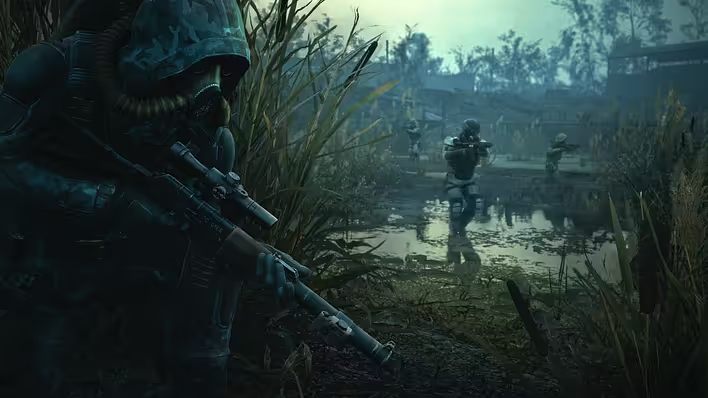
It was then that the Ukrainian studio GSC Game World released the game S.T.A.L.K.E.R.: Shadow of Chernobyl.
The game is not a direct adaptation of the novel. Its authors used the main ideas of “Roadside Picnic,” the image of the Zone, and the profession of a stalker, creating a completely independent universe.
The events unfold in the Chernobyl exclusion zone, which, after a fictional second explosion at the nuclear power plant, has turned into a dangerous world of anomalies, mutants, and mysterious artifacts.
It is here that the word “stalker” acquired its most famous modern meaning.
In the game, stalkers are people who illegally enter the Zone. Some seek artifacts to make money, others conduct scientific research, while others try to uncover its secrets or simply survive in extremely dangerous conditions.
The image of the stalker combines several traits: an explorer, an adventurer, a hunter, a seeker of thrills, and a person who constantly balances between life and death. This is how millions of players around the world envision him today.
How the game influenced modern culture
The popularity of the S.T.A.L.K.E.R. series turned out to be so great that the word “stalker” began to live its own life.
For many people, it is no longer associated with either the Strugatskys' novel or Tarkovsky's film. Primarily, they recall the gloomy landscapes of the Chernobyl exclusion zone, abandoned villages, anomalies, artifacts, detectors, gas masks, and a constant sense of danger.
It is the S.T.A.L.K.E.R. series that has most influenced the modern perception of the stalker image. It has made it a symbol of a person who consciously ventures where most would never dare to go, to explore the unknown, uncover secrets, and survive in extreme conditions.
No less importantly, the game has turned the Chernobyl exclusion zone into one of the most recognizable images of Ukrainian pop culture in the world. For many foreigners, it is the S.T.A.L.K.E.R. series that became their first acquaintance with Chernobyl and the Ukrainian gaming industry.
However, the story of this word does not end here. Gradually, it began to acquire new meanings, some of which are almost no longer connected with either the Strugatskys' novel or the game. These will be discussed in the second part of the article.
Urban stalkers: explorers of abandoned places
Over time, the word “stalker” has gone far beyond literature and computer games. It began to refer to people who explore abandoned buildings, industrial enterprises, mines, bunkers, military structures, and other neglected places.
This direction is known as urban exploration (urban exploration, or urbex). However, in Eastern European countries, its participants are often called stalkers. This is largely due to the novel “Roadside Picnic,” Tarkovsky's film, and especially the S.T.A.L.K.E.R. game series, in which abandoned territories became the main arena of events.
For most urban stalkers, it is not just about seeking thrills. Many engage in photography, document historical buildings, study industrial heritage, or seek to preserve the memory of places that may soon disappear forever.
That is why among representatives of this community, there has long been an unwritten rule: “Take nothing but pictures. Leave nothing but footprints.” It emphasizes the main principle of urban exploration — to respect the place, not to destroy it, and not to take found items.
At the same time, such expeditions are associated with real risks. Old structures may be in a state of disrepair, contain toxic substances, have open mines, unstable ceilings, or other dangers. Moreover, many sites are private property or are protected, so trespassing can violate the law.
That is why responsible researchers emphasize: urban exploration requires not only curiosity but also serious preparation, knowledge, and respect for current legislation.
The Chernobyl zone and real stalkers
After the release of the game S.T.A.L.K.E.R., the word “stalker” began to be widely used regarding people who illegally entered the Chernobyl exclusion zone.
This became particularly noticeable in the 2000s. The popularity of the game prompted many fans to head to the Zone to see for themselves the places that inspired the developers. Some visitors used official routes, but there were also those who tried to enter illegally.
It was these people that journalists, bloggers, and subculture participants began to call stalkers.
It is worth noting that this is not an official term. There is no such concept in legislation or regulatory documents. It is rather a cultural name that emerged under the influence of artistic works and gradually became established in media and popular culture.
After the beginning of the full-scale war, the situation around the Chernobyl zone changed significantly, and the issue of safety took on a completely different meaning. Therefore, today, romanticizing illegal entry into the Zone would be inappropriate.
Stalking: when the word took on a negative meaning
At the same time, in the English language, the word stalker developed in another direction.
The term stalking means obsessive and unwanted pursuit of a person, while stalker refers to a person who engages in such pursuit.
This can manifest in constant calls, messages, unwanted gifts, surveillance, appearing near a home or workplace, as well as intrusive control of a person's online activity.
Unlike the romantic image of the explorer-stalker, in legal and psychological contexts, stalking is considered a dangerous form of behavior. It can cause a person to experience constant fear, anxiety, and a sense of loss of personal safety.
That is why in many countries around the world, stalking is a separate offense or even a criminal act.
Is viewing someone else's profile stalking?
In recent years, the word “stalker” has acquired yet another, more colloquial meaning.
In social networks, one can often hear humorous expressions like: “I did a bit of stalking on his Instagram” or “She’s a real stalker — found photos from ten years ago.”
In most cases, this is just internet slang.
If a person simply views another user’s open profile, this is not stalking in the legal or psychological sense. A completely different situation arises when the observation becomes obsessive, systematic, unwanted, and begins to cause fear or discomfort in a person.
It is such behavior that corresponds to what psychologists and lawyers call stalking.
One word — several different stories
Today, the word “stalker” can be heard in a variety of contexts.
For some, it is an experienced guide from the Strugatskys' novel. For others, it is the mysterious hero of Tarkovsky's film. Some immediately think of the Ukrainian game series S.T.A.L.K.E.R. and dangerous journeys through the Chernobyl zone. Some are closer to the image of an explorer of abandoned places, while others primarily think of obsessive pursuit of a person.
Despite their common origin, today these are essentially several different concepts that exist in parallel. They are united only by the initial meaning of the English verb to stalk — to follow unnoticed or to penetrate where others do not dare to go.
The history of this word well illustrates how language changes along with culture. Literature gave it new meaning, cinema made it a symbol of philosophical quests, the Ukrainian video game transformed it into a recognizable image of an adventurer, while modern law and psychology turned it into a term that describes a dangerous form of pursuit.
That is why today, upon hearing the word “stalker,” it is primarily worth paying attention to the context. Depending on the situation, it can mean the hero of a fictional work, an explorer of abandoned places, or a person who violates another person's personal boundaries. Few words have undergone such an unusual journey — from an English hunting term to one of the most well-known concepts in modern pop culture.