IP - is an international standard for classifying the protection of devices and is presented in the form of a rating/class.
Структура IPXX класа
What is IP (Ingress Protection, International Protection Marking Rating)?
This standard defines the degree of protection against moisture, dust, and other external factors provided to equipment.
The IP rating has the format "IPXY", where X indicates protection against solid objects, and Y indicates protection against water. The IP code may also have additional letters that describe other types of protection.
For which devices is the IP rating used?
The IP rating applies to electrical and electromechanical devices. The level of protection allows understanding under what conditions the equipment will operate correctly.
It is very important to know the device's ability to withstand the effects of water and dust to ensure reliable operation in various conditions.
What do the two digits in the IP rating mean?
After the prefix "IP" (Ingress Protection), two digits are used, each indicating the level of protection of the device against two different factors: solid particles (dust) and water, respectively.
IP - Ingress Protection
X - Level of protection against solid particles and objects (dust, dirt, hands, tools, wires, etc.)
Y - Level of protection against water
A third digit was previously used to indicate resistance to mechanical impact. However, this indicator is no longer used.
What does the first digit of the IP protection class mean?
In the structure "IPXY", X is the first digit and can have a value from 0 to 6 or X.
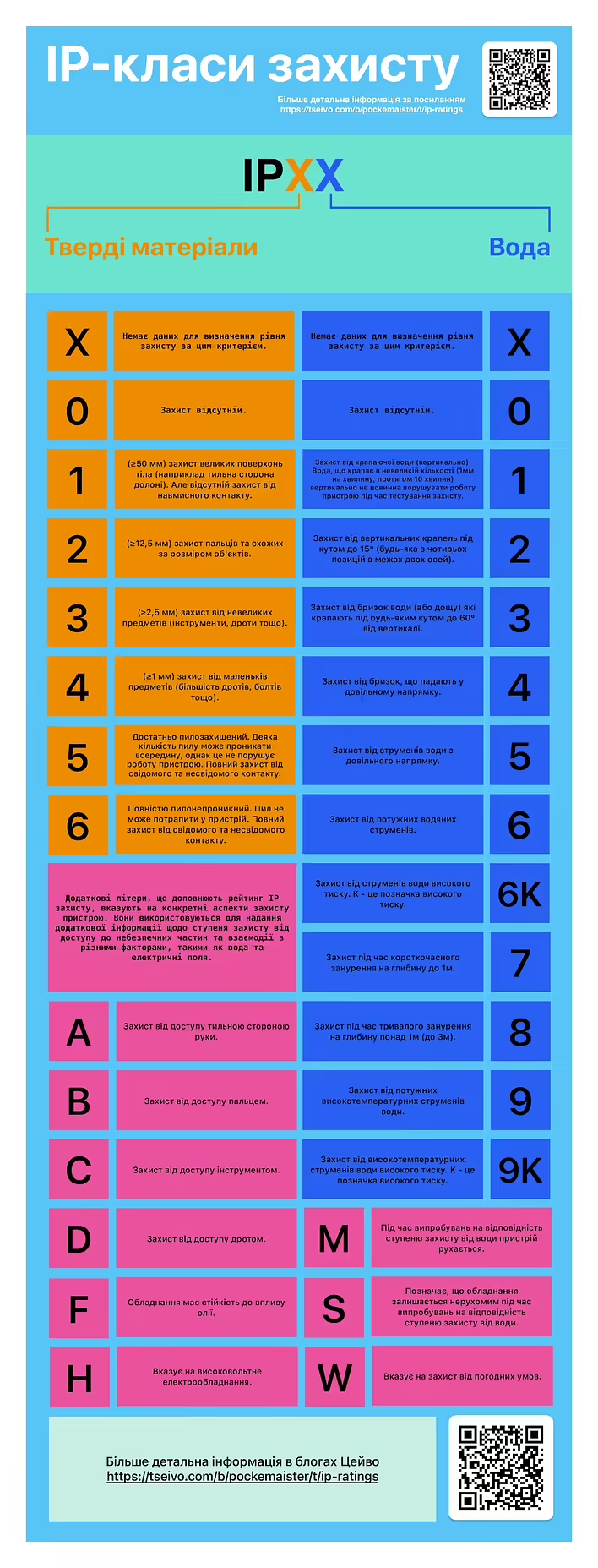
X: X means that there is no data to determine the level of protection according to this criterion. 0: No protection. 1: (≥50 mm) protection of large body surfaces (e.g., the back of the hand). However, there is no protection against intentional contact. 2: (≥12.5 mm) protection for fingers and similar-sized objects. 3: (≥2.5 mm) protection against small objects (tools, wires, etc.). 4: (≥1 mm) protection against small items (most wires, bolts, etc.). 5: Dust protected. Some dust may enter, but it does not interfere with the operation of the device. Full protection against intentional and unintentional contact. 6: Completely dustproof. Dust cannot enter the device. Full protection against intentional and unintentional contact.
What does the second digit of the IP protection class mean?
In the structure "IPXY", Y is the second digit and can have a value from 0 to 9 or X.
X: X means that there is no data to determine the level of protection according to this criterion. 0: No protection. 1: Protection against dripping water (vertically). Water dripping in small amounts (1mm per minute, for 10 minutes) vertically should not interfere with the operation of the device during the protection test. 2: Protection against vertical drops at an angle of up to 15° (any of the four positions within two axes). Water dripping vertically should not interfere with the operation of the turned device (3mm per minute, 2.5 minutes on each side, 10 minutes total) during the protection test. 3: Protection against splashes of water (or rain) that drip at any angle up to 60° from vertical. Water should not interfere with the operation of the turned device for 5 minutes during the protection test. 4: Protection against splashes falling in any direction. Water should not interfere with the operation of the device for 10 minutes during the protection test. 5: Protection against water jets from any direction. Water entering through a nozzle (6.3 mm) onto the housing from any direction should not have harmful effects for one minute per square meter (at least three minutes total) during the protection test. The volume of water during the test should be 12.5 liters per minute, and the pressure 30 kPa at a distance of 3 meters. 6: Protection against powerful water jets. During testing, powerful jets of water (12.5mm) onto the housing from any side should not have harmful effects. The volume of water during the test should be 100 liters per minute, and the pressure 100 kPa at a distance of 3 meters. 7: Protection during short-term immersion at a depth of up to 1m. During short-term immersion, water does not enter in amounts that interfere with the operation of the device. Continuous operation in submerged mode is not anticipated. Water should not interfere with the operation of the submerged device for 30 minutes during the protection test. 8: Protection during prolonged immersion at a depth of more than 1m (up to 3m). Complete waterproofing (for certain types of equipment, this may mean that water can penetrate, but only without harmful consequences). The device can operate in submerged mode. 9: Protection against powerful high-temperature water jets. Testing of devices is conducted with hot water (80 °C) and water pressure of 80-100 bar.
There is also an exception - the addition of the letter K to 6 and 9. K is a designation for high pressure. Protection against the effects of frequent high pressure is required in some specialized fields.
6K - Protection against high-pressure water jets. K is a designation for high pressure. 9K - Protection against high-temperature high-pressure water jets. K is a designation for high pressure.
What additional letters does the IP protection rating have and what do they mean?
Additional letters that complement the IP protection rating indicate specific aspects of the device's protection. They are used to provide additional information regarding the degree of protection against access to hazardous parts and interaction with various factors such as water and electric fields.
The letters and their meanings:
A: Protection against access from the back of the hand. B: Protection against access from a finger. C: Protection against access from a tool. D: Protection against access from a wire.
The letters from A to D indicate the degree of protection for people against access to hazardous parts and are specified only when the degree of protection against access to hazardous parts is higher than the degree of protection indicated by the first digit. These letters may also be used when the first digit is absent (is X).
Other additional letters:
F: Equipment has resistance to oil effects. H: Indicates high-voltage electrical equipment. M: During tests for compliance with the degree of protection against water, the device is in motion. S: Indicates that the equipment remains stationary during tests for compliance with the degree of protection against water. W: Indicates protection against weather conditions.
Perhaps information about IP classes will be better perceived in the form of an image:
Пам'ятка з переліком значень IP-класів
For convenience - you can download the reminder about the values of IP classes in PDF format. When distributing - please leave a link to the original source.




![[Personal experience] How to hang a swing on a metal pull-up bar?](https://cdn.tseivo.com/e76ifnqj90sapho8adacvm65sp43)