This content has been automatically translated from Ukrainian.
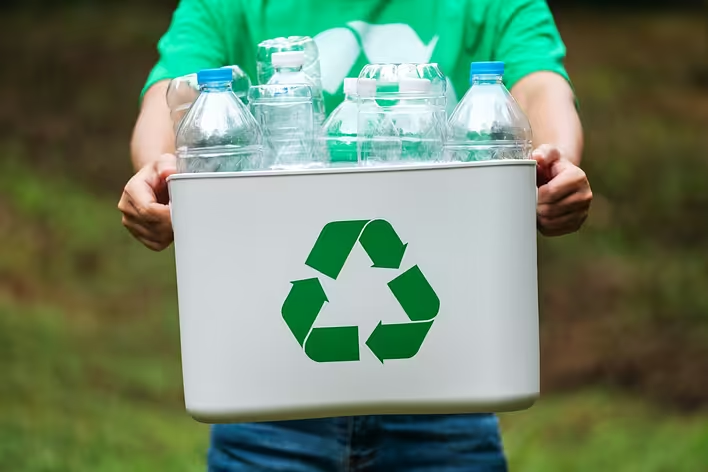
The numbers in the triangle are not about recycling, as often thought, but about the type of material (polymer) from which the item is made. And this determines how the plastic behaves: whether it can be heated, washed, reused, or better thrown away immediately.
In everyday life, we deal with seven main types — and each of them has its own "character".
1 — PET (polyethylene terephthalate)
This is the same transparent, lightweight plastic from which most water and beverage bottles are made. It is lightweight, transparent, and holds its shape well.
But there is a nuance: PET is primarily designed for single-use. Over time and with heating, it can lose its properties, so reusing such bottles is not the best idea.
In everyday life, this includes:
- bottles for water, carbonated drinks, juices
- packaging for salads, berries, ready meals
- jars for sauces, peanut butter
- bottles for shampoos, gels
Interesting fact: the same PET is also used in textiles — for example, in polyester.
But it is important: this plastic does not like heat and multiple uses. When heated or used for a long time, substances (such as antimony) may leach out.
2 — HDPE (high-density polyethylene)
This plastic looks more "matte" and dense. It is often used for milk bottles, canisters, and household chemical containers.
HDPE is considered a fairly safe and stable material. It withstands contact with liquids well and does not react easily, making it suitable for reuse.
In everyday life:
- bottles for milk, kefir
- canisters for water
- packaging for household chemicals
- bottles for shampoos and detergents
- children's toys
- storage containers
Why it is loved:
- very strong and impact-resistant
- not afraid of moisture and most chemicals
- considered one of the safest for contact with food
This is the plastic that can be safely reused (within reason).
3 — PVC (polyvinyl chloride)
One of the most controversial types of plastic. In everyday life, it can be found in films, packaging, sometimes — in interior elements or artificial leather.
The problem is that PVC often contains additives that can migrate from the material. Therefore, for food and drinks, it is not the best choice. If you see "3" on a container or bottle — it is better to treat it with caution.
In everyday life:
- pipes, window frames
- shower curtains
- floor coverings (linoleum)
- artificial leather (bags, furniture)
- cable insulation
- sometimes — food wrap
The problem is that this plastic often contains plasticizers (such as phthalates) that can affect health.
Therefore:
- for household items — okay
- for food and heating — better to avoid
4 — LDPE (low-density polyethylene)
Soft, flexible, and a bit "crinkly" — this is the same plastic used to make bags, wraps, and some lids.
LDPE withstands moisture well and is not brittle, but is rarely used for rigid containers. In everyday life, it is more about packaging than storing food for a long time.
In everyday life:
- supermarket bags
- food wrap
- freezer bags
- bread packaging
- soft tubes (sauces, honey)
- inner lining of paper cups
Its plus is flexibility and water resistance. It is quite stable and not considered dangerous.
But:
- not very suitable for reuse
- rarely recycled
5 — PP (polypropylene)
One of the most convenient and versatile options. PP is often used for containers, lunch boxes, lids, and kitchen utensils.
Its main advantage is heat resistance. It is well suited for hot food and often withstands microwaving. That is why many consider this type of plastic optimal for daily use.
In everyday life:
- food containers
- lunch boxes
- yogurt cups
- bottle caps
- kitchen utensils
- baby bottles
- medical containers
PP:
- not afraid of hot food
- holds its shape well
- resistant to chemicals and loads
That is why it is often labeled as "microwave safe" (although this does not mean absolute safety when heating).
6 — PS (polystyrene)
This is the familiar "foam" or lightweight transparent plastic.
In everyday life:
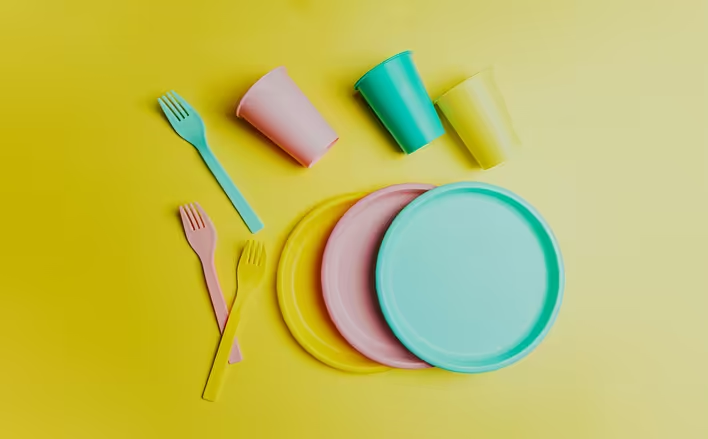
- disposable cups
- food trays (especially meat in supermarkets)
- fast food boxes
- plastic cutlery
- packaging for electronics (foam)
The problem is that:
- when heated, it can release styrene
- it has low thermal resistance
Therefore, this is typically single-use plastic that is better not to reuse and definitely not to heat.
7 — OTHER (other plastics)
This is the most interesting and confusing category. It includes everything that did not fall into the previous groups:
- polycarbonate (PC)
- acrylic
- nylon
- bioplastics (PLA)
- mixed materials
In everyday life, this includes:
- reusable water bottles
- water coolers
- some containers
- baby bottles (older models)
- transparent boxes
The main nuance — BPA (bisphenol A), which may be in polycarbonate. That is why it is often labeled BPA free.
This is plastic where you always need to read the fine print.
How to use this
You don't have to memorize all seven types. A simple guideline is enough:
- Okay for household and food: 2 (HDPE), 4 (LDPE), 5 (PP)
- With caution: 1 (PET), 7 (check composition)
- Better to avoid for food: 3 (PVC), 6 (PS)
And one more important point: even "safe" plastic does not mean it should be heated daily — when heated, any plastic can release micro-particles.
Like it?React
🧵
This post doesn't have any additions from the author yet.