This content has been automatically translated from Ukrainian.
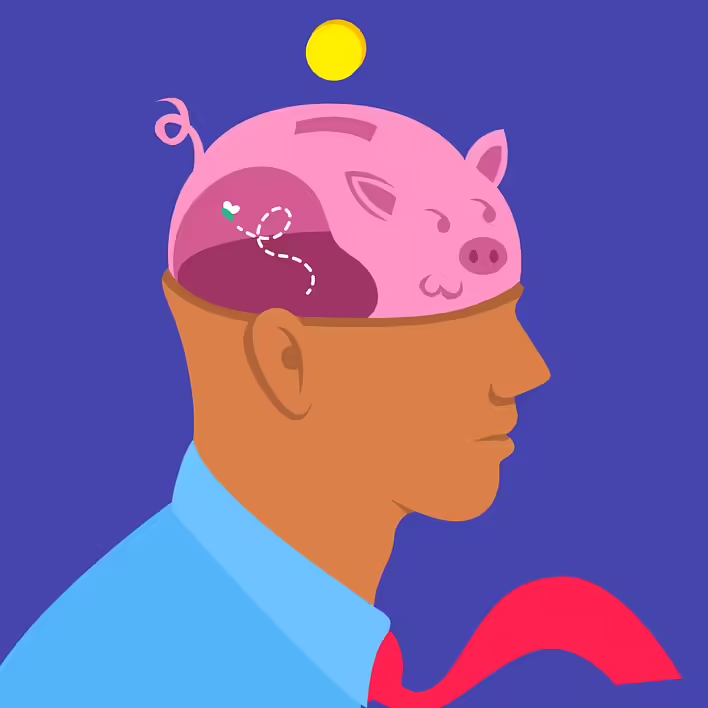
In many economics textbooks, you can find the concept of “rational man” (Lat. homo economicus). This is not a real person, but a simplified model that helps economists explain and predict people's behavior in the world of money, goods, and choices. It has become the foundation of classical and neoclassical economics, but at the same time, it is one of the most criticized ideas in this field.
Who is the “rational man”?
According to the classical model, a rational man:
- has clear and stable interests;
- possesses complete information;
- can process it logically;
- always chooses the option that will bring him the maximum benefit.
In simpler terms, if such a person faces a choice, they will weigh all the “pros” and “cons,” calculate possible costs and benefits — and make the optimal decision. Without emotions, impulses, and mistakes.
Why do economists need such a model?
The model of the rational man emerged not because someone sincerely believed in its realism. It was needed as a convenient tool. Even Adam Smith and later economists of the 18th and 19th centuries tried to explain complex economic processes with simple rules.
The rational man allows:
- to build mathematical models;
- to predict market reactions to price changes;
- to explain supply and demand;
- to analyze competition and firm behavior.
Without such simplification, the economy would be too chaotic for analysis.
How does this look in practice?
Imagine a shopper in a supermarket. From the perspective of classical economics, he:
- compares all brands;
- knows the actual quality of each product;
- remembers prices in other stores;
- chooses the best price-to-benefit ratio.
In real life, however, a person often picks a familiar brand, reacts to a discount with a bright label, or buys something impulsively — simply because they are tired or hungry.
Key assumptions of the model
The classical model is based on several key ideas:
- People act in their own interests. Altruism or moral motives are either ignored or considered a form of personal benefit.
- Choice is always consistent. If a person prefers A over B, and B over C, then they will not choose C over A.
- Errors are random. The model does not account for systematic and repeatable errors.
These assumptions later became the main target for criticism.
What is the problem with the “rational man”?
Over time, it became clear: people do not just sometimes behave irrationally — they do so predictably. Emotions, social pressure, habits, fear of loss, and even the wording of the question influence decisions.
People:
- overpay for status items;
- cling to unprofitable decisions due to “sunk costs”;
- fear losses more than they rejoice in gains;
- often lack either the time or desire to calculate everything down to the last detail.
These observations spurred the development of behavioral economics, which complemented the classical model with a more “human” perspective.
Does this mean the model is outdated?
Despite the criticism, the model of the rational man has not disappeared. It is still actively used in economics, finance, and business — but with an understanding of its limitations.
Its strength lies not in accurately describing people, but in the fact that:
- it provides a clear starting point;
- it works on large datasets;
- it allows for the identification of general patterns.
In a sense, the “rational man” is not a portrait of a real consumer, but an idealized compass that shows where the economy would move if everyone were coldly logical.
The classical economic model of the “rational man” is a simplification that made the development of economic science possible. It helps explain markets but poorly describes living people with their emotions, weaknesses, and contradictions. It is at the intersection of this model and real behavior that the most interesting questions of modern economics arise.
Like it?React
🧵
This post doesn't have any additions from the author yet.