This content has been automatically translated from Ukrainian.
Among Japanese urban legends, a special place is occupied by Aka Manto — a mysterious and deadly spirit that appears… in school bathrooms. Its story is simple, but it is this simplicity that makes it truly frightening.
Who is Aka Manto
The name “Aka Manto” literally translates to “red cloak.” He is described as a tall man with a mask or a hidden face, dressed in a red cape. Sometimes he looks attractive, other times — like something overtly inhuman.
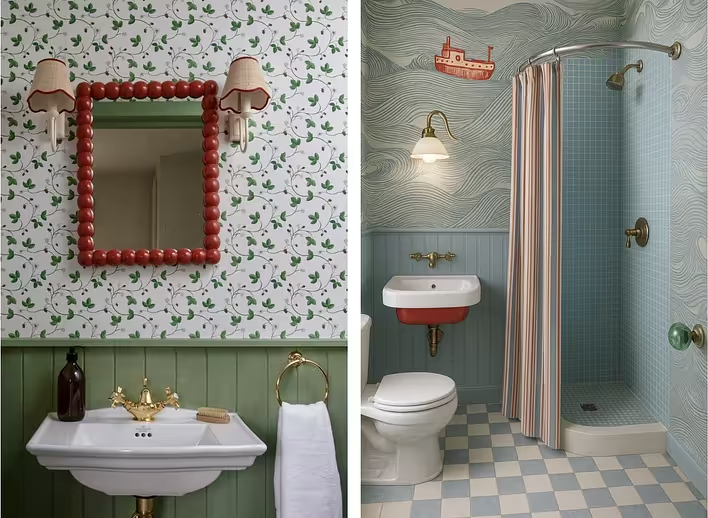
His appearance always occurs in one place — in a bathroom stall, usually in schools or public buildings.
Deadly Question
When a person is alone in the bathroom, they may hear a voice. This is Aka Manto.
He asks a simple question — “Red paper or blue?”
And this is where the real horror begins. If you choose red — the victim is brutally killed, often described as an attack with severe injuries and a lot of blood. And if you choose blue — death is also inevitable, but different: suffocation or “life being sucked out,” after which the body becomes unnaturally pale.
Aka Manto frightens not by appearance, but by the situation. You are in a confined space, alone, and must make a choice that changes nothing.
In some versions of the legend, there is a single chance to survive — refuse the choice or say something like:
“I don’t need paper”
But even this does not guarantee salvation. As in most Japanese horror stories, the rules change, and the spirit always has the advantage.
Origin of the Legend
The story of Aka Manto appeared in the 20th century, but became particularly popular in post-war Japan. There are versions that it is:
- a spirit of revenge that plays with its victims;
- or simply an embodiment of the fear of confined spaces and hopelessness.
Interestingly, the setting — the bathroom — is chosen not by chance. In Japanese culture, this place has traditionally been considered “liminal,” associated with unclean forces.
Aka Manto in Pop Culture
Like many other urban legends, Aka Manto has actively transitioned into modern culture.
- In manga and anime such as Toilet-Bound Hanako-kun, motifs of school spirits and “bathroom ghosts” are often used — although the characters may have different names, their logic of behavior is very similar.
- In the series Yamishibai: Japanese Ghost Stories, stories inspired by such legends appear, including the theme of fatal choice.
- The image of Aka Manto also appears in Japanese horror games and short films, where it is often used as a “moment of sudden horror.”
Like it?React
🧵
This post doesn't have any additions from the author yet.