This content has been automatically translated from Ukrainian.
Japanese urban folklore is filled with eerie stories, but one of the most brutal is the legend of Teke-Teke. This is the ghost of a girl who died under the wheels of a train and returned to the world of the living to seek revenge.
Origin of the Legend
According to the most common version, Teke-Teke was a schoolgirl who accidentally (or through suicide) fell onto the tracks. The train cut her body in half, but instead of dying, her spirit remained in this world.
Due to the horrific injury, she lost her lower body — and now moves by relying on her hands or elbows, dragging herself forward. This movement creates the characteristic sound "teke-teke," from which her name is derived.
If you want to learn more about this legend, you can watch the 2009 Japanese horror film "Teke-Teke," which gives us another interpretation of the origin of the schoolgirl ghost.
What Teke-Teke Looks Like
Descriptions may vary slightly, but she is most often depicted as follows:
- a young girl in a school uniform;
- long disheveled hair;
- pale or bloodied face;
- absence of the lower half of her body.
In some versions, she carries a scythe or another sharp object.
Sometimes Teke-Teke is confused with or associated with other Japanese spirits, such as Kashima Reiko — another ghost of a woman without a lower body. In some versions, they are even the same entity with different names.
How She Attacks
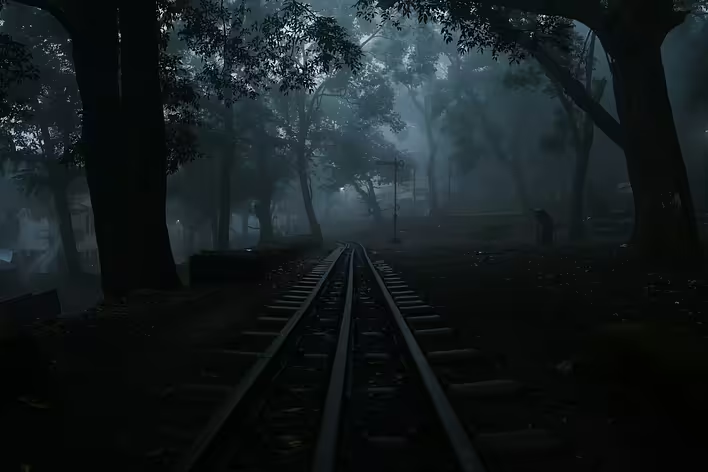
Teke-Teke primarily appears at night, especially near train stations, on dark streets, and generally in deserted places in the city.
She moves extremely quickly, despite lacking legs, and if she spots a person — she begins to chase them.
If escape is not possible, she may cut her victim in half or simply kill them, leaving the body distorted. Sometimes — she "transforms" the victim into a spirit similar to herself.
Can You Escape?
In most stories — there is almost no chance of survival. However, there are rare "survival rules" that change depending on the version of the legend:
- answer her questions correctly (if she speaks);
- not walk near the tracks at night;
- ignore any strange sounds resembling "teke-teke."
Like in many urban legends, these rules create more of an illusion of control than actually helping.
Like it?React
🧵
This post doesn't have any additions from the author yet.