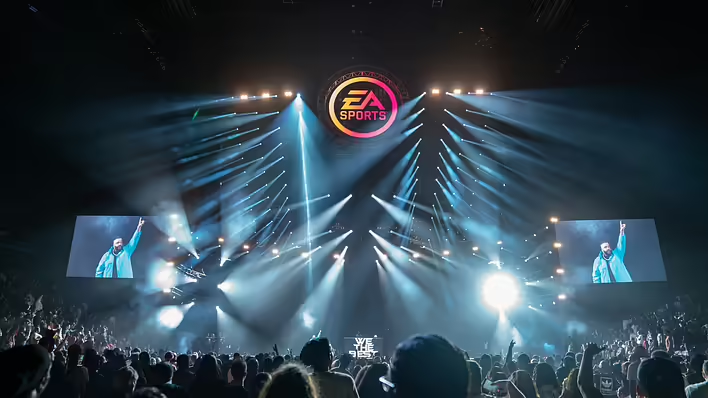
Gamers are people who actively play video games. They may do this for fun, as a hobby, or professionally.The word "gamer" is derived from the English "game" + the suffix -er, which means "one who does something." So literally: one who plays games. In the Middle Ages, the word "gamer" already existed in the English language and meant:
"a person who participates in gambling" (gambling).
In the 20th century, with the development of tabletop games (like Dungeons & Dragons), the term "gamer" began to be used for fans of such games.Since the 1980s, the meaning has shifted and started to be primarily associated with video games — it was then that it acquired its modern sense.
Conventionally, all gamers can be divided into several categories, according to the time spent in the game and the ultimate goal.
Casual gamers
Play from time to time, mostly for relaxation.
Often choose mobile or simple games.
Hardcore gamers
Play regularly and intensively.
Focus on complex games, completion, PvP battles (player versus player).
Esports players
Professional players who participate in competitions with large prize pools.
Play in team disciplines: CS2, Dota 2, League of Legends, etc.
Streamers / content creators
Stream their gameplay online (for example, on Twitch, YouTube).
Gaming for them is work and a form of interaction with the audience.
With the first category, it seems everything is clear. These are ordinary people who play games for their own enjoyment. Gaming for them is a simple and understandable pastime, like reading books or watching a favorite series. They are not chasing victory, nor do they strive to hone specific gaming skills — they simply do it "just for fun".
Moving on to the second category. These are still not professional players, but they spend significantly more time on video games than casual gamers. Here, the enthusiasm can be equated to a hobby. People are interested in everything happening in the world of video game development, read thematic news, visit forums, choose more complex games for themselves, and spend money on necessary equipment (computers, monitors, consoles, etc.). The main difference from the next categories is that they do not monetize their gaming in any way.
Now about esports players.
Esports are organized competitions in video games where professional players (so-called esports players) compete for prizes, titles, and recognition. The term "esports" (from the English cyber — "digital" and sport — "sport") began to be actively used in the late 1990s — early 2000s, when the popularity of online games and organized tournaments was growing.
1990s: The first major tournaments appear, such as World Cyber Games (WCG) and Electronic Sports World Cup (ESWC), which initiate international competitions in video games.
2000s: The development of the internet and online games contributes to the formation of professional teams and leagues.
2010s: Esports becomes a mass phenomenon, with large tournaments featuring prize pools in the millions of dollars, such as The International with Dota 2.
The largest international tournaments
The International (Dota 2): One of the largest tournaments in the world with a prize pool exceeding $40 million.
League of Legends World Championship: An annual tournament for the popular game League of Legends, with a huge audience and high prizes.
CS:GO Major Championships: Tournaments for Counter-Strike: Global Offensive, held several times a year with large prize pools.
Ukraine in esports:
Ukraine has a rich experience in esports, particularly thanks to the team Natus Vincere (Na'Vi). They are the pride of our country. The organization actively supports young talents, conducts training camps, and promotes the development of esports infrastructure in Ukraine. Their successes inspire a new generation of gamers and enhance Ukraine's prestige on the international stage.
Natus Vincere (Na'Vi) is one of the most famous and successful esports organizations in the world, founded in Kyiv in December 2009. Its name in Latin means "born to win." Since then, Na'Vi has won numerous titles in various disciplines, including Dota 2 and Counter-Strike.
Dota 2: In 2011, Na'Vi won The International, the first major tournament for Dota 2, which earned them $1 million in prize money.
Counter-Strike: The team won PGL Major Stockholm 2021, becoming the first team to win this tournament after a two-year break. They also won the Intel Grand Slam, receiving $1 million for winning four tournaments from ESL and IEM in one season.
2024: Na'Vi continued their successes, winning Intel Extreme Masters Rio 2024 and ESL Pro League Season 20, and becoming the number one team in the HLTV.org ranking for 18 weeks.
In 2010, the legendary computer club — Kyiv Cyber Arena opened in Kyiv. At the time of its opening, it was the largest in the country, occupying an area of 1500 m².During its operation, "Kyiv Cyber Arena" became a venue for numerous international tournaments, including:
IEM European Finals for CS 1.6
**The first minor for Dota 2 from Valve after TI7
PUBG StarSeries i-League and WCS Spring & Summer
Tournaments for Dota 2 and CS:GO
In February 2021, the club officially closed for repairs and updates. However, due to the COVID-19 pandemic, the restoration has been delayed, and it is currently unknown when and in what format the arena will resume its activities.
Another major player in this field is StarLadder, a Ukrainian company founded in 2012 that specializes in organizing esports tournaments. It has gained international recognition for hosting major events in disciplines such as Counter-Strike: Global Offensive (CS:GO), Dota 2, PUBG, and others.
StarLadder StarSeries — one of the most famous series of tournaments held since 2012. These competitions cover various disciplines, including CS:GO and Dota 2, and attract players and fans from all over the world.
CS:GO Major in Berlin (2019) — StarLadder organized one of the largest tournaments in the world for CS:GO, which took place in Berlin in 2019. This event became a significant milestone in the company's history and enhanced its reputation on the international stage.
Collaboration with NODWIN Gaming — In January 2025, StarLadder was acquired by the Indian company NODWIN Gaming for $5.5 million. This deal allows for the combination of StarLadder's experience in hosting top esports events with NODWIN Gaming's vision for development.
Festivals in Dubai — StarLadder collaborates with EMG to organize annual esports festivals in Dubai from 2023 to 2025. These events promote the development of esports in the Middle East and attract the best teams from around the world.
Plans for 2025 — Despite changes in the CS2 Major schedule, StarLadder plans to hold the 20th season of StarSeries in September 2025. This indicates the company's commitment to continue organizing major tournaments even amidst changing schedules for international competitions.
Now we move on to the last category — streamer-gamers. These are players who stream their gameplay live through platforms like Twitch, YouTube, Kick, Facebook Gaming, etc. They not only play but also interact with viewers, comment on events in the game, entertain the audience — essentially combining gaming, show hosting, and blogging.The streamer starts the broadcast from their PC or console. Viewers can watch the stream in real-time and communicate with the host in the chat. Often, streamers also earn from this by using donations — viewers can send money that appears on the screen during the broadcast. Let's talk a little more about the monetization of streams. Here are the most popular ways to earn:
1. Donations — viewers send money to the streamer during the broadcast. The most direct way to support. A viewer voluntarily sends money during the stream.
Platforms: Donatello, DonatePay, Streamlabs, Patreon, Buy Me a Coffee.
Donations are often accompanied by a message on the screen and voiceover — this motivates donations for the reaction of the streamer.
Some streamers add: “donation — triggers music/effect/joke/game change.”
2. Subscriptions (subs).On platforms like Twitch or YouTube, viewers can subscribe for a fee to:
get a "sub" badge in the chat,
use unique emojis,
gain access to private streams or chats.
Twitch: a sub costs from $4.99, the streamer receives ~50% (or more if a partner).
YouTube: sponsorship (membership) — also from ~$5.
3. Advertising — direct or through affiliate programs.
Pre-roll — a short advertisement before the stream.
Ad integration — the streamer promotes a brand, game, or service (for example, VPN, energy drink, online store) live.
Banner on the screen — partner's logo.
Profit depends on:
the number of viewers (from 1,000 viewers and above — already interesting for the brand),
the theme of the stream (games, lifestyle, tech, etc.),
the activity of the audience.
4. Sponsorship — companies pay for placing their logo or advertisement.
Brands enter into long-term contracts with popular streamers.
This can be a clothing brand, devices, energy drinks, peripherals, etc.
For example:
Logitech, Razer — provide equipment and funding.
Monster Energy, GFuel — support popular streamers.
5. Merchandise sales — t-shirts, mugs, etc.
Streamers create a brand — and sell items with their own logo, phrases, memes, etc.
This helps not only to earn but also to strengthen the fan base.
And finally. In modern usage, it is correct in Ukrainian to:
stream — as a broadcast (from the English stream)
streamer — as a person who hosts a stream
And not “стрім” and “стрімер” — this is a calque from Russian, which was previously widespread but is now officially not considered normative in Ukrainian IT lexicon.