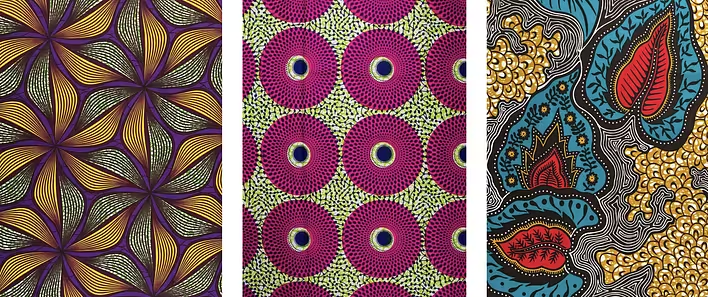
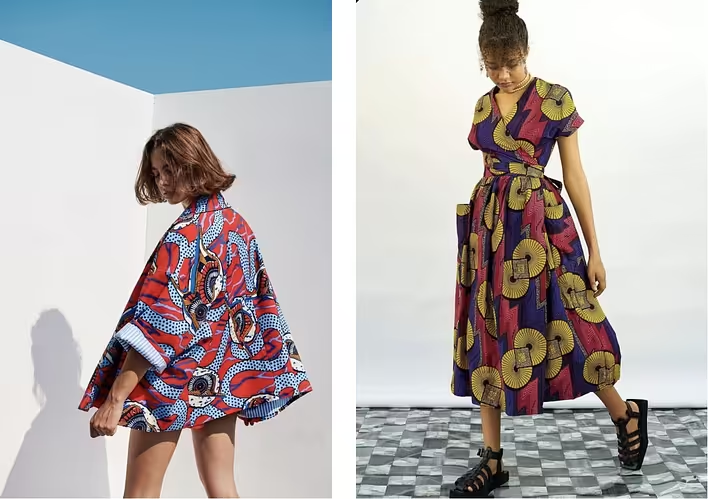
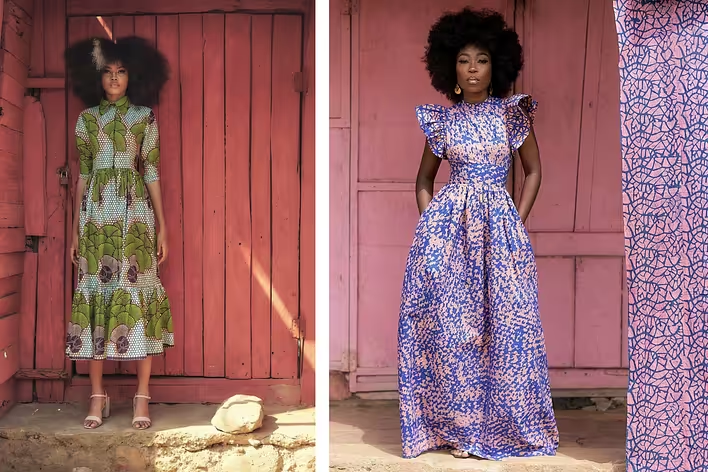
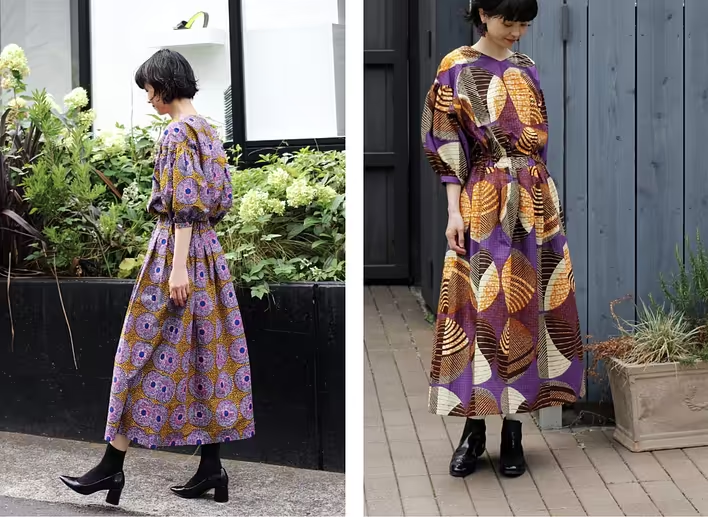
Today, Ankara is one of the most recognizable fabrics in the fashion world. Bright geometric patterns, rich colors, large floral motifs, and bold combinations have long transcended traditional clothing. It is used in high fashion, street style, interiors, accessories, and even contemporary art. African wax prints regularly appear in the collections of global designers, and modern fashion constantly reinterprets them in dresses, suits, turbans, and bags.
But the most interesting thing about Ankara is its unexpected history. Despite the fact that this fabric is often called "African" today, its origins are much more complex and span several continents: Asia, Europe, and Africa.
What is Ankara
Ankara is a cotton fabric with bright prints, often referred to as African wax print, Dutch wax, or wax hollandais. It is made using the wax-resist dyeing method—a technology related to batik. This is why the fabric often exhibits the characteristic effect of small "cracks" in color, which has become its signature feature.
Classic Ankara usually has an equally bright pattern on both sides of the fabric. Most often, it is dense cotton, although today there are also blended options with polyester.
For many people around the world, Ankara has become almost a visual synonym for Africa. However, its journey to this status has been long and quite unexpected.
The origin of the name itself is not definitively established. There are several theories. According to one, the word "Ankara" is linked to the Turkish capital Ankara, from where supposedly cheaper versions of the fabric originated. Another popular theory claims that the name comes from African traders who altered the word "Accra"—the name of Ghana's capital, through which the fabric trade was actively conducted.
In different regions of Africa, the fabric has its own names. In East Africa, the words "kitenge" or "kanga" are often used, while in Francophone countries, it is called wax hollandais.
From Indonesian Batik to "African" Fabric
The history of Ankara begins in the 19th century in Indonesia. There, a tradition of hand batik—an intricate fabric dyeing technique using wax—had existed for centuries. Artisans manually applied wax to the fabric, after which the fabric was dyed. Where there was wax, the dye did not penetrate, creating a pattern.
Dutch colonizers, who controlled Indonesia, decided to mechanize this process and produce the fabric industrially. They hoped to sell a cheaper factory alternative to local batik. However, the plan failed: Indonesians did not accept the machine-made copies. They were considered to look "wrong," and the characteristic crackle—small paint cracks—was perceived as a defect.
Then European traders turned their attention to West Africa, where trading ships were already actively sailing. And here something unexpected happened: the fabric was extremely popular with local buyers. In Ghana, Nigeria, Senegal, and other countries, bright prints quickly became fashionable. Over time, it was Africa that transformed this fabric into a cultural phenomenon.
Ankara and Colonial History
Today, discussions about cultural identity and colonialism often revolve around Ankara. After all, the fabric that the world considers "traditionally African" actually arose as a result of colonial trade between Europe and Asia.
However, over time, it was African societies that gave it new meaning. Designs were adapted to local tastes, and production was partially relocated to Ghana and Nigeria. Local factories, unique styles, and regional characteristics emerged.
Thus, Ankara is an example of how an imported material can become an inseparable part of cultural identity.
High Fashion and Global Popularity
In the 21st century, Ankara experienced a new global surge in popularity. African designers began to actively integrate traditional prints into modern cuts, and the global fashion industry took notice of these fabrics.
Today, Ankara is used in:
evening dresses;
suits;
street fashion;
accessories;
furniture design;
interior decor.
Particularly popular have become combinations of traditional prints with modern silhouettes—oversized blazers, minimalist dresses, or sportswear.
Famous artists and designers also use wax print as a way to speak about post-colonial identity, migration, and globalization.
Due to the popularity of the fabric, the market has been flooded with cheap copies. Classic Dutch wax has historically been considered the standard of quality—the fabric was dense, and the colors very durable.
Today, many wax prints are produced en masse, and the quality can vary significantly. Cheap options often:
fade after washing;
have dull colors;
are printed only on one side;
wear out faster.
Because of this, textile enthusiasts pay attention to the density of the fabric, the clarity of the print, and the quality of dyeing.