This content has been automatically translated from Ukrainian.
What does Asimov Cascade mean
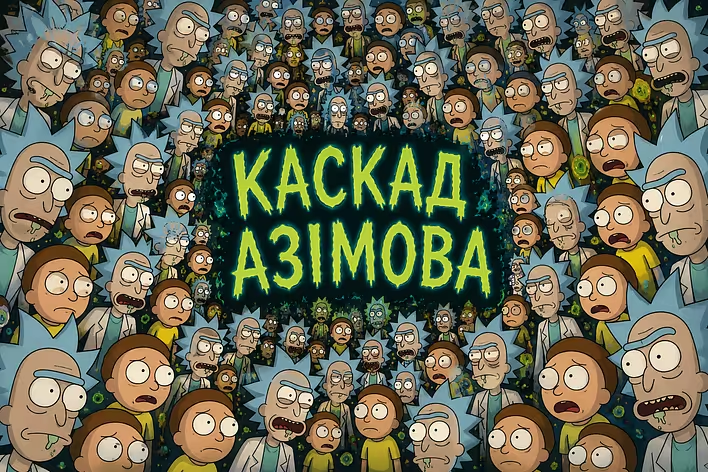
Asimov Cascade (eng. Asimov Cascade) is a fictional term from the animated series “Rick and Morty”, which first appears in the episode Mortyplicity — the second episode of the fifth season. This is how Rick describes the situation when the decoy families (eng. decoys) — robotic duplicates of the Smith family — start creating new duplicates themselves. Eventually, those also make their own copies, leading to an endless chain of identical families, making it practically impossible to determine who was created first.
Despite its scientific sound, Asimov Cascade is not a real theory or scientific term. Such a concept does not exist in robotics, computer science, or in the works of Isaac Asimov. It was specifically invented by the writers of “Rick and Morty” to explain the events of this episode and give them a characteristic pseudoscientific style.
In the episode, Rick explains that he created robotic copies of his family as decoys for enemies. Each such family lives separately and is convinced that it is the real one. Since all Ricks think alike, each of them eventually comes to the same conclusion: for their own safety, they need to create another decoy family. This is where the cascade begins.
Its principle can be briefly described as follows:
Rick creates a decoy family → Decoy Rick believes it is the real one → creates another decoy family → new Rick repeats the same process.
As a result, the number of copies rapidly increases, and the families themselves can no longer understand who is the original and who is just another decoy. Moreover, when they learn about the existence of other duplicates, they begin to perceive them as a threat and try to destroy them. The entire plot of the episode revolves around this conflict.
The word cascade in English means “cascade” or “chain reaction”. In the context of the episode, this name very accurately describes the events: one created family spawns the next, and that one — another, and this process continues until it completely spirals out of control.
Why is the cascade called Asimov's
The name Asimov Cascade is a reference to Isaac Asimov — one of the most famous science fiction writers of the 20th century. He made a huge contribution to the popularization of themes related to robots, artificial intelligence, and human interaction with machines. Asimov is best known as the author of The Three Laws of Robotics — fictional rules that defined the behavior of robots in his works.
At the same time, it is important to understand that the term “Asimov Cascade” does not exist in the writer's books. Isaac Asimov never described a phenomenon in which robots or their copies endlessly create new duplicates. Searching for this term in his novels, short stories, or popular science works will yield no results.
The creators of “Rick and Morty” often use the names of famous scientists and writers to lend greater plausibility to fictional concepts. In various episodes, one can hear pseudoscientific terms that sound convincing, even though they do not actually exist. Asimov Cascade is one such example.
So why did the authors choose Asimov's surname? Most likely, due to the association with robots and classic science fiction. In the episode, the decoy families are robotic copies of humans, and the story itself explores questions characteristic of many of Asimov's works: what distinguishes the original from the copy, can an artificially created being consider itself real, and what happens when robots begin to act independently.
However, this is where the similarity essentially ends. Asimov Cascade is not a hidden concept from the writer's works and has no relation to his Three Laws of Robotics. It is an original invention of the writers of “Rick and Morty,” which merely uses the surname of the famous science fiction writer as a cultural reference.
What does “Rule 34” mean in the Asimov Cascade
One of the most mysterious phrases in the episode is Rick's line:
"It's Rule 34 of an Asimov Cascade."
It is heard closer to the end of the episode when Beth asks how much time is left before they are found by other decoy families. Rick replies that they won't be able to hide anyway, as any place they consider safe will also be recognized as the best hiding spot by other Ricks. It is right after this that he utters the mysterious phrase about “Rule 34 of the Asimov Cascade.”
The series never explains what this rule means. There is no official list of rules for the Asimov Cascade, so “Rule 34 of an Asimov Cascade” is yet another fictional element of the “Rick and Morty” universe.
It is because of the number 34 that many viewers recall the well-known internet rule Rule 34, which states: “If something exists, there is porn of it on the internet.” This is one of the most famous memes of internet culture, so after the episode aired, many fans concluded that the writers intentionally made such a reference.
However, there is no official confirmation of this. The creators of the series have not explained whether they indeed meant the internet meme or simply used the number 34 as a joke. Because of this, there are several interpretations among fans, but none of them is considered canonical.
The most common interpretation is that Rick is ironically talking about the inevitability of the cascade: if all Ricks think alike, they will inevitably choose the same strategy. In other words, any hiding place that seems perfect to one Rick will seem the same to all the others. This is why hiding from their own duplicates is practically impossible. This interpretation aligns well with the events of the episode, although the series does not explicitly confirm it.
Frequently Asked Questions
Does the Asimov Cascade really exist?
No. Asimov Cascade is a completely fictional concept created specifically for the animated series “Rick and Morty”. This term does not exist in scientific literature or in the works of Isaac Asimov.
Is the Asimov Cascade related to the Three Laws of Robotics?
Only indirectly. The series uses Isaac Asimov's surname as a reference to his works about robots and artificial intelligence. However, Asimov Cascade is not part of the Three Laws of Robotics and has never been mentioned in the writer's books.
What does Mortyplicity mean?
Mortyplicity is the title of the second episode of the fifth season of “Rick and Morty.” It is formed from the name Morty and the English word multiplicity (“multiplicity,” “a large number”), reflecting the main theme of the episode — the emergence of numerous copies of the Smith family.
What are decoy families?
Decoy families are robotic duplicates of the Smith family that Rick created to confuse his enemies. Each such family is convinced that it is the real one, so it behaves just like the originals and can even create new duplicates. This is what triggers the Asimov Cascade.
Does “Rule 34 of the Asimov Cascade” exist?
No. In the series, Rick only mentions “Rule 34 of an Asimov Cascade” once, but does not explain what he means. There is no official list of rules for the Asimov Cascade, so any explanations of this phrase remain mere fan interpretations.
Like it?React
🧵
This post doesn't have any additions from the author yet.