This content has been automatically translated from Ukrainian.
The Importance of Agriculture for the Economy and Society as a Whole
- Ensuring the country's food security and its impact on the health of the population
- Contribution to GDP and the country's export potential
- Development of the economy at local and regional levels
- Providing jobs for a significant part of the population
- Providing a raw material base for industrial production
Features of Agriculture as a Type of Economic Activity
1. The means of production are living organisms — plants and animals, which develop according to biological laws. Therefore, in agriculture, the action of economic laws is closely intertwined with the action of natural laws (one of the features is seasonality).
2. The main means of production is land, unlike other types of activities where land serves as a spatial operational basis.
3. Agricultural enterprises operate under conditions of risk and uncertainty.
4. Production in agricultural enterprises operates over a significant territory, thus associated with a large volume of transportation of machinery, materials (seeds, fuel, fertilizers), and finished products.
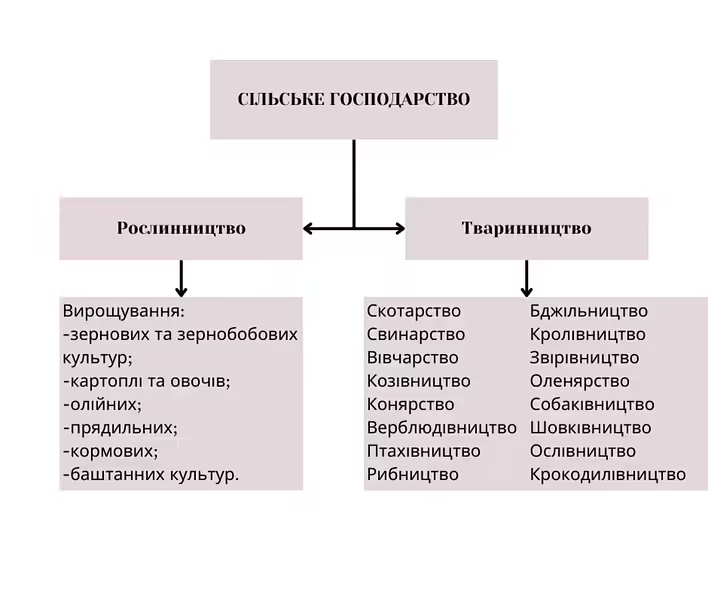
According to the National Classification of Economic Activities, agriculture is the use of plant and animal natural resources, including activities related to the cultivation of agricultural crops, raising and breeding agricultural animals on farms or in a natural environment.
This is the oldest type of economic activity, marking the transformation of humans — a biological species into an active subject of economic activity. This is a sector that will always be part of the economy.
Factors of Agricultural Location
Natural and Geographical: land, heat, moisture.
Social and Geographical: development of agricultural lands, their quality; population distribution; level of agricultural intensity; level of development, structure, and nature of industrial placement, level of transport development.
Economic: Scientific and technological progress, market conditions, level of development of market relations, volume of investment, changes in land ownership forms, etc.
Modern Models of Agricultural Production Development
Modern models of agricultural production development can be divided into two main approaches: productivism and post-productivism.
Productivism:
Productivism is focused on increasing the productivity of agricultural production through intensification, concentration, and specialization.
The main characteristics of this approach include:
- Intensive use of land, labor, capital, and other resources to achieve high productivity.
- Concentration of production of large volumes of products in a limited area.
- Specialization in growing a limited range of crops or cultivating a specific crop with high commercial potential.
- Use of the latest technologies, genetically modified organisms, agrochemical means, and innovative management methods.
Post-Productivism:
Post-productivism aims to ensure sustainable development of the agricultural sector through extensification, diversification, and deconcentration.
The main aspects of post-productivism include:
- Extensive use of land and other natural resources with maximum preservation of ecosystems.
- Diversification of agricultural production through the development of various types of activities, such as animal husbandry, organic product cultivation, agroecotourism, etc.
- Deconcentration of production due to the development of small and medium agricultural enterprises, promoting the distribution of power and ownership in the rural sector.
- Use of environmentally friendly production methods, taking into account the principles of sustainable development and biodiversity conservation.
Global Trends in Agricultural Location Worldwide
Global Trends:
- increased labor productivity in agricultural production, accompanied by mechanization and chemicalization of agriculture;
- the impact of urbanization on agricultural specialization in the most urbanized regions of the world;
- growing negative impact of agriculture on the environment;
- increased share of agricultural land under genetically modified crops;
- increased share of agricultural land under organic farming.
Trends
- Urbanization
The consequence of urbanization is an increased demand for perishable and high-value crops produced locally, such as vegetables, from which farmers can earn income that depends on the demand for products among city dwellers. As urban agglomeration increases, the areas allocated for suburban gardening and urban agriculture may also expand.
- Significant negative impact on the environment. Agriculture uses 11% of the world's land surface as arable land and is a user of 70% of all freshwater. Almost 80% of cases of deforestation worldwide are associated with the expansion of arable land.
- There is a clear trend in the world towards increasing the area of agricultural lands allocated for the cultivation of genetically modified crops.
The largest areas of such lands are concentrated in 22 countries, including Argentina, Brazil, China, and India.
The main goal is to increase resistance to diseases and herbicides.
- Urban agriculture (farming) provides cities with fresh food, creates jobs, processes urban waste, creates green spaces, and enhances the resilience of cities to climate change.
Like it?React
🧵
This post doesn't have any additions from the author yet.