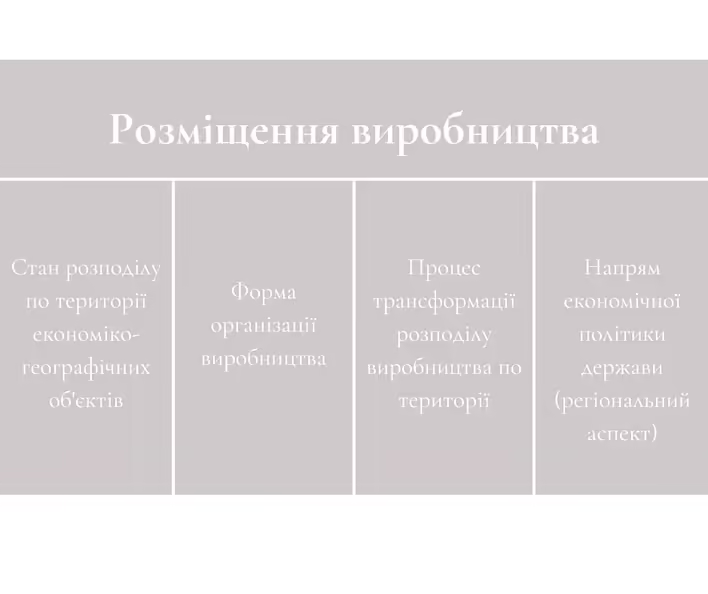
Territorial structure of the economy — it is the relationship between spatial elements of the economy that perform a certain function in the development of the economic-geographical formation and express regional proportions and the state of territorial division of labor
(by Y. Oliynyk, A. Stepanenko, A. Holikov)
Stable, typically repeated combinations of territorial relations form elements of the territorial structure.
The theoretical foundations for distinguishing elements of the territorial structure were developed by M. Baranovsky, H. Lappo, I. Mayerhoiz, and others.
Economic relief of the territory, what is it?
“Economic relief” reflects the varying magnitude of economic potentials of economic objects.
Economic lines (transport highways, power lines, sea routes) combined with economic nodes and powerful multi-sector concentrations (cities) form the supporting economic framework of the country.
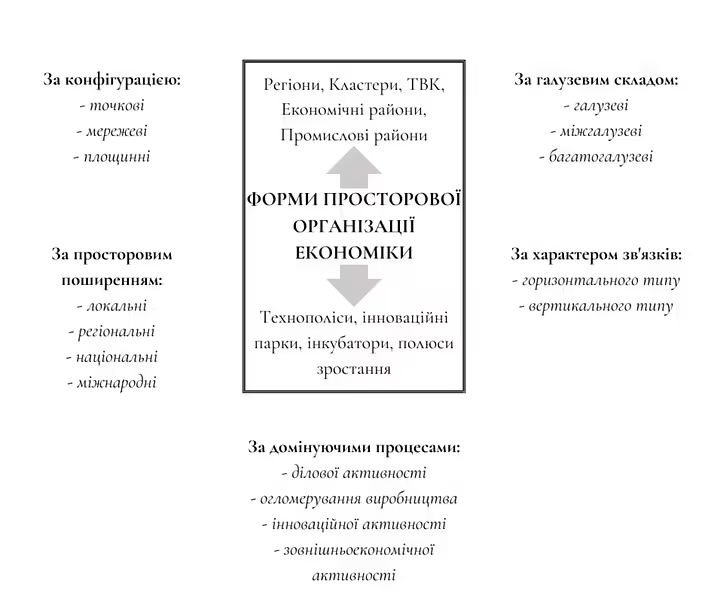
Forms of territorial structure of the economy
Integral-spatial (based on the analysis of all sectors of the economy)
territorial-sectoral (based on the study of the placement features of enterprises in one sector)
linear-network (represents the unity of economic centers and axes of development)
Analysis of the territorial structure of the economy
1. By administrative-territorial units (ATO) of various levels — for the purposes of regional economic policy
Advantages of the approach — the presence of a comparable information base
Disadvantages — simplified view of spatial aspects of development
2. By distinguished relatively integral territorial units — elements of the territorial structure (TS) — when conducting scientific research
Examples of TS elements: district, node, center, agglomeration
Advantages of the approach — better suited for studying functions and connections within the territory
Disadvantages — subjectivity in distinction; dynamism
Classification of elements of the territorial structure
point (points, centers, concentrated nodes);
nodal (dispersed nodes, agglomerations);
areal (discrete formations): microdistricts, mesodistricts, districts, and zones;
regional (continuous elements): first and second order microdistricts, meso- and macrodistricts.
Classification of elements of the territorial structure by various characteristics
1. By degree of complexity
Simple
Complex
2. By hierarchical ordering
Primary (simplexes)
Territorial subsystems
Territorial systems
3. By development of functions
Single-functional
Multi-functional
Integral
Захарченко В.І., Захарченко С.В. Форми просторової організації економіки: типологія та особливості розвитку (український контекст) (Джерело - Український географічний журнал)
Concept of the supporting framework of the territory
Supporting framework — an active integral part of the territorial structure of the area in the form of a mutually conditioned combination of economic centers and lines.
Concept of the supporting framework of the territory — is an approach to planning and organizing the development of the territory, which involves creating a network of primary and secondary objects that form the structure and functional organization of this territory. The main idea is to create a “framework” or basis that supports and promotes the development of other elements in the territory.
The main principles of the concept of the supporting framework of the territory include:
Main centers: These are key points in the territory that have strategic importance for development. They can be large cities, industrial complexes, or centers of transport nodes.
Transport highways: The supporting framework includes a network of transport highways that ensure connectivity between main centers and secondary objects.
Energy and communication infrastructure: To ensure the effective functioning of the supporting framework, reliable infrastructure is needed, which includes electricity supply, water supply, sewage, and communication.
Secondary centers and regional objects: Beyond the main centers, the supporting framework also includes secondary centers that contribute to the development of the territory at the regional level.
Strategic planning: The development of the supporting framework requires strategic planning and coordination of actions among various stakeholders, including government, business, and civil organizations.
Territorial-structural processes
Differentiation — integration:
This process reflects the development of diversity in economic, social, and cultural characteristics of different territories. This may be accompanied by integration, when different regions unite for joint development and cooperation.
Concentration — deconcentration: Concentration indicates the clustering of certain economic, social, or infrastructural objects in a limited space, while deconcentration means their distribution over a broader territory. These processes can occur depending on economic and social factors.
Attraction — diffusion:
Attraction occurs when people and resources are drawn to certain centers or areas, while diffusion reflects the distribution of population and resources from central areas to less developed territories.
Agglomeration — deagglomeration:
Agglomeration describes the concentration of various economic activities and enterprises in large cities or industrial centers, while deagglomeration occurs when these functions are redistributed to smaller cities or regions.
Polarization — leveling:
Polarization reflects the difference in development and living standards between different regions or groups of the population, while leveling aims to reduce these differences by promoting the development of less developed territories.