This content has been automatically translated from Ukrainian.
Sectoral Structure of the Economy
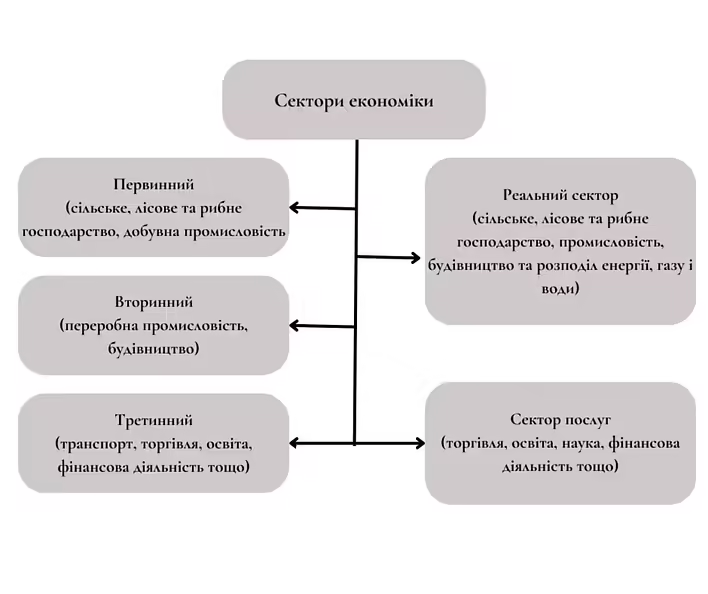
Economic sector — a significant part of the economy, distinguished by a characteristic essential for analysis.
In the economies of countries, sectors are distinguished:
- Primary (includes activities that extract, grow, or harvest raw materials)
- Secondary (includes processing activities)
The primary and secondary sectors form the real economy (the economy that produces goods), in other words — the real sector of the economy
- Tertiary sector — the service sector (an outdated term — non-productive sphere)
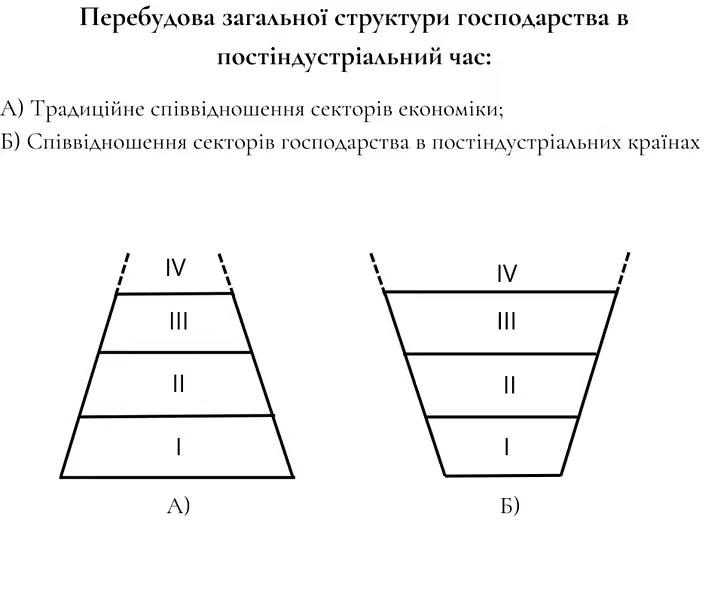
Sometimes within the tertiary sector, the following is distinguished
- Quaternary scientific-information, which includes activities related to scientific and technical developments, as well as the processing, accumulation, and consumption of information.
(Alen Fisher (1895–1976) — theory of the three-sector structure of the economy)
Division into Spheres According to the Economic Code of Ukraine (Article 261)
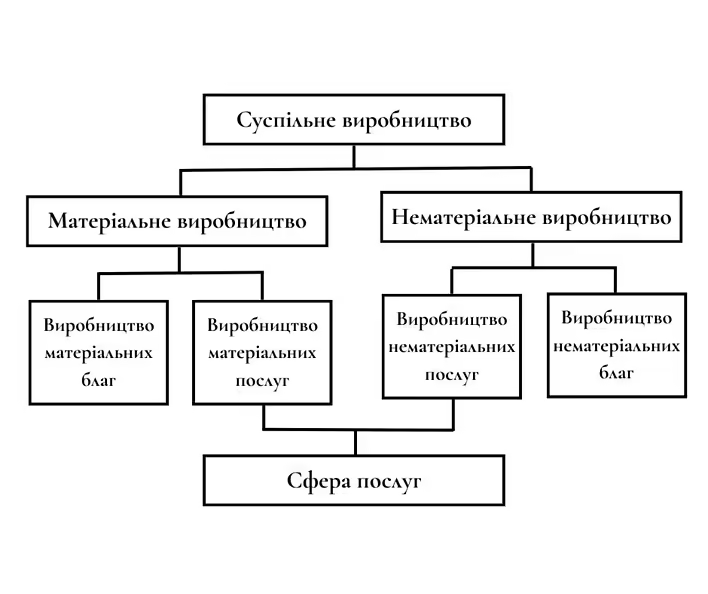
- To the sphere of material production belong industries defined by activities that create, restore, or find material goods (products, energy, natural resources), as well as continue production in the sphere of circulation (realization) through the movement, storage, sorting, packaging of products or other types of activities.
- All other types of activities in their entirety constitute the sphere of non-material production (non-productive sphere).
Branch Structure of the Economy
Branch — a collection of all production units that carry out predominantly the same or similar types of production activities. Branches unite enterprises that produce homogeneous products.
A branch can refer to both the industry as a whole and, for example, the food industry.
Concept of Types of Economic Activity and Their Classification
Economic activity — is the process of combining actions that allow obtaining a corresponding set of products or services.
The type of economic activity is established in such a way as to unite resources (equipment and machinery, available technologies, labor force, raw materials, and materials) for the production of certain products and the provision of services.
- Classification of types of economic activity divides branches and productions into sections, which are denoted by capital Latin letters, as well as divisions, groups, and classes, which are distinguished by numerical codes.
For example, the type of economic activity with code A 01.11 is decoded as follows:
A — section “AGRICULTURE, FORESTRY AND FISHING”;
01 — division “Agriculture, hunting, and related service activities”;
01.1 — group “Growing of annual and biennial crops”;
01.11 — class “Growing of cereals (except rice), pulses, and oilseed crops.”
(https://kved.ukrstat.gov.ua)
Like it?React
🧵
This post doesn't have any additions from the author yet.