This content has been automatically translated from Ukrainian.
Counting the world's cities is problematic. Why?
1. Different countries assign city status based on varying criteria
In many countries, the status of settlements depends on the number of inhabitants (for example, in Denmark it is 250 people, in Japan — over 50,000.)
Some countries do not have cities at all (for example, in France, communes are analogous to cities, but they do not take into account the number of inhabitants and their employment sector)
2. The number of cities is constantly changing (wars, migration, natural disasters, technological disasters, etc.)
How many cities are there in the world?
2 million 668 thousand places that have city status
Approximately 2.5 million cities
Dynamics of the number of cities
Year 1800 — there were 45 cities with a population of over 100,000.
Year 1950 — there were 875 cities with a population of over 100,000.
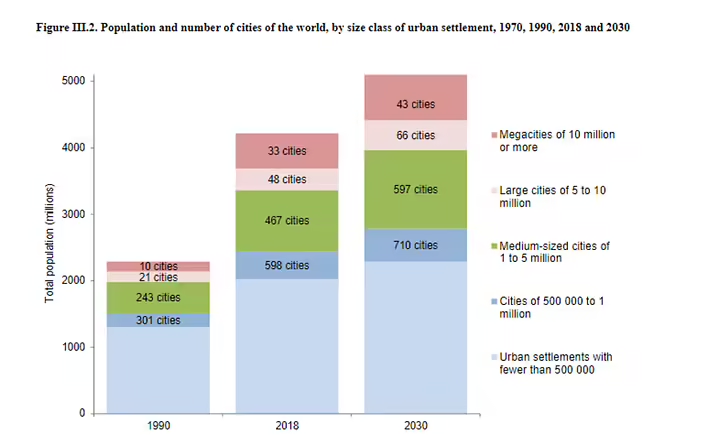
Currently, over 550 cities in the world have more than 1 million residents
The population of cities is constantly increasing
Dynamics of population and number of cities by urban settlement size class
Share of urban population
The share of the urban population in the world was
in 1900 — 13.3%
in 1950 — 28.9%
in 2007 — 50%
in 2017 — 54.9%
Forecast for 2050:
two-thirds of the world's population will live in cities
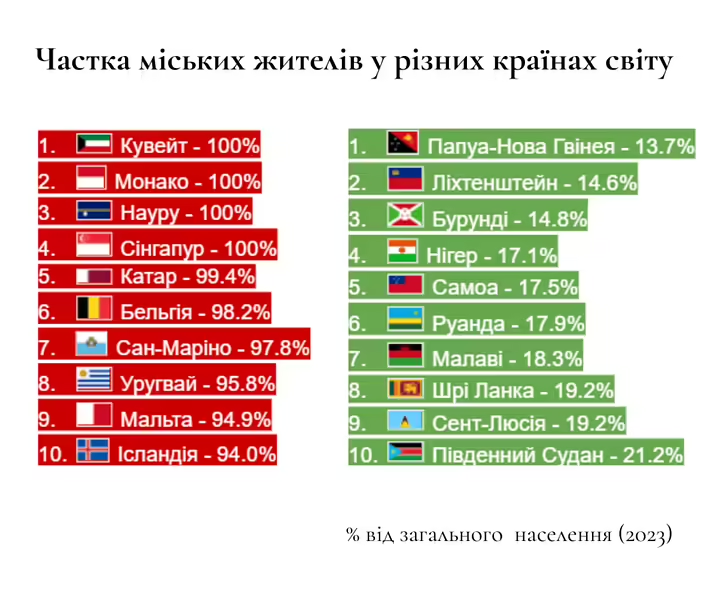
Share of urban residents in different countries of the world
Year 2022
The population of the earth reached 8.009 billion people
Year 2023 Top 10 countries by population:
India
China
USA
Indonesia, Pakistan, Nigeria, Brazil, Bangladesh, Russia, Mexico
FORECASTS:
The population will continue to grow and peak in 2064 at 9.7 billion people
By 2100, the population will decrease to 8.8 billion people
Reasons: wars, natural disasters, climate change, declining birth rates due to increased employment of women
In three dozen countries with low birth rates and aging populations, the number of residents may decrease by more than 50%: Japan, Thailand, Italy, Spain, Portugal, South Korea…
The population of China will decrease from 1.456 billion in 2022 to 732 million in 2100
By the end of the century, the world will become multipolar, with dominant states being India, Nigeria, China, and the USA
Changes in the settlement system
Global warming is accelerating: in the next 50 years, over a billion people will live in unbearable heat
1 billion people will be forced to leave their homes or suffer from unbearable heat for each 1 degree of global warming
According to UN analysts' forecasts, by 2500, over 70% of the world's population will live in urban agglomerations
The spread of globalization in historical retrospect has been characterized by three waves:
- the first (the first half of the 20th century) was characterized by the intensive development of cities and industry, and the construction of transport infrastructure;
- the second (the second half of the 20th century) was marked by the formation of transnational, transcontinental, and global corporations, and the relocation of "dirty" industries to the territories of poor third-world countries;
- the third (early 21st century — to the present) is characterized by urbanization extending beyond geopolitical and administrative borders
Global cities
5 criteria of overall globality (the city's impact on human civilization)
- level of business activity: number of headquarters of companies that are among the 500 largest firms in the world, etc.
- human capital: number of universities ranked among the best in the world, share of the population with higher education, etc.
- information exchange: number of media outlets of global significance, etc.
- cultural level: number of foreign tourists, number of world-class museums, etc.
- political weight: number of embassies, number of political research centers of global significance (based on citation rates of publications), etc.
Global cities, leaders
Degree of business activity: New York, London, Paris
Human capital: New York, London, Chicago
Information exchange: Paris, Brussels, London
Cultural level: London, Paris, New York
Political capitals: Washington, New York, Brussels
The top ten global cities: New York, London, Paris, Tokyo, Hong Kong, Los Angeles, Singapore, Chicago, Seoul, Toronto
Like it?React
🧵
This post doesn't have any additions from the author yet.